
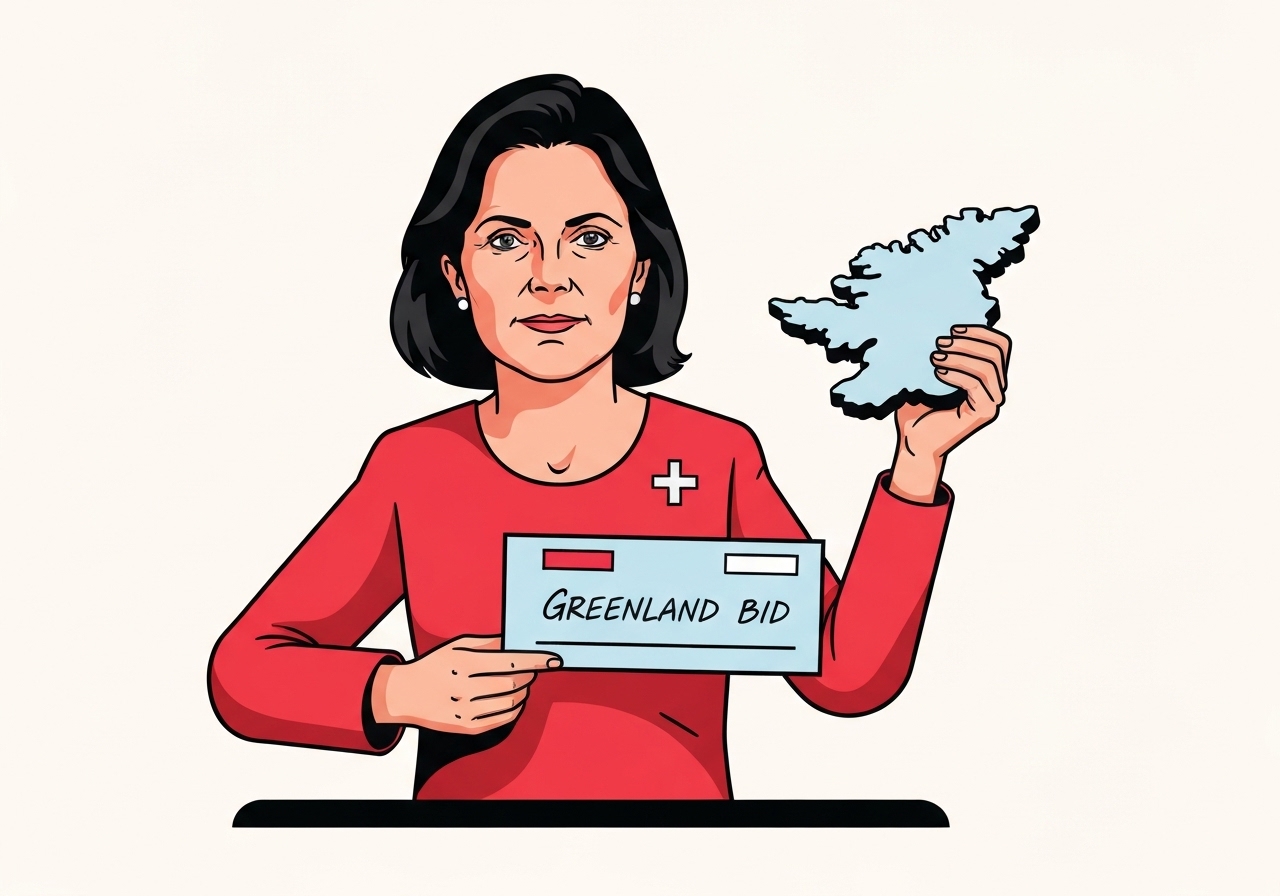
— Denmark’s prime minister, Mette Frederiksen, has taken a firm public stand against President Donald Trump’s repeated proposals about Greenland, and her posture appears to have helped blunt an immediate U.S. push. After threats that included talk of seizing the territory, Mr. Trump told world leaders in Davos he would not use force and later referenced “the framework of a future deal.” Rising congressional opposition and market reactions also shaped the outcome, but Frederiksen’s defensive diplomacy played a central role in preventing a rapid shift of control.
Key Takeaways
- Mette Frederiksen publicly opposed U.S. overtures over Greenland beginning in late 2025; her stance involved direct diplomacy and public messaging.
- On Jan. 25, 2026, at the Davos forum, President Trump said he “would not use force” to acquire Greenland and mentioned “the framework of a future deal,” signaling a tactical retreat.
- Congressional criticism in Washington and declines in U.S. markets coincided with the administration’s change in tone, complicating a unilateral move.
- Greenland is a Danish autonomous territory with strategic Arctic value, making any transfer of control politically and legally complex.
- Frederiksen’s approach combined public rebuttal, alliance diplomacy, and domestic messaging; for now it appears to have deterred a forced takeover.
- The situation remains fluid: negotiations and diplomatic channels continue, and no final settlement has been confirmed.
Background
Greenland, a vast Arctic island of roughly 2.1 million square kilometers, is an autonomous territory within the Kingdom of Denmark and hosts strategic military and resource interests. Over recent years, Arctic access and mineral prospects have elevated Greenland’s geopolitical profile, attracting attention from NATO members and non-NATO actors alike. Any suggestion that a foreign power might seek to change the island’s status touches legal, political and security frameworks that include Denmark, Greenlandic institutions, and NATO.
Mette Frederiksen, Denmark’s prime minister since 2019, has been characterized by a combative political style and a willingness to confront adversaries publicly. The New York Times profile notes a long-standing personal disdain for intimidation and a readiness to engage in high-stakes diplomacy. That personal and political posture became salient when the U.S. president renewed public assertions about acquiring Greenland, setting up an unusual transatlantic confrontation.
Main Event
Throughout late 2025 and into January 2026, President Trump publicly suggested that the United States should pursue control or expanded influence over Greenland, prompting alarm in Copenhagen and Nuuk. Denmark’s government rejected the idea outright on legal and political grounds and sought allies in Europe and NATO to underline that Greenland’s status could not be unilaterally altered. Frederiksen engaged in a visible mix of private and public diplomacy to convey that message.
At the World Economic Forum in Davos on Jan. 25, 2026, Mr. Trump addressed the issue directly, telling assembled leaders he would not employ military force to take Greenland and later referring to talks that had produced “the framework of a future deal” that could satisfy parties. Those remarks marked a notable softening from earlier rhetoric that had been interpreted by some as a threat to seize territory.
Observers in Copenhagen and Washington saw multiple pressures converging on the White House: vocal congressional opposition to any land transfer, concern among NATO partners about precedent, and market volatility that raised the political cost of escalation. Frederiksen’s insistence on Denmark’s sovereignty and her public refusal to entertain offers framed the diplomatic playing field as negotiations rather than concessions under duress.
Analysis & Implications
Frederiksen’s posture illustrates how a relatively small NATO member can leverage international norms, alliance mechanisms and public diplomacy to resist pressure from a larger interlocutor. By making the dispute visible in multilateral forums and invoking legal and alliance-based barriers, Copenhagen raised the reputational and political costs of any unilateral U.S. move. That strategy appears to have contributed to a tactical retreat by the U.S. president in Davos.
Nonetheless, the episode underscores persistent tensions over Arctic strategy and resources. Even if immediate coercion has been set aside, competing interests in Greenland—strategic military positioning, rare-earth and other mineral exploration, and shipping routes—will keep the island on the agenda of major powers. Future rounds of negotiation could center on security cooperation, infrastructure investment, or resource partnerships rather than outright transfer of sovereignty.
Domestic politics on both sides of the Atlantic will shape next steps. In Denmark, Frederiksen must balance a firm defense of sovereignty with managing relations with NATO and the U.S.; in the United States, Congressional skepticism and market reactions limit executive latitude for risky foreign adventures. Internationally, NATO allies will watch the outcome for its implications on alliance cohesion and norms about territorial integrity.
Comparison & Data
| Factor | Denmark/Greenland Position | U.S. (Trump) Position |
|---|---|---|
| Sovereignty | Denmark asserts legal control; Greenland autonomous institutions oppose transfer | Exploratory interest and proposals for increased U.S. presence |
| Use of Force | Rejected; invoked international law and alliance norms | Publicly disavowed at Davos: “would not use force” |
| Political Constraints | Domestic support for defense of territory | Congressional opposition, market sensitivity |
The table summarizes positions and constraints. While the U.S. rhetoric elevated tensions, legal status and allied pushback created institutional brakes that favored Denmark in the near term.
Reactions & Quotes
Key public statements and reactions came from the president and allied capitals; each remark reshaped diplomatic momentum.
“I would not use force to take Greenland.”
Donald J. Trump (speech, World Economic Forum, Davos, Jan. 25, 2026)
“The framework of a future deal”
Donald J. Trump (remarks, Davos press exchanges, Jan. 25, 2026)
Across Europe and within U.S. politics, officials and commentators highlighted the legal and reputational limits on changing Greenland’s status. Copenhagen framed its response through alliance consultations and public rebuttals, while some U.S. lawmakers emphasized congressional oversight as a check on executive action.
Unconfirmed
- Whether the Davos statements represent a permanent end to U.S. interest in acquiring Greenland or only a temporary de-escalation.
- The precise contents and scope of the “framework of a future deal,” which has not been publicly detailed or verified.
- The relative weight of factors (Frederiksen’s diplomacy versus congressional and market pressures) in driving the U.S. change of tone.
Bottom Line
For now, Mette Frederiksen’s assertive defense of Danish sovereignty appears to have helped block an immediate U.S. attempt to force a change in Greenland’s status. Public diplomacy, alliance consultation and legal norms combined to raise the cost of any unilateral move and shifted the interaction toward negotiation rather than coercion.
That outcome is provisional. Strategic interest in Greenland will persist, and future diplomatic, economic or security arrangements may arise that alter the status quo. Observers should watch forthcoming discussions among Denmark, Greenlandic leaders, NATO partners and the U.S. for concrete proposals and any institutional steps that would change control or influence over the island.
Sources
- The New York Times (news) — profile and reporting on Mette Frederiksen and events surrounding Greenland, Jan. 25, 2026.