
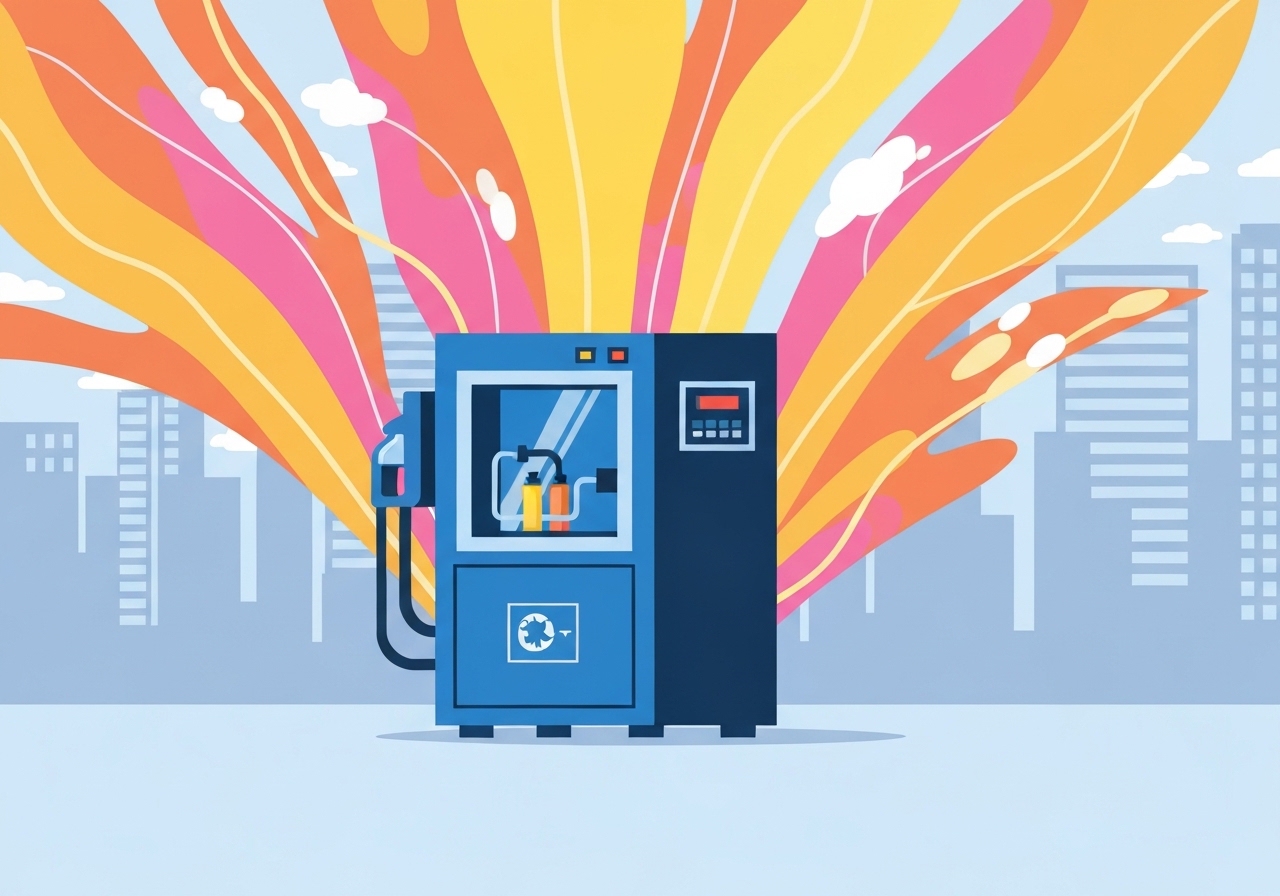
Lead: A New York startup, Aircela, has developed a refrigerator-sized unit that synthesizes gasoline from ambient air and electricity. The device, demonstrated publicly this year, captures CO2 and water vapor, converts them through electrochemical steps into hydrocarbons and dispenses gasoline from a built-in pump. In its present configuration the machine produces about one gallon per day and can store up to 17 gallons, positioning it as a small-scale or off-grid fuel option rather than a mass-market replacement. The company says the process is based on established chemistry, though significant energy input and cost remain limiting factors.
Key Takeaways
- Aircela’s unit captures CO2 from air, extracts water vapor and uses electrolysis and catalytic chemistry to produce liquid hydrocarbons; each machine yields roughly 1 gallon of gasoline per day.
- The device can hold up to 17 gallons in its integrated storage, allowing slow refilling of small vehicles or equipment.
- Aircela has targeted a retail price in the $15,000–$20,000 range during initial production runs, with plans to reduce cost via scale.
- Energy accounting: about 37 kWh of chemical energy exists in one gallon of gasoline, and Aircela estimates roughly 75 kWh of electricity are required to synthesize a gallon—implying about >50% end-to-end power efficiency target.
- The company projects that powering machines with dedicated off-grid photovoltaic arrays could lower energy cost to under $1.50 per gallon, though that excludes capital and maintenance for panels and equipment.
- Each step in Aircela’s process—direct air capture, electrolysis for hydrogen, CO2 hydrogenation to methanol, and methanol-to-gasoline conversion—has prior scientific and industrial literature backing it, including research by legacy oil companies.
- Practical use cases are primarily remote, off-grid, or low-consumption applications rather than everyday fueling for conventional urban drivers.
Background
Interest in converting electricity and atmospheric carbon into liquid fuels has grown alongside renewables and direct-air-capture research. Historically, petrochemical firms and national laboratories have explored routes from synthesis gas and methanol to gasoline; ExxonMobil and others have investigated methanol-to-gasoline pathways since the 1970s. Advances in catalysts, electrochemistry and modular manufacturing now make compact systems conceivable where decades-old approaches were only feasible at large industrial scales.
Direct air capture (DAC) and electrolysis are two distinct technologies that Aircela combines into a single packaged unit. DAC removes dilute CO2 from ambient air, a more energy-intensive task than point-source capture but attractive for flexible siting. Electrolysis splits water into hydrogen and oxygen; the hydrogen is then reacted with captured CO2 to form methanol, which is further processed to produce gasoline-range hydrocarbons. Private startups have aggressively pursued miniaturization and integration of these steps to serve niche markets such as remote sites, specialty vehicles, and equipment users who value fuel independence.
Main Event
Aircela revealed a fridge-sized prototype that integrates an air contactor, a water-capture and electrolysis stack, catalytic reactors for CO2 hydrogenation to methanol, and a final conversion stage to produce gasoline-range molecules. The unit dispenses product via a conventional-looking fuel nozzle, underscoring the company’s design priority: compatibility with existing internal-combustion engines. Demonstrations have shown continuous output on the order of one gallon per day, with internal tanks sized to 17 gallons.
The company has stated a near-term retail target between $15,000 and $20,000 per unit; that price point aims to make the system attainable for specialty users and to enable deployment in clusters for larger demand. Aircela’s public comments—and reporting by trade outlets—emphasize the need to pair the machines with low-carbon electricity, primarily solar, to avoid simply shifting emissions to power generation. The firm projects that when run on dedicated photovoltaics the marginal energy cost could be under $1.50 per gallon, relying on their >50% end-to-end efficiency goal and the ~75 kWh per gallon production figure they cite.
Engineers working on the prototype say the project stitches together well-established chemical conversions rather than inventing new chemistry: DAC for CO2 capture, electrolysis for hydrogen production, catalytic hydrogenation to methanol, and methanol-to-gasoline upgrading. Each phase has industrial precedents, though most existing deployments operate at far larger scales than Aircela’s unit. The technical challenge for the startup is not demonstration of chemistry but integration, durability, cost reduction and reliable off-grid power pairing.
Analysis & Implications
At face value the machine reframes the energy vector: electricity plus air becomes a transport fuel compatible with the existing vehicle fleet. That compatibility lowers near-term adoption friction because drivers need not retrofit or replace vehicles. However, the energy penalty is clear—roughly double the electrical energy input relative to the chemical energy output—so the concept only makes carbon and economic sense when the electricity is low-carbon and inexpensive.
For remote or off-grid communities, military logistics, or niche applications (e.g., classic car owners, race teams using small volumes of specialty fuel), the ability to produce fuel onsite may outweigh high capital costs. In grid-connected or urban settings where electricity prices are higher and grid power includes fossil generation, the carbon and cost benefits erode quickly. The full lifecycle carbon balance depends heavily on the electricity source and the embodied emissions of the unit and its solar array.
Scaling remains a central barrier. Producing significant volumes of transportation fuel via many fridge-sized units entails multiplying capital, maintenance and land for solar arrays. Alternatively, concentrating the same processes at utility scale benefits from economies of scale and existing industrial infrastructure. Aircela’s value proposition thus sits between portable autonomy and clustered deployment: modularity allows incremental capacity, but cost-per-gallon improves with larger installations or aggregated units.
Policy and market signals will influence uptake. Subsidies for low-carbon fuels, carbon pricing, or incentives for energy storage and remote power can tilt economics. Conversely, accelerating vehicle electrification reduces long-run market demand for liquid fuels, which could limit the business case to specialty segments. The technology also raises regulatory questions about on-site fuel production, safety, and permitting when units store and dispense flammable liquids at private properties.
Comparison & Data
| Metric | Value |
|---|---|
| Energy contained in 1 gal gasoline | ~37 kWh |
| Estimated electricity required per gal (Aircela) | ~75 kWh |
| Daily production per unit | ~1 gallon/day |
| Onboard storage | up to 17 gallons |
| Initial target price | $15,000–$20,000 |
The table highlights the core trade-offs: roughly double electrical input for each unit of chemical energy produced, small daily output, and modest onboard storage. These figures frame likely applications—low-volume, high-autonomy scenarios where delivery logistics or grid access are constraints. They also clarify why pairing with cheap, clean electricity is essential for both emissions and operating-cost goals.
Reactions & Quotes
Company statements emphasize technical feasibility and niche practicality rather than mass disruption. Aircela has framed the product as a practical tool for specific users who need fuel independence and are prepared to invest in panels and hardware.
“Aircela is targeting >50% end to end power efficiency.”
Aircela (statement to The Autopian)
This claim underpins the company’s <1.50$/gal energy-cost estimate when paired with dedicated photovoltaic generation; independent validation of sustained, real-world efficiency and lifecycle accounting will be decisive for broader credibility.
“Any sufficiently advanced technology is indistinguishable from magic.”
Arthur C. Clarke
Public reaction mixes amazement with skepticism. Many observers compare the device to science-fiction replicators, while energy specialists stress the arithmetic of energy inputs, land use for solar arrays, and capital costs when assessing real-world utility.
“ExxonMobil and others have studied methanol conversion routes since the 1970s; the chemistry is established, but scale matters.”
Industry literature summary (historical research)
Industry analysts note that the chemistry has industrial precedent, but emphasize that moving from bench and pilot systems to durable, low-cost consumer hardware presents different engineering, safety and regulatory challenges.
Unconfirmed
- Long-term durability and maintenance schedule for Aircela’s integrated modules remain unpublished and unverified by third-party tests.
- Unit pricing of $15,000–$20,000 is reported as a target; firm retail pricing, financing options and warranty terms are not yet publicly confirmed.
- The company’s claimed sustained >50% end-to-end efficiency has not been independently audited in long-duration, real-world operating conditions.
- Full lifecycle emissions accounting—including manufacturing, balance-of-system solar infrastructure, and end-of-life handling—has not been released for peer review.
Bottom Line
Aircela’s fridge-sized gasoline-from-air demonstrator stitches together established chemical steps into a compact package that is technically plausible and practically intriguing for narrow use cases. The combination of DAC, electrolysis, CO2 hydrogenation to methanol, and methanol-to-gasoline upgrading is grounded in prior science; the main questions are economic, logistical and regulatory rather than purely chemical feasibility.
For now, the product makes the most sense where off-grid, distributed fuel production offsets expensive or difficult fuel delivery—remote sites, specialty vehicle owners, or emergency logistics. Broader climate or transport-sector impacts depend on whether the electricity used is very low-carbon, whether costs fall substantially with scale, and whether policymakers create incentives that favor low-carbon synthetic fuels over other decarbonization pathways such as electrification.
Sources
- Jalopnik — media reporting on Aircela’s demonstration (journalism).
- The Autopian — reporting citing Aircela’s efficiency and pricing targets (media).
- Popular Science — coverage noting storage and production-rate details (media).
- ExxonMobil — corporate/industry research history on methanol-to-gasoline and fuel synthesis (industry/official).