
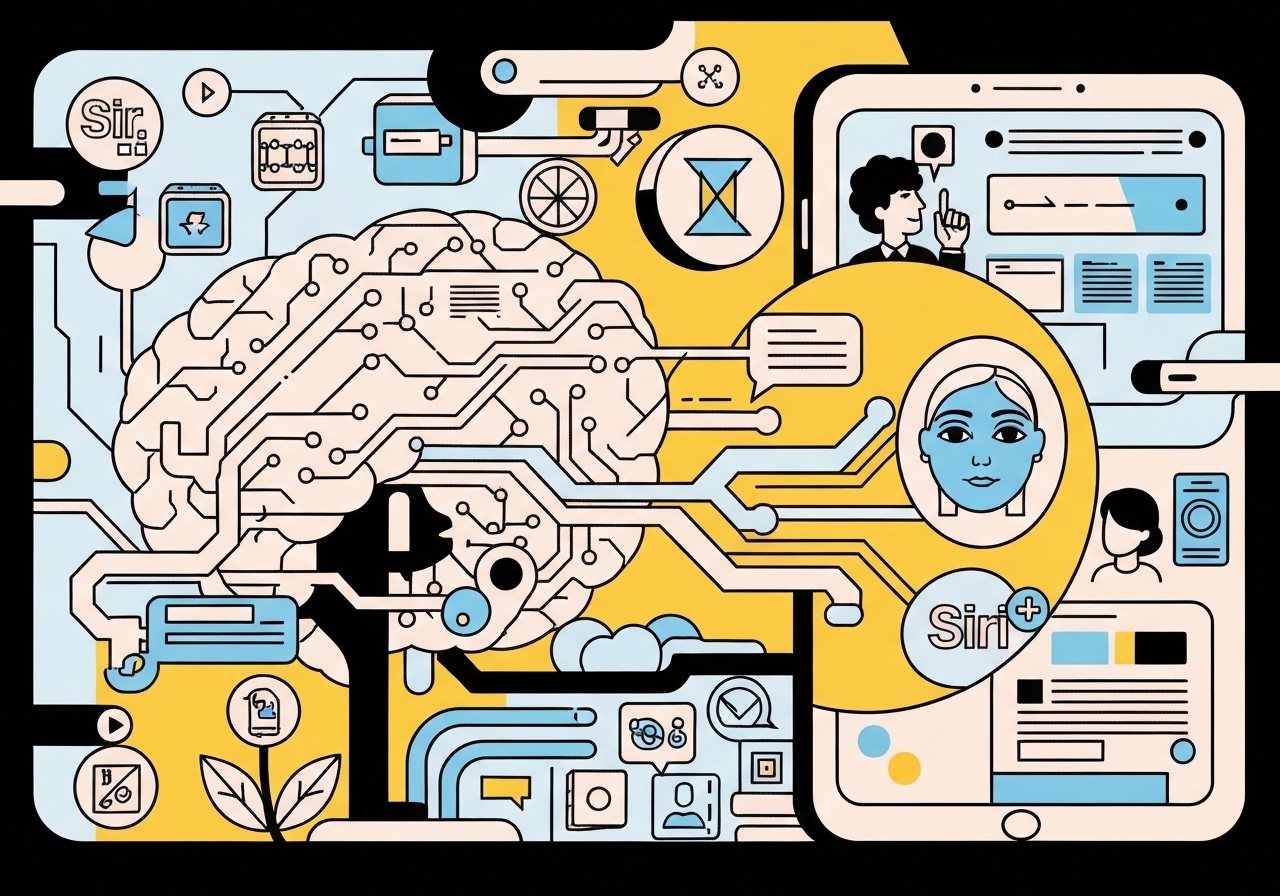
On , reports surfaced that Apple has reorganized parts of its AI teams and is preparing two distinct Siri upgrades tied to iOS 26.4 and iOS 27, with Google’s Gemini models said to underpin the new assistant. The changes reflect a broader push by Apple to accelerate generative AI work after lagging behind competitors. Sources told reporters the moves combine product roadmap shifts and internal personnel realignment, aimed at delivering more conversational and context-aware Siri features over the next year. Early results and timelines remain partly fluid as engineering milestones are finalized.
Key Takeaways
- Apple is reportedly restructuring some AI teams to prioritize Siri development and generative features tied to iOS releases in 2026 and 2027.
- The company plans two new Siri iterations: an interim enhancement targeted to iOS 26.4 and a broader revamp scheduled for iOS 27.
- Bloomberg and other outlets report that Google’s Gemini technology will serve as foundational models for the updated Siri, marking a rare cross-company reliance.
- The initiative follows months of internal debate at Apple over model sourcing, privacy trade-offs, and product timelines.
- Exact release dates, commercial terms with Google, and the scope of on-device versus cloud processing remain unconfirmed.
- The shake-up could affect teams across Siri, machine learning, and cloud engineering, with potential hiring and reallocation in 2026.
Background
Apple historically emphasized on-device intelligence, tighter privacy controls, and modest incremental improvements to Siri rather than rapid generative upgrades. That strategy produced strengths in data protection but left the assistant trailing more capable conversational systems from rivals. In recent quarters, pressure has grown internally and externally to close the gap as user expectations for conversational AI rose sharply.
Apple has experimented with several approaches, from smaller on-device models to selective cloud-based processing for heavier tasks. Past reorganizations at Apple have shuffled responsibility between Siri, Core ML, and other AI-focused groups when strategic priorities shifted. External partnerships for fundamental models would represent a notable tactical departure from Apple’s long-standing preference for internally developed stacks.
Main Event
Reporting on January 25, 2026 indicates Apple has accelerated a program to produce two new Siri variants: a nearer-term upgrade planned for iOS 26.4 and a more comprehensive redesign slated for iOS 27. The interim release is described as an evolutionary step that integrates stronger backend models, while the later version aims to rework Siri’s conversational architecture and context retention.
According to coverage, Google’s Gemini family of models is intended to be a primary engine behind the upgraded Siri, a move that would rely on a third-party foundation model rather than a purely in-house solution. Engineers are said to be balancing privacy-preserving techniques, latency constraints, and feature breadth when deciding which computations run on device versus in the cloud.
Internally, sources report personnel changes and a refocusing of engineering resources toward the Siri roadmap. That includes closer collaboration among voice recognition, natural language understanding, and user-experience teams to align product scope with release windows. Apple has not publicly confirmed a partnership with Google or a final shipping schedule as of the report date.
Analysis & Implications
If Apple does integrate Gemini models into Siri, the move signals pragmatic flexibility: leveraging best-in-class foundational models to accelerate product parity while retaining control over user experience layers. For Apple, the trade-off will be aligning its privacy commitments with any external model usage, which could require technical and contractual mitigations to limit data exposure.
For competitors, Apple adopting third-party models could alter the dynamics of model development versus product integration. Companies that build and license models might find new commercial opportunities, while firms that previously considered Apple an insulated competitor could see increased collaboration and interdependence across the industry.
From a product perspective, staging two releases — iOS 26.4 as an interim improvement and iOS 27 as a deeper overhaul — allows Apple to ship usable enhancements sooner while buying time for higher-risk, higher-reward engineering work. That approach reduces the window for competitor differentiation but raises expectations for each incremental update’s real-world performance.
Comparison & Data
| Item | Target Release | Role |
|---|---|---|
| Siri interim upgrade | iOS 26.4 | Incremental features, backend model integration |
| Siri major revamp | iOS 27 | Architectural redesign, extended context |
| Underlying model (reported) | — | Google Gemini (foundational) |
The table summarizes the reported staging. Using a third-party foundational model could speed development cycles, but it also introduces commercial and technical dependencies that Apple has historically minimized. The practical effect for end users will depend on latency, privacy controls, and how much new functionality surfaces in routine Siri interactions.
Reactions & Quotes
“People familiar with the matter said Apple is reorganizing teams to accelerate Siri’s next phases.”
Bloomberg (reporting)
The reporting framed the changes as both a strategic shift and a tactical reallocation of staff. Observers noted that Apple balancing privacy and speed is central to any decision that relies on external model providers.
“If accurate, the move to leverage larger foundation models would be a pragmatic pivot for Apple to meet market expectations more quickly.”
Independent industry analyst (comment to press)
Analysts emphasized that the technical integration, not merely the licensing decision, will determine user benefit. Market reaction will track perceived improvements in Siri’s utility and Apple’s ability to preserve privacy controls around model use.
Unconfirmed
- Specific contractual terms between Apple and Google for Gemini model access have not been publicly confirmed.
- Exact feature lists and performance benchmarks for the iOS 26.4 and iOS 27 Siri updates remain unverified.
- Any personnel move details, including names or team structures, reported internally are not independently confirmed.
Bottom Line
The reported shake-up shows Apple recalibrating its approach to generative AI for assistants, moving toward faster product iteration and potential use of third-party foundational models. That pragmatic pivot could close capability gaps faster than a purely internal development path, but it raises new privacy and dependency considerations that Apple must manage visibly.
For users, the near-term expectation should be measurable but incremental improvements in Siri with broader conversational gains arriving in a later, larger release. Investors, partners, and developers will watch how Apple balances model sourcing, technical integration, and privacy guarantees as the company rolls out these updates.
Sources
- Bloomberg — media reporting (paywalled coverage of Apple internal plans)
- Apple Newsroom — official company announcements and press materials (official)
- Google AI — official product and research pages for Gemini and related technologies (official)