
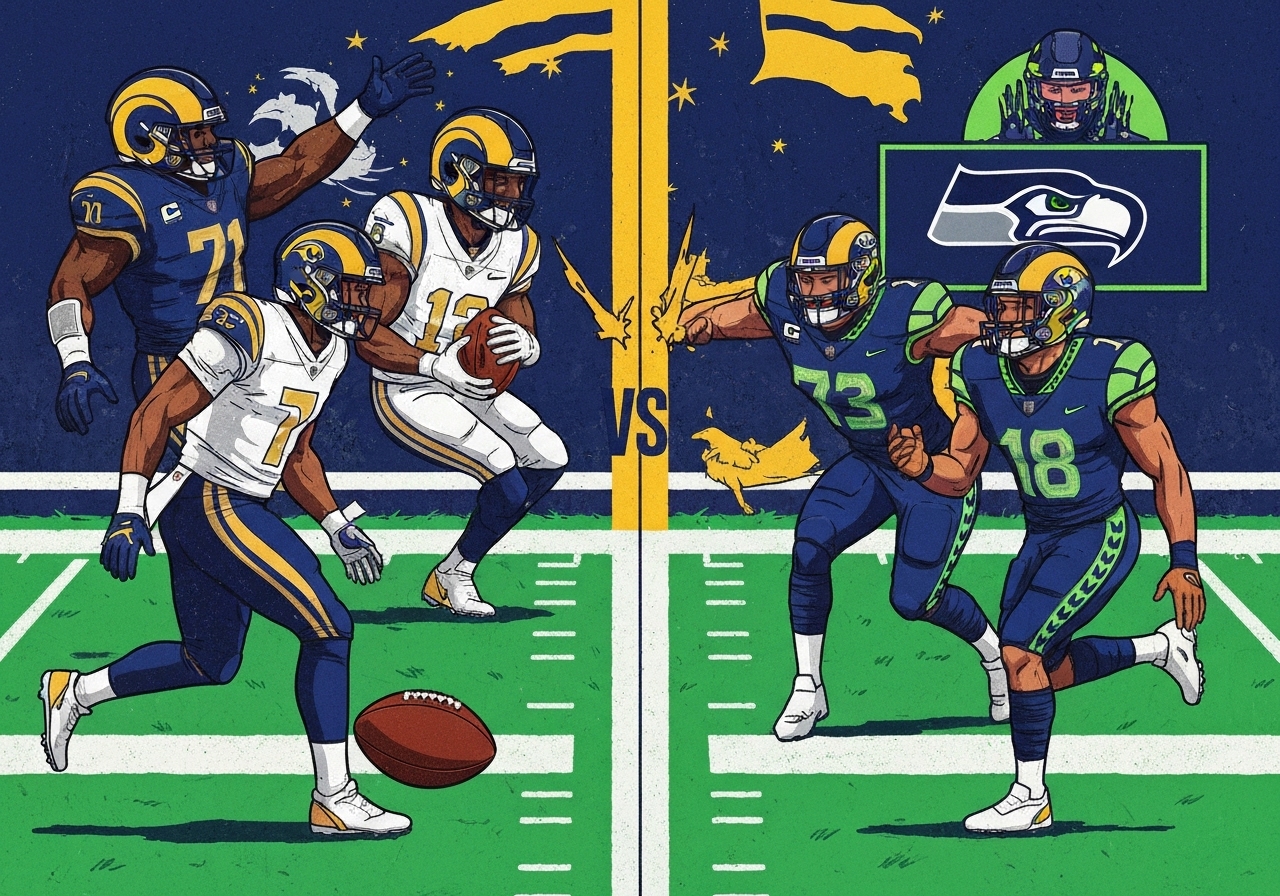
Lead: The Los Angeles Rams (14-5) travel to Lumen Field in Seattle to meet the 15-3 Seahawks in the NFC Championship on Sunday, Jan. 25, with kickoff at 6:30 p.m. ET and the game airing on FOX. Seattle opened as a 2.5-point favorite (Seahawks -2.5; -106) with an over/under of 45.5 and moneyline favorites at -139; the Rams sit at +118. After two razor-thin regular-season meetings — a 21-19 Rams win in Week 11 and a 38-37 Seahawks overtime victory in Week 16 — our model and situational factors point to value buying the Rams at +3 (bet to -130) or smaller on +2.5 live. This preview covers odds, matchup context, injury notes, statistical comparisons and why the Rams are our spread selection.
Key Takeaways
- The game is Sunday, Jan. 25 at 6:30 p.m. ET at Lumen Field (Seattle), broadcast on FOX.
- Published market lines: Seahawks -2.5 (-106); total 45.5 (‑115o / -105u); moneyline Seahawks -139, Rams +118.
- Two regular-season meetings were decided by a single yard and one point; Week 11: Rams 21-19; Week 16: Seahawks 38-37 OT with a two-point conversion finish.
- DVOA context shows L.A. with the top offense (30.7% DVOA) and Seattle with the top defense (-24.2% DVOA), framing a classic offense-vs-defense matchup.
- Special teams tilt favors Seattle (ranked No. 2 in ST DVOA) while the Rams rank 26th, a potential swing factor in a low-variance contest.
- Injury and rest differentials favor Seattle (home, extra rest); Rams face fatigue risk on their third straight road game and a shorter recovery window.
- Handicapping view: project spread Seattle -1 after adjustments; recommended live target is Rams +3 (or +2.5 if +3 isn’t available).
Background
These clubs split two regular-season meetings by the narrowest of margins. In Week 11 Seattle missed a 61-yard, game-ending field goal and fell 21-19; the rematch in Week 16 saw Seattle rally from 16 points down for a 38-37 overtime victory that ended with a successful two-point conversion. Those results produced the NFC West crown and the No. 1 seed for Seattle and set up a road test for Los Angeles in the conference final.
The narrative entering this game is simple: one of the league’s most efficient offenses, led by Matthew Stafford and a deep ensemble of skill talent, against the league’s stingiest defense under head coach Mike Macdonald. From a schematic view, Sean McVay’s personnel choices (11 vs. 13 personnel) and Seattle’s ability to neutralize heavy packages will be central. Personnel availability, recent workloads and matchup-specific wrinkles will determine which staff imposes its will.
Main Event
Game-planning and in-game adjustments will matter most. The Rams have leaned on both 11- and 13-personnel packages at different times; they used 11 personnel frequently early in the season and shifted to 13 personnel over 60% of snaps in Week 16. That flexibility allows L.A. to manipulate matchups but also gives Seattle options to stay in nickel and generate pressure without heavy blitzing.
Seattle’s defense has been dominant at multiple levels: defensive line pressure generation, versatile safeties who can play the run (notably rookie Nick Emmanwori) and coverage units that limit chunk passing plays. L.A.’s offense counters with Stafford, the Kyren Williams/Blake Corum backfield, stout offensive line play (Dotson returning helps) and exceptional tight-end depth that opens play-action and mismatches.
Special-teams plays have altered the series: Rashid Shaheed’s punt-return touchdown in the Week 16 rematch swung field position and momentum, underlining why Seattle’s No. 2 special teams DVOA is meaningful in tight games. Conversely, the Rams rank 26th in ST DVOA, so fielding clean returns and limiting mistakes is a must for L.A. to have a chance to win at Seattle.
Analysis & Implications
Matchup data frames this as good-on-good: Football Outsiders-style DVOA places L.A.’s offense at the top and Seattle’s defense at the summit. Historically, when a top scoring defense faces a top scoring offense late in the postseason, the defense has prevailed in seven of eight comparable instances since the merger — a trend worth noting, though sample sizes are small.
Coaching adjustments will likely decide the contest. McVay’s success when facing a team for a third time in the playoffs (3-0 career) suggests he can find new wrinkles. Macdonald, meanwhile, has built a flexible modern defense capable of staying in nickel and adjusting to personnel packages. Whichever staff better masks tendencies or presents an unexpected look will gain a measurable edge.
Fatigue and rest are meaningful. Seattle enjoyed an extended rest window and the comfort of playing at home; the Rams are on their third straight road game after back-to-back hard-fought postseason wins. Our projection model adjusts for travel and short recovery and moves the market about two points in Seattle’s favor, but lingering health questions for Seattle’s offense (notably Sam Darnold’s oblique) temper a pure-rest advantage.
Comparison & Data
| Line/Metric | Rams | Seahawks |
|---|---|---|
| Record | 14-5 | 15-3 |
| Spread (market) | +2.5 | -2.5 |
| Moneyline | +118 | -139 |
| Offense DVOA | +30.7% | — |
| Defense DVOA | -12.4% | -24.2% |
Context: the DVOA figures above illustrate the offensive/defensive polarity of this matchup. The Rams posted one of the league’s most efficient offensive seasons; Seattle’s defense led the league in several run-pass efficiency metrics. Use these numbers to weight play-calling expectations: L.A. will seek high-value, time-consuming drives while Seattle will try to force third-and-long and win with field position and turnovers.
Reactions & Quotes
Seattle’s staff has emphasized detail and execution after Week 16. Team statements and media availability have focused on preparedness and limiting opponent strengths.
“We’re focused on doing our jobs — fundamentals, gap integrity and getting off blocks.”
Seahawks defensive coach (post-practice comments)
That quote underscores Seattle’s game-plan posture: play sound defense and let the offense manage the clock. Analysts note the unit’s ability to generate pressure without heavy blitzing, enabling coverage flexibility.
The Rams’ camp has highlighted adaptability in personnel and play-calling after alternating 11/13-personnel looks during the season.
“We want to create matchups — on third down, in the red zone, wherever the leverage presents itself.”
Rams offensive coordinator (pre-game notes)
McVay’s staff will try to force Seattle into uncomfortable defensive alignments; success depends on execution by Stafford, tight ends and the running game. Public commentary from league analysts has split on whether the Rams can sustain drives against Seattle’s front.
“Special teams and turnovers are the margin in games like this.”
League analyst
That observation is borne out by recent meetings: a single special-teams score or a turnover swing changed the complexion of their Week 16 rematch. Expect both staffs to emphasize field-position plays during the week.
Unconfirmed
- Reports that Charles Cross may miss time or force a depth LT change have not been officially confirmed; personnel shifts at left tackle remain speculative.
- Sam Darnold’s oblique is described as a lingering issue; the degree it affects his deep passing on game day is not fully verified.
- Late scratch possibilities for marginally listed players (questionable/doubtful designations) will materially affect line movement; check official gameday reports.
Bottom Line
This NFC Championship projects as a close, tactical contest between a top-ranked offense and a top-ranked defense. Seattle’s rest, home-field edge and special-teams superiority are real advantages; conversely, the Rams’ offensive versatility, experienced quarterback play and proven ability to win tight games make them a live underdog pick.
Handicapers should value the Rams at +3 (buy to -130) or take a smaller ticket at +2.5 if +3 is unavailable. Moneyline and total hold less appeal given variance in game script and special-teams impact. In a near coin-flip matchup, points with Stafford and a playoff-tested offense are reasonable when the market over-adjusts for rest and recency.
Sources
- Action Network (sports analysis & odds)
- NFL.com (official schedule and game information)
- Football Outsiders (DVOA and analytics)