
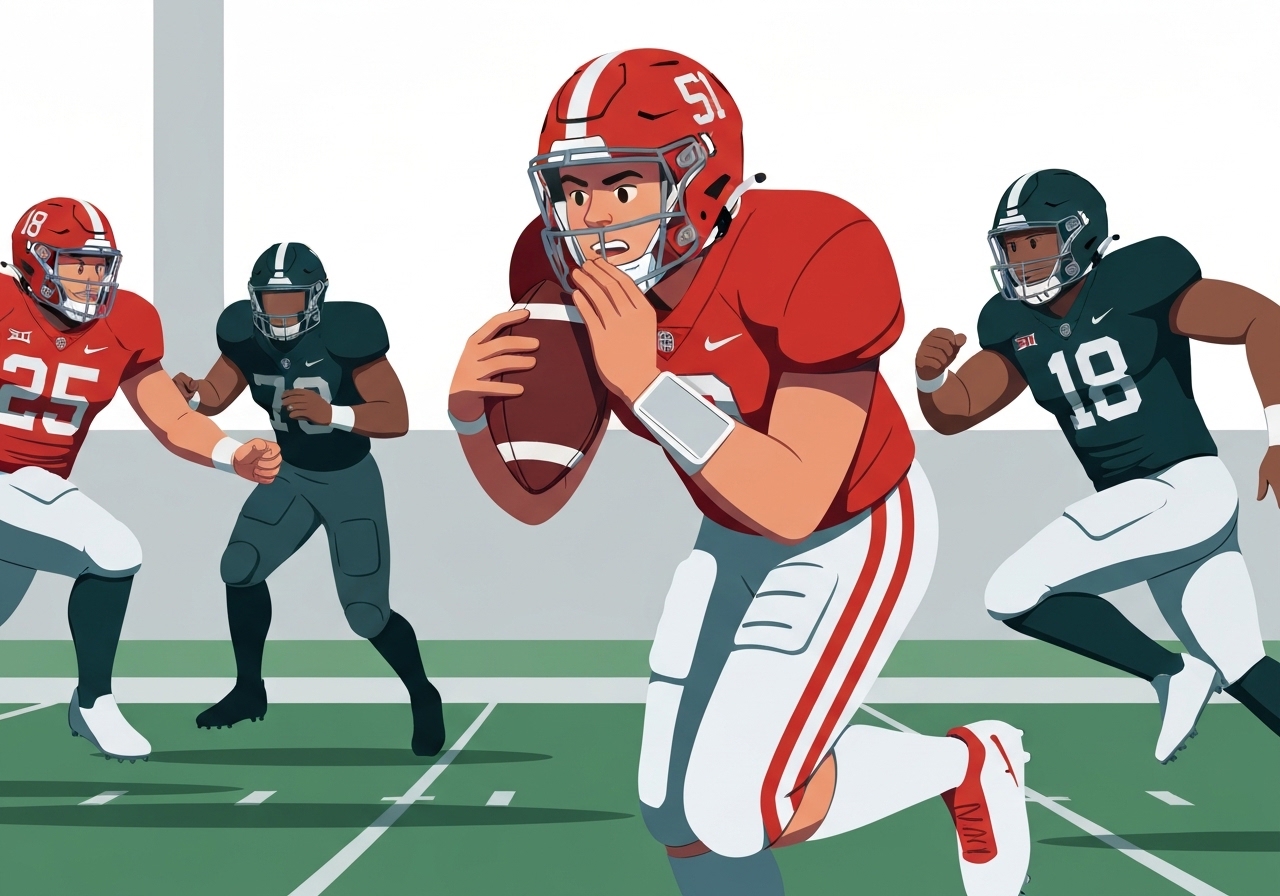
With the clock under two minutes in Sunday’s 10-7 win over the Broncos, Patriots quarterback Drake Maye improvised on a third-down play and picked up a crucial first down around the left edge. The run directly preserved possession and helped New England secure a berth in the Super Bowl. Center Garrett Bradbury said he expected a handoff to running back Rhamondre Stevenson and was surprised to find Maye carrying the ball. Maye later confirmed the play was called as a handoff before he elected to keep it and turn the game’s defining sequence in New England’s favor.
Key Takeaways
- The play occurred on third down after the two-minute warning in a game the Patriots won 10-7, a result that advanced them to the Super Bowl.
- Drake Maye ran around the left side to pick up a first down; the move preserved possession in a one-score game.
- Center Garrett Bradbury expected the snap to be handed to Rhamondre Stevenson and said he was surprised when Maye kept the ball.
- Bradbury recounted that Maye told teammates after the game he had “debated” telling them he would keep it but ultimately did not.
- Maye told reporters the called play was a stretch handoff in big personnel before he improvised once defenders loosened pursuit.
- The decision highlights Maye’s mobility and on-field judgment at a pivotal moment, raising questions about quarterback–line communication.
Background
The sequence unfolded late in a low-scoring contest in which every possession carried outsized importance. New England’s offense has leaned on a mix of personnel and zone-stretch concepts this season, often using Rhamondre Stevenson as the short-yardage and power option near the line. Garrett Bradbury, the team’s starting center, is a veteran anchor of the interior line responsible for pre-snap calls and executing handoffs. In that role he expected the standard handoff exchange on the play called after the two-minute warning.
Drake Maye has been highlighted this year for combining passing growth with mobility, and the Patriots’ game plan has at times privileged conservative ball control in close games. In late-game scenarios the quarterback’s choices between improvised runs and strict adherence to playcalls can swing outcomes quickly. Historically, teams have rewarded situational awareness from quarterbacks when those decisions preserve possession or negate turnovers, but such improvisation can also increase risk if linemen and backs are out of position.
Main Event
On third down following the two-minute warning, the Patriots lined up in what Maye described as “big personnel,” and the call was a stretch handoff to the right aimed at getting Stevenson into a crease. Instead, Maye kept the ball and attacked the left edge, outrunning immediate pursuit to secure the first down. The play’s success turned a potential turnover or stalled drive into a clinching sequence that allowed New England to close out the game safely.
Bradbury said he initially reacted with disbelief when he turned to look for the running back and found Maye holding the ball. According to Bradbury’s account — reported by Andrew Callahan of the Boston Herald — his immediate thought was alarm because the line had been prepared to block for Stevenson. After the game Bradbury said Maye acknowledged he had considered telling the offensive line he would keep the ball but chose not to.
Maye later explained the on-field read at his postgame news conference, saying the play was the same stretch concept the offense had run earlier and that defenders ‘‘got lackadaisical’’ enough to allow an edge run. He credited situational awareness and timing for the decision and framed it as a play that presented itself in the moment rather than a premeditated deviation from the call.
Analysis & Implications
Maye’s choice to keep the ball in a pivotal moment underscores the tactical trade-off between improvisation and coordinated execution. On one hand, a quarterback’s mobility can generate yardage and preserve drives when linemen or backs are late to reach blocking assignments; on the other hand, unexpected keeps can disrupt blocking schemes and expose the ball-carrier to adverse angles or confusion. The immediate payoff here mitigates criticism, but repeated uncommunicated improvisation could strain trust between a quarterback and his offensive line.
From a coaching standpoint, the play raises questions about the tolerance for such improvisation in high-stakes contexts like the Super Bowl. Coaches balance the value of instinctive plays against the need for consistent assignments and minimizing turnover risk. If Maye’s decision is seen as repeatable and low-risk, staff may incorporate more designed QB options or clarify when quarterbacks should audible into keepers; if it’s viewed as a lucky break, instruction may tighten to prioritize assignment fidelity.
For opposing defenses, the sequence highlights a potential vulnerability: when defenders overpursue or misalign on a stretch look, a mobile quarterback can exploit the edge. Defensive coordinators preparing for the Super Bowl will likely emphasize containment principles and force Maye to make throws under pressure, while Patriots coaches may mix looks to encourage similar open-field opportunities without sacrificing lineman coordination.
Comparison & Data
| Situation | Down | Time | Score | Result |
|---|---|---|---|---|
| Victory-clinching sequence vs. Broncos | 3rd down | After two-minute warning | Patriots 10–7 | First down; possession retained; advanced to Super Bowl |
The table above isolates the critical variables that made the play decisive: late game clock, single-score margin, third down, and successful conversion. Those factors amplify the consequence of a single decision—success preserves control and forces the opponent to use timeouts or play urgent defense, while failure can hand momentum to the opposition.
Reactions & Quotes
Teammates and reporters quickly relayed the surprise on the offensive line. Garrett Bradbury described his immediate reaction and later recounted the postgame exchange with Maye to local media.
“Oh my god — I turn around, Drake’s over there with the ball, and I’m like, ‘Go, go, go!’”
Garrett Bradbury — Boston Herald (Andrew Callahan)
Bradbury’s remark captures the split-second confusion in the trenches when an expected handoff does not occur. He emphasized that the line had been set up for a Stevenson carry and only realized the change after Maye had already committed to the run.
Maye framed his choice as an in-the-moment read rather than a planned deviation, telling reporters the called play was a stretch to the right before he found an opening on the edge.
“We were in big personnel…little stretch play. At some point, they get lackadaisical and got the chance to get around the edge.”
Drake Maye — Postgame press conference
Maye’s description emphasizes opportunity recognition and timing; he attributed the success to the defense’s slight lapse and his ability to capitalize without disrupting the team’s broader approach to ball control.
Unconfirmed
- It is unconfirmed whether Maye intended to keep the ball before the snap or truly made the decision only after reading the defense.
- There is no public confirmation that head coach staff approved similar improvisations in future game plans for the Super Bowl.
- Reports do not specify whether any in-game signal or cadence contributed to the offensive line’s misread of the play.
Bottom Line
The play crystallized the dual nature of instinctive quarterback play: it can win games in tight moments, but it also tests the communication and cohesion of an offense. Drake Maye’s run preserved possession and secured a Super Bowl berth, earning immediate praise for situational awareness while prompting legitimate questions about alignment between signal-caller and line.
Looking ahead to the Super Bowl, coaches and opponents will weigh whether Maye’s decision represents a repeatable tactic or a high-reward outlier. Regardless, the sequence will be studied by both staffs as a case study in late-game decision-making, and it underscores how a single improvisation can have outsized postseason consequences.
Sources
- NBC Sports — sports news report
- Boston Herald (Andrew Callahan) — local press reporting