
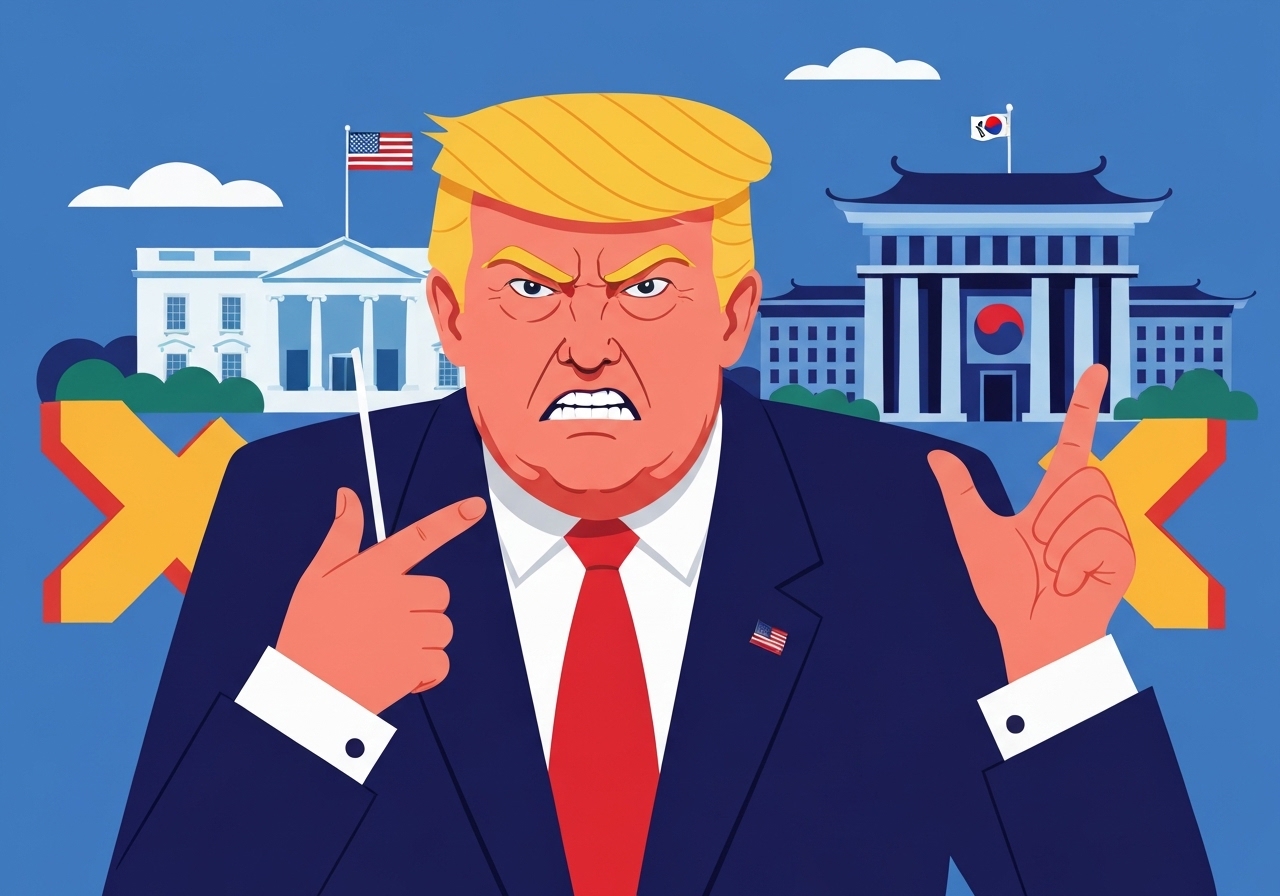
President Donald Trump on Monday announced a unilateral increase in U.S. tariffs on South Korean imports — raising duties on autos, pharmaceuticals and lumber from 15% to 25% — citing a delay by South Korea’s legislature to ratify a trade agreement negotiated last summer. The announcement, posted on the president’s Truth Social account, referenced a deal reached with South Korean President Lee Jae Myung on July 30, 2025, and reaffirmed during Trump’s Oct. 29, 2025 visit to Gyeongju, South Korea. U.S. and South Korean officials gave conflicting immediate accounts: Reuters reported Seoul’s Blue House saying it had not received formal U.S. notification, while the White House statement was made publicly by the president. The move escalates tension between two major trading partners and risks immediate trade and political fallout.
Key takeaways
- The tariff increase moves a blanket 15% duty to 25% on specified South Korean imports including autos, pharmaceuticals and lumber, as announced by President Trump on Truth Social on Jan. 26, 2026.
- Trump said the change was prompted by the South Korean legislature’s delay in approving a trade agreement reached July 30, 2025, and reaffirmed on Oct. 29, 2025, during the APEC summit in Gyeongju.
- U.S. imports from South Korea totaled $131.6 billion in 2024, according to the Office of the U.S. Trade Representative, making South Korea one of the U.S.’s largest goods suppliers.
- Reuters reported that the Blue House said the U.S. government had not formally notified Seoul of a tariff hike; CNBC said it had sought comment from South Korea’s embassy in Washington, D.C.
- South Korean automaker Hyundai is the single largest importer of new vehicles from South Korea into the U.S., making the auto sector particularly exposed to higher duties.
- The U.S. Supreme Court heard arguments in November 2025 about the legality of unilateral presidential tariffs; a decision in that case remains pending.
Background
The tariff dispute traces to a bilateral trade deal announced by the two presidents on July 30, 2025. That agreement reportedly set a uniform 15% tariff rate on covered imports from South Korea — a compromise Mr. Trump framed as lower than previous threats he had floated. When the deal was reaffirmed during Trump’s Oct. 29, 2025 appearance at the APEC CEO Summit in Gyeongju, both capitals publicly presented it as a major step toward deeper economic cooperation.
Ratification required action by South Korea’s National Assembly, where debates over the text and domestic political considerations slowed progress. South Korean lawmakers have faced pressure from industry groups and voters concerned about domestic market impacts, while the executive branch has urged timely approval. In Washington, the administration has emphasized reciprocity and investment commitments; critics have warned that unilateral moves could strain longstanding security and economic ties between the two countries.
Main event
On Jan. 26, 2026, President Trump posted that he was increasing tariffs on specified South Korean imports from 15% to 25% because — in his words — Seoul’s legislature had not enacted the deal. The announcement named autos, pharmaceuticals and lumber among affected categories and framed the step as a penalty for delay. He reiterated earlier claims about financial commitments tied to the deal, but those figures and implementation mechanics were not documented in an official U.S. notification cited by Seoul.
Within hours Reuters reported that South Korea’s presidential office (the Blue House) said it had not been formally notified by the U.S. government of any tariff increase, and that Seoul would convene advisers and relevant ministries to assess potential responses. CNBC also reported it had requested comment from South Korea’s embassy in Washington, D.C., but no public confirmation of a formal U.S. transmission had been posted by either capital at the time of initial reporting.
Industry participants signaled immediate concern. Automakers and parts suppliers, already operating on thin margins and complex cross-border supply chains, face higher input and finished‑vehicle costs if duties are applied as the president announced. Given Hyundai’s role as the largest single new-vehicle importer from South Korea, the car sector may experience the fastest and most visible short-term effects in U.S. showrooms and pricing.
Analysis & implications
A unilateral tariff hike between allied economies carries political as well as economic consequences. Economically, an across-the-board increase to 25% would inflate the landed cost of covered imports for U.S. buyers and could trigger retaliatory trade measures, supply‑chain reconfiguration, or higher consumer prices. South Korea’s export sectors — especially autos and pharmaceuticals — would face reduced demand or redirected trade flows, with downstream impacts on U.S. manufacturers that rely on Korean inputs.
Politically, the move tests the resilience of U.S.–South Korea ties built on security cooperation and shared strategic interests. Seoul may respond through diplomatic protests, seeking consultations under any existing trade‑dispute mechanisms, or by slowing cooperation in other bilateral areas. Domestic politics in both capitals could harden positions: in South Korea, lawmakers might use a perceived U.S. overreach to rally opposition; in the U.S., the administration’s supporters may frame the action as enforcing reciprocity.
Legally, the announcement sits against ongoing judicial scrutiny. The U.S. Supreme Court heard arguments in November 2025 about whether the president can impose broad tariffs without explicit Congressional authorization. If the Court rules limits exist, unilateral tariff changes could be reversed or tied up in litigation; if it upholds executive authority, future administrations may find an expanded toolkit for trade leverage.
Comparison & data
| Item | Previous U.S. Tariff | Announced Tariff | U.S. Imports (2024) |
|---|---|---|---|
| Autos (selected) | 15% | 25% | $131.6B (total Korea→U.S., 2024) |
| Pharmaceuticals | 15% | 25% | |
| Lumber | 15% | 25% |
This simplified table contrasts the president’s announced tariff increase with the previously stated blanket rate tied to the July accord and situates the change against total bilateral goods trade in 2024. The $131.6 billion figure from the Office of the U.S. Trade Representative highlights the scale of goods flows that could be affected. Sectoral exposure will vary: autos and parts have integrated supply chains and may see near-term supply and price disruptions, whereas some pharmaceuticals rely on long-term contracts and regulatory pathways that moderate immediate shifts.
Reactions & quotes
White House communications framed the action as enforcement of a negotiated bargain; Seoul’s presidential office pushed back on procedural grounds. Industry groups and markets signaled alarm at the prospect of abrupt cost increases for cross‑border trade.
“South Korea’s Legislature is not living up to its Deal with the United States.”
Donald J. Trump, President (Truth Social post)
Trump’s post framed the tariff increase explicitly as a consequence of legislative delay. The statement reiterated prior claims about the July 30, 2025 agreement and the Oct. 29 reaffirmation in Gyeongju.
“The U.S. government has not officially notified us of any tariff increase,”
Blue House, Presidential Office of South Korea (reported by Reuters)
Seoul’s presidential office, as reported by Reuters, described an absence of formal U.S. notification and said it would convene relevant ministries to consider next steps. That account introduces a procedural discrepancy between the U.S. announcement and Seoul’s understanding at the time of reporting.
Unconfirmed
- Whether U.S. authorities have transmitted formal, legally binding notice of a tariff increase to Seoul — Reuters reported no formal notification at the time of its story.
- The practical timeline and effective date for applying the 25% duties; the president’s post did not specify implementation mechanics or immediate enforcement steps.
- Claims that South Korea agreed to provide “$350 Billion Dollars” in U.S.-selected investments as part of the July agreement remain an administration assertion and lack independent corroboration in official texts released publicly.
- Whether and how South Korea may retaliate or pursue dispute-settlement procedures has not been finalized and will depend on intergovernmental consultations now reportedly underway.
Bottom line
The president’s announcement raises the stakes in a bilateral relationship that blends strategic alliance with deep economic ties. If implemented, a move from 15% to 25% on key South Korean exports would have tangible effects on prices, supply chains and political relations in both countries; if not implemented or reversed, the announcement still shifts negotiating dynamics and domestic politics.
Near term, markets, companies and policymakers will watch for formal notifications, Seoul’s diplomatic responses and any legal challenges that could determine whether the duties take effect. Over the medium term, the episode will influence how trade agreements are negotiated, ratified and enforced between allies — and whether judicial review becomes the primary check on executive tariff powers.
Sources
- CNBC — news report (initial coverage and request for comment to South Korea’s embassy)
- Reuters — international news agency (reported Blue House response and follow-up)
- Office of the U.S. Trade Representative (USTR) — official U.S. government trade statistics and analysis (2024 bilateral goods figure)
- U.S. Supreme Court — official court site (reference to November 2025 oral arguments on presidential tariff authority)