
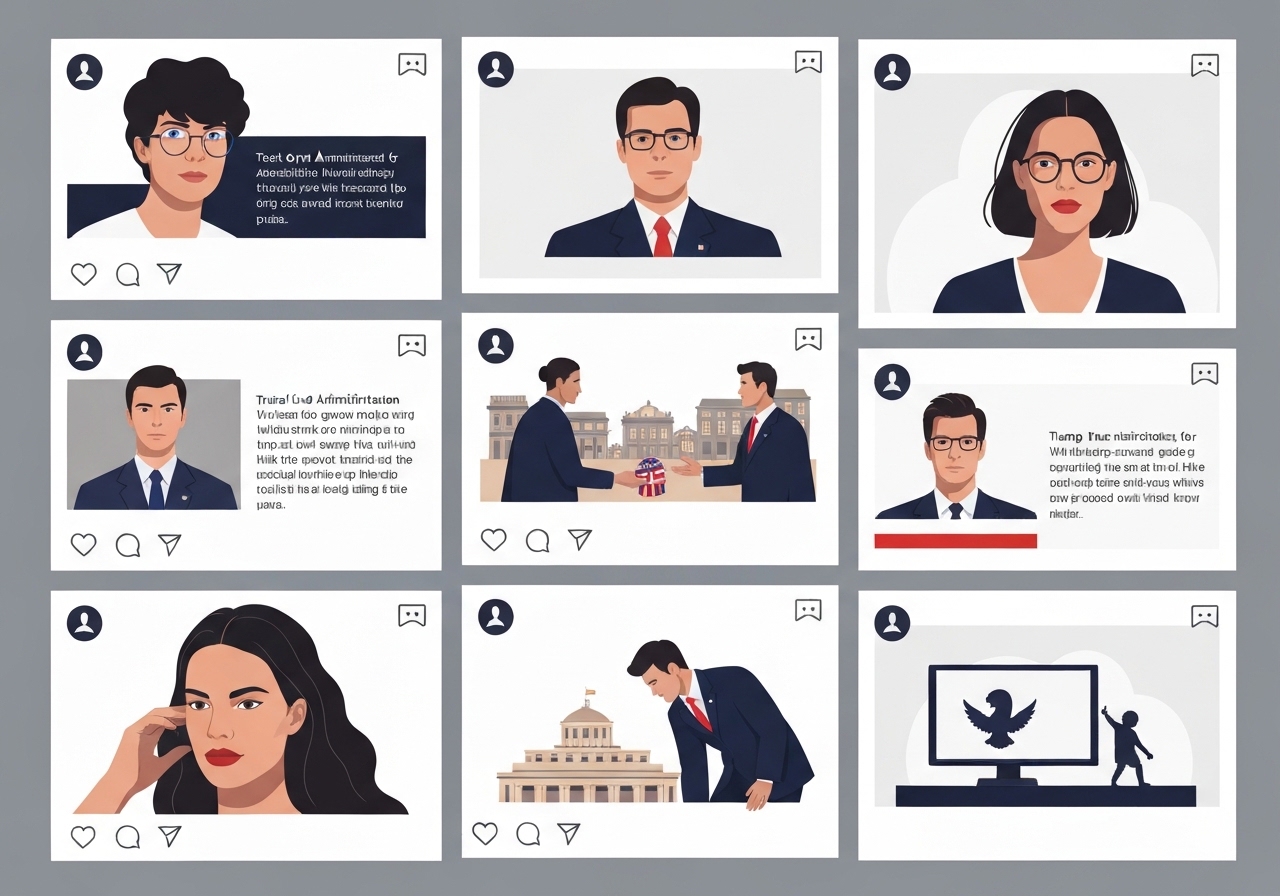
— A review of government social accounts found that in the past month the White House, Department of Homeland Security and Department of Labor published a string of posts that reused slogans, imagery and even a song tied to white‑nationalist groups. Several posts referenced neo‑Nazi texts, ethnic‑cleansing rhetoric and QAnon motifs, and some mused publicly about mass deportation. One joint White House–DHS recruitment post for Immigration and Customs Enforcement was overlaid with the words “WE’LL HAVE OUR HOME AGAIN,” a phrase also used as the title of a song embraced by the Proud Boys and other white‑supremacist networks. Civil liberties groups, researchers and some officials say the pattern has alarmed observers who track extremist iconography.
Key takeaways
- The review covers dozens of government social‑media posts in January 2026 from official White House, DHS and Labor accounts that included imagery or language tied to far‑right movements.
- A joint White House–DHS recruitment post for Immigration and Customs Enforcement displayed the phrase “WE’LL HAVE OUR HOME AGAIN,” the title of a song circulated by Proud Boys and white‑nationalist groups since 2020.
- Some posts referenced neo‑Nazi literature, used ethnic‑cleansing language, echoed QAnon themes, or promoted lyrics associated with far‑right anthems.
- The song linked to the phrase has appeared on encrypted platforms and was cited by the attacker who murdered three Black people in Jacksonville, Fla., in 2023.
- Agency officials have issued brief responses characterizing the messages as recruitment or routine outreach; outside extremism researchers view the posts as adopting coded signals used by militants.
- Public reaction is split: some audiences interpret the material as patriotic outreach, while experts and civil‑rights groups see plausible extremist resonance.
Background
Social‑media outreach has been a core tool for federal agencies to recruit staff, share policy and shape public perception. In recent years, extremist groups have also refined an array of visual and verbal signals—slogans, song lines, numeric codes and repurposed historical phrases—that function as shorthand inside their networks. That blending of aesthetics and language makes it possible for innocuous‑looking posts to carry layered meanings for different audiences.
Researchers monitoring far‑right movements say the Proud Boys and allied groups have circulated a handful of songs, phrases and icons on public feeds and encrypted apps since around 2020. Some of that material migrated into mainstream platforms where it can be amplified rapidly. At the same time, government social accounts routinely reuse stock imagery and patriotic language, increasing the risk that an overlap will be read as intentional signaling rather than coincidence.
Main event
Throughout January 2026, the White House, DHS and Labor posted messages on Instagram, Facebook and X that, in aggregate, reused verbal and visual elements now recognized by extremism trackers. One prominent example was a collaborative recruitment piece for U.S. Immigration and Customs Enforcement that featured the phrase “WE’LL HAVE OUR HOME AGAIN” overlaid on recruitment imagery. That phrase matches the title of a song produced by members of a self‑described pro‑White group and embraced by the Proud Boys.
Other posts in the same period referenced materials identified with neo‑Nazi writing and used rhetoric suggesting mass deportation—content that prompted immediate attention from watchdog groups. Some items included imagery and taglines that, to analysts versed in the subculture, align with known codes and motifs used by far‑right militants on Telegram and other platforms since 2020.
Agency officials responded with short statements emphasizing recruitment and routine outreach while asserting no intent to endorse extremist views. Outside experts, however, cataloged the overlaps and warned that repetition across multiple official accounts increases the chance these signals will be amplified within extremist networks.
Analysis & implications
First, the reuse of language and music linked to white‑nationalist circles by official accounts raises questions about vetting processes for social content. Even if posts were not crafted to appeal to extremists, their replication across high‑visibility channels can function as inadvertent validation or amplification of fringe material. That risk is especially acute when a phrase or lyric carries a documented violent or exclusionary history.
Second, the phenomenon underscores how coded extremist communication has moved from private forums into public spaces. When slogans or songs appear on government feeds, they travel faster and reach audiences that might not otherwise encounter them, blurring the line between fringe signaling and mainstream messaging. Analysts warn that repeated patterns can normalize extremist tropes over time unless agencies tighten content review.
Third, there are political and operational consequences. Domestically, communities targeted by the referenced imagery—particularly racial and religious minorities—may feel increased vulnerability and mistrust toward institutions meant to protect them. Internationally, allied governments and human‑rights monitors may interpret such posts as a shift in tone or tolerance, affecting diplomatic credibility.
Finally, the episode may prompt policy responses: clearer content‑approval protocols, third‑party vetting, or public disclosures about how social posts are reviewed and who signs off on them. The balance agencies choose—between rapid outreach and rigorous screening—will shape whether similar overlaps recur.
Comparison & data
| Agency | Representative content (Jan. 2026) | Context |
|---|---|---|
| White House | Recruitment imagery overlaid with “WE’LL HAVE OUR HOME AGAIN” | Joint post with DHS for ICE recruitment |
| Department of Homeland Security | Posts using nationalist slogans and historical references | Shared on Instagram, Facebook, X |
| Department of Labor | Graphics and taglines echoing exclusionary rhetoric | Part of standard outreach series |
The table above summarizes illustrative examples from January 2026; reports indicate “dozens” of contested posts across official accounts in that month. Quantifying intent requires internal records on approvals and messaging strategy, which are not public in full.
Reactions & quotes
Agency spokespeople described the posts as routine outreach and recruitment tools, not endorsements of extremist views.
Agency official (public statement)
Extremism researchers noted that the specific phrases and song lines have been repeatedly used by Proud Boys and allied networks since 2020, increasing the risk the content would be read as a signal.
Extremism researcher (academic)
Civil‑liberties groups urged clearer vetting and transparency, saying communities affected by the rhetoric deserve explanations and safeguards.
Civil‑rights organization (advocacy)
Unconfirmed
- Whether each flagged post was approved at senior levels inside the White House, DHS or Labor remains unclear without agency disclosure.
- There is no public evidence that the agencies coordinated with any outside group when choosing specific phrases or imagery.
- The degree to which extremist groups took direct encouragement from these posts—versus recognizing them opportunistically—has not been definitively established.
Bottom line
The cluster of January 2026 posts from the White House, DHS and Labor highlights a persistent communications risk: overlap between routine government messaging and material that carries extremist meaning for targeted audiences. Even absent malicious intent, repetition of certain slogans, images or song lines can function as validation or amplification of white‑supremacist narratives.
To reduce future harm and restore public confidence, agencies will likely face pressure to tighten approval protocols, increase transparency about social‑media practices and engage third‑party experts to vet content. For watchdogs and the general public, the incident underscores the importance of prompt disclosure and rigorous review when official messages intersect with symbols of hate.
Sources
- The New York Times — news media: original reporting on government social‑media posts (Jan. 27, 2026)