
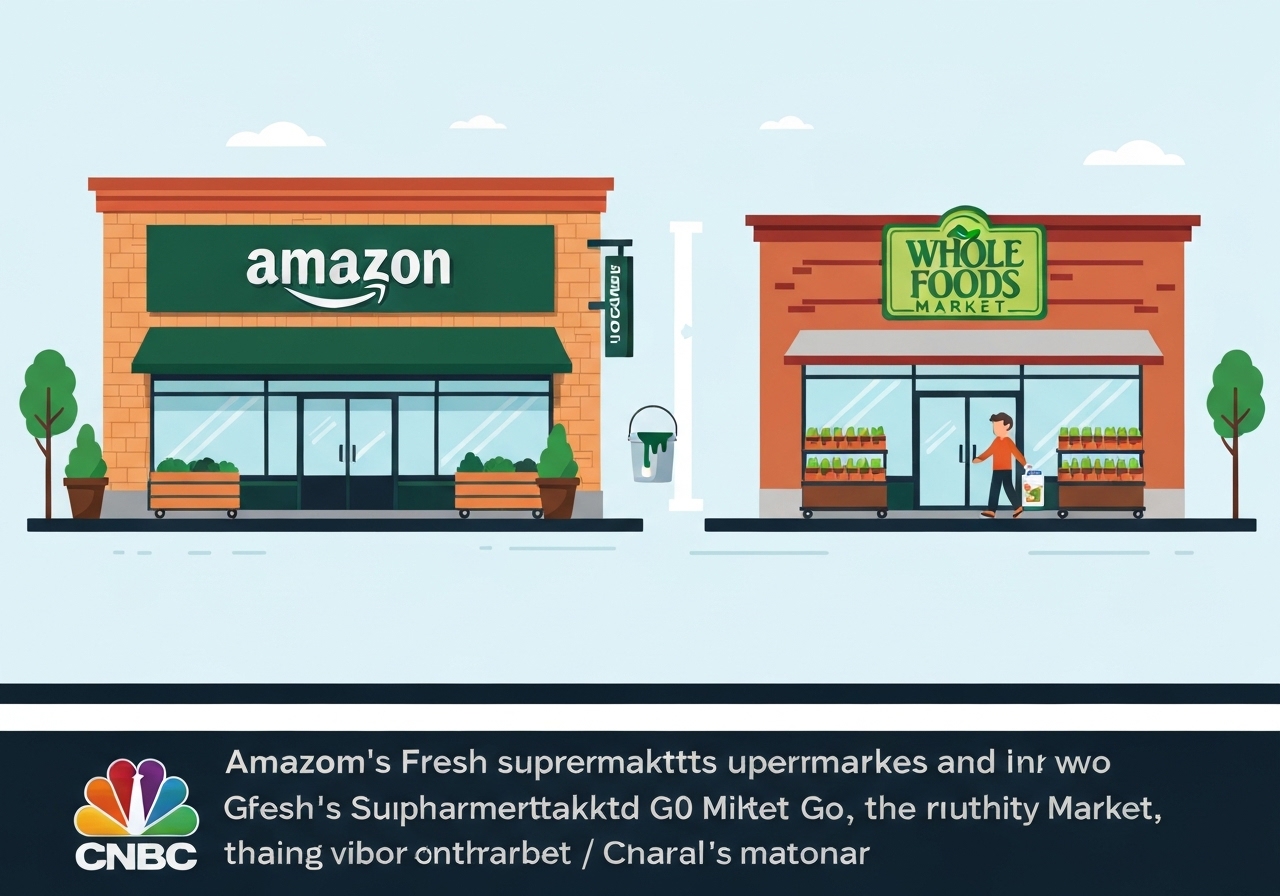
Lead: Amazon announced on Jan. 27, 2026 that it will close its Amazon Fresh and Amazon Go physical stores and convert various locations into Whole Foods Market outlets across the U.S. The company said the move follows a strategic review intended to concentrate investment in higher-priority formats while keeping Fresh as an online grocery service. Amazon also said it plans to open more than 100 new Whole Foods locations over the next few years and expand smaller “Whole Foods Daily Shops.” The decision marks a significant shift in Amazon’s brick-and-mortar grocery approach.
Key takeaways
- Amazon will sunset Amazon Fresh and Amazon Go physical stores and convert multiple locations into Whole Foods Market sites, announcement made on Jan. 27, 2026.
- The company plans to open more than 100 new Whole Foods locations over the next few years and expand Whole Foods Daily Shops (mini-markets).
- Amazon will continue to operate its Fresh online grocery service while reprioritizing in-store investments toward a mass physical format.
- Key historical milestones: Amazon bought Whole Foods for $13.7 billion in 2017; Amazon Go debuted in 2018; Amazon Fresh launched in 2020.
- Amazon removed cashierless systems from its grocery stores in 2024 and has been marketing the underlying software to venues such as stadiums, hospitals and colleges.
- All U.K. Amazon Fresh stores were closed in September 2025 as part of earlier retrenchment.
Background
Amazon’s grocery efforts span nearly two decades and multiple business models. The company made its largest-ever acquisition in 2017 when it bought Whole Foods Market for $13.7 billion, gaining a nationwide premium-grocery footprint and supply-chain foothold. In 2018 Amazon introduced Amazon Go, a small-format convenience concept built around cashierless “Just Walk Out” technology designed to speed checkout by tracking items with cameras and sensors.
In 2020 Amazon launched the Fresh grocery chain with the stated goal of reaching broader, mass-market shoppers; the rollout included an initial burst of openings followed by pauses, closures and iterative redesigns. Amazon introduced a revised Fresh concept in 2023, but the chain faced renewed retrenchment in 2024 and 2025, including removal of its cashierless systems from grocery locations and shuttering all U.K. Fresh stores in September 2025.
Main event
On Jan. 27, 2026 Amazon published a blog post announcing it will close physical Amazon Fresh and Amazon Go stores and convert a number of those locations into Whole Foods Market outlets. The company described the decision as the outcome of a careful evaluation of how best to serve customers and allocate capital. Conversions are planned over coming months and years, with Amazon emphasizing expansion of Whole Foods and its smaller Daily Shops rather than maintaining multiple bricks-and-mortar chains.
Amazon said it will retain Amazon Fresh as an online grocery service and that it still intends to experiment with and roll out select new physical-store concepts, including a mass-market format it described in general terms. The company also reiterated plans to open more than 100 additional Whole Foods stores over the next few years, signaling a consolidation under the established Whole Foods brand.
The announcement underscores a long-running internal debate over in-store technology. Amazon’s Go stores, introduced in 2018, were a visible showcase for cashierless systems. After testing and partial commercialization efforts—such as offering the software to stadiums and other venues—Amazon removed the in-store automated checkout systems from grocery locations in 2024, shifting emphasis away from that proprietary hardware-software deployment.
Analysis & implications
Strategically, the move reduces brand overlap and concentrates Amazon’s grocery retail investment in the Whole Foods platform, which offers stronger name recognition and an existing supply chain. Converting Fresh and Go sites into Whole Foods locations allows Amazon to leverage procurement, private-label programs, and loyalty linkages with Amazon Prime to drive higher-margin grocery sales. The plan to add 100-plus Whole Foods stores suggests Amazon sees enduring growth in physical grocery footprint, but under a single, proven banner.
For competitors, the consolidation simplifies the competitive map: regional grocery chains and national players will now contend with a larger, more uniform Whole Foods presence rather than a patchwork of Amazon-branded formats. Suppliers and landlords should expect renegotiated lease terms, merchandising plans, and assortment changes as locations transition from Fresh or Go assortments to those typical of Whole Foods and Whole Foods Daily Shops.
The announcement also signals Amazon’s pragmatic retreat from large-scale deployment of in-store cashierless technology. After investing in cameras, sensors and software, the company shifted in 2024 to sell and trial that technology with third parties. That pivot suggests Amazon concluded the operational and cost trade-offs of cashierless groceries did not yet justify a broad consumer rollout at scale in its own stores.
Comparison & data
| Milestone | Year |
|---|---|
| Whole Foods acquisition | 2017 ($13.7B) |
| Amazon Go debut | 2018 |
| Amazon Fresh launch | 2020 |
| Revamped Fresh concept | 2023 |
| Removed cashierless systems from grocery stores | 2024 |
| U.K. Fresh stores closed | September 2025 |
| Conversion announcement | January 27, 2026 |
This timeline highlights recurrent strategy shifts: acquisition in 2017 gave Amazon an immediate supermarket platform; the next phase tested automation and new formats (2018–2020); subsequent years focused on recalibration, cost control and selective expansion into the Whole Foods brand. The next wave—100+ new Whole Foods openings—represents a renewed bet on conventional grocery retail under a unified brand.
Reactions & quotes
Amazon framed the change as a customer- and capital-allocation decision in its public post, noting conversions will let it prioritize formats that better serve shoppers.
“After a careful evaluation of the business and how we can best serve customers, we’ve made the difficult decision to close our Amazon Go and Amazon Fresh physical stores, converting various locations into Whole Foods Market stores.”
Amazon (official blog post)
Observers recall founder Jeff Bezos’ 2018 rationale for cashierless stores as a response to checkout friction, a sentiment Amazon later revisited as it scaled and tested alternatives.
“No one likes to wait in line. Instead, we imagined a store where you could walk in, pick up what you wanted, and leave.”
Jeff Bezos, 2018 shareholder letter
Unconfirmed
- Exact number of Fresh and Go locations that will close versus convert is not specified in Amazon’s announcement; a definitive list has not been published.
- Timing for each store conversion and a full timeline for the planned 100+ new Whole Foods openings remain unspecified in the public statement.
- Details on whether any converted locations will retain elements of Fresh or Go branding or technology are not confirmed.
Bottom line
The conversion of Amazon Fresh and Amazon Go physical locations into Whole Foods stores signals a pragmatic consolidation: Amazon is moving away from multiple retail experiments toward strengthening a single, recognizable grocery brand while preserving online Fresh. The company’s pledge to add more than 100 Whole Foods locations shows continued commitment to physical grocery, but under a more centralized strategy that should improve operational consistency and brand clarity.
For consumers and competitors, the change will reshape store assortments, loyalty integrations and local market dynamics over the coming years. For Amazon, the central challenge will be executing conversions efficiently while balancing investments in e-commerce, automation licensing and any new physical formats it chooses to pilot.