
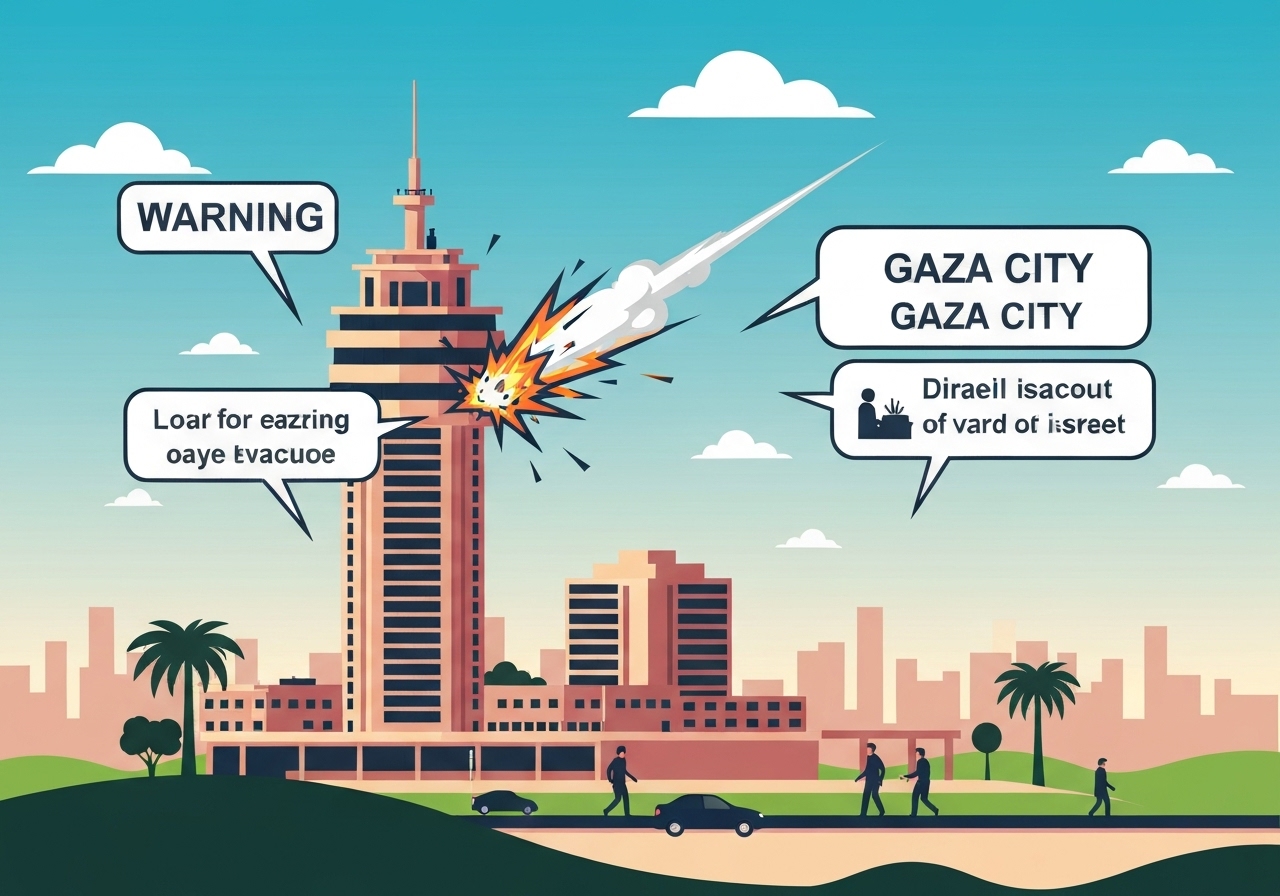
Lead: On Sept 6, 2025, Israel’s military told residents of Gaza City to move south toward Khan Younis and struck a multi‑storey tower it said was used by Hamas as ground forces pushed deeper into the city.
Key Takeaways
- The Israeli military issued evacuation warnings for parts of Gaza City and directed civilians toward a designated coastal area in Khan Younis.
- Forces bombed a high‑rise tower that the military said served Hamas purposes; Hamas denied the claim and said the building sheltered displaced people.
- Gaza health authorities reported at least 40 deaths across the territory on Sept 6, with about half the fatalities in Gaza City.
- Israel says it controls nearly half of Gaza City and about 75% of the wider territory as operations continue.
- Prime Minister Benjamin Netanyahu ordered the capture of Gaza City; tens of thousands of reservists were mobilised to support the campaign.
- International groups, including Amnesty International, urged Israel to halt the offensive and warned of mass displacement.
- Diplomatic talks over hostages continue, with U.S. officials, including President Donald Trump, describing negotiations as in “very deep” stages.
Verified Facts
Israeli forces stepped up operations around Gaza City after an order from Prime Minister Benjamin Netanyahu to capture the enclave’s largest urban area. The offensive has included weeks of heavy strikes and ground moves through outer suburbs, with troops reported within a few kilometres of the city centre by early September 2025.
On Sept 6, 2025 the military used social media posts and the distribution of evacuation warnings to tell civilians to relocate southward. Military spokesperson Avichay Adraee said residents should head to a designated coastal zone near Khan Younis where the military indicated food, medical care and shelter would be available.
The military announced it struck a multi‑storey tower in Gaza City, asserting the building was used by Hamas and contained explosive devices nearby. Hamas denied the claim, saying the tower was a civilian shelter. Reports did not immediately confirm the building’s military use or the number of casualties from that specific strike.
Local Gaza health authorities reported at least 40 people killed across Gaza on Sept 6, with around half of those fatalities occurring in Gaza City. Prior to the current offensive, roughly one million people lived in Gaza City, nearly half of Gaza’s population.
Since the Oct 7, 2023 Hamas‑led attack that killed about 1,200 people in Israel and led to the taking of 251 hostages, more than 64,000 Palestinians have been reported killed in Gaza by local health agencies. Israeli officials say 48 hostages remain captive, and they estimate about 20 of them are still alive.
| Item | Reported figure |
|---|---|
| Hostages taken Oct 7, 2023 | 251 |
| Remaining hostages | 48 (about 20 believed alive) |
| Palestinian deaths in Gaza (since Oct 2023) | More than 64,000 (local authorities) |
| Reported deaths on Sept 6, 2025 | At least 40 |
Context & Impact
The push into Gaza City risks displacing hundreds of thousands who have already fled once during the nearly two years of conflict. Many residents who were previously displaced returned to Gaza City and some say they will not move again.
Humanitarian agencies say the enclave faces a severe crisis: widespread destruction of housing, strained medical facilities and shortages of food, water and fuel. Large‑scale movement of civilians within the territory would complicate aid delivery and protection efforts.
International reaction has been critical in parts. Human rights groups have accused Israeli forces of actions that have caused large numbers of civilian deaths and widespread destruction, while some Israeli families of hostages press for an outcome that secures the captives’ release. The offensive has increased diplomatic pressure on Israel from several overseas allies.
- Possible short‑term impacts: sharper humanitarian shortages, additional internal displacement, interruption of aid convoys.
- Possible medium‑term impacts: higher civilian casualties, intensified international scrutiny, pressure on negotiations over hostages.
Official Statements
The military said civilians were warned in advance and that the designated Khan Younis area was a humanitarian zone offering food and medical care.
Israeli military spokesperson Avichay Adraee
Hamas said towers are monitored and used by civilians, calling the strikes part of a systematic displacement plan.
Hamas statement
Unconfirmed
- The military’s claim that the struck high‑rise was actively used for Hamas command, intelligence or weapons storage has not been independently verified.
- The exact casualty toll, and whether any deaths occurred specifically in the tower strike, remains unclear pending further on‑the‑ground verification.
- Reports that specific senior Hamas leaders were killed in recent operations require confirmation from independent sources.
Bottom Line
Israel’s intensified campaign in Gaza City, including evacuation orders and high‑rise strikes, is likely to increase civilian displacement and humanitarian need while adding pressure to ongoing hostage negotiations. Independent verification of military claims and casualty figures remains limited.