
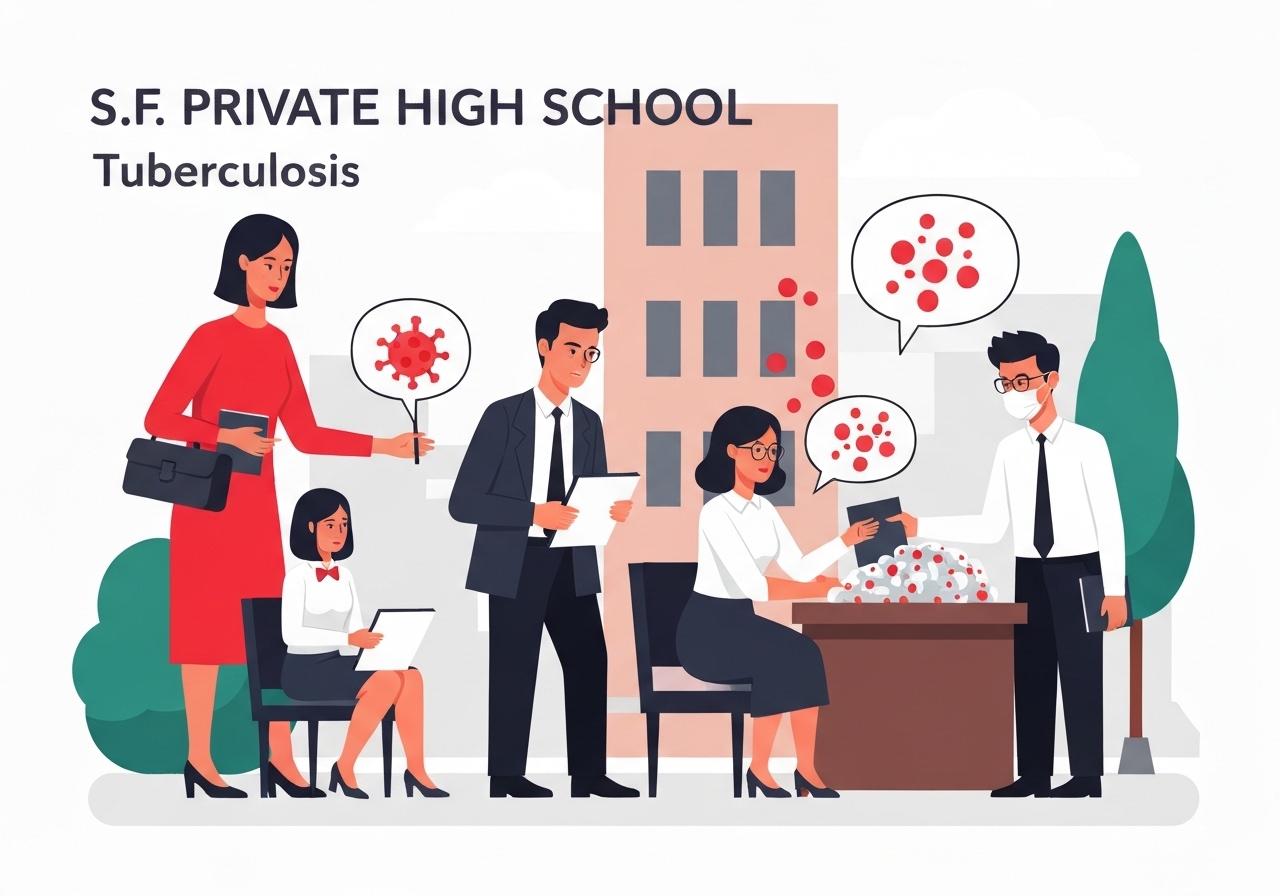
Since November 2025, San Francisco public health officials have identified three active cases of tuberculosis connected to Archbishop Riordan High School in the city’s Westwood Park neighborhood. The San Francisco Department of Public Health (DPH) confirmed the cases on Jan. 27, 2026, and said it is working with school leadership on testing, contact tracing and other mitigation measures; officials have not characterized the individuals’ roles. Authorities say immediate risk to the wider public is low while targeted screening, symptom monitoring and temporary activity adjustments are underway at the school.
Key Takeaways
- Three active tuberculosis (TB) cases have been identified in people connected to Archbishop Riordan High School since November 2025, according to San Francisco DPH.
- DPH and school leadership have implemented required testing for all students and staff and are conducting contact tracing to identify close contacts.
- The department advised symptom monitoring, indoor masking and modifications to certain indoor activities to reduce transmission risk within the school community.
- Officials did not disclose whether the three cases involve students, faculty, or other staff, and the school did not immediately respond to requests for comment.
- Public health guidance notes TB usually requires prolonged exposure to spread; symptoms can include cough, fever and weight loss, and both active and latent TB are treatable.
- San Francisco reported 91 active TB cases in 2024, per public health records cited by officials.
Background
Archbishop Riordan is a private Catholic high school that began as an all-boys institution and is now coeducational; it is located in the Westwood Park area of San Francisco. Tuberculosis is caused by Mycobacterium tuberculosis and is transmitted primarily through airborne respiratory particles expelled when an infectious person coughs, speaks or breathes near others for an extended period. Public health practice focuses on identifying active cases, isolating infectious people, tracing close contacts and screening those at risk to prevent further spread.
In many high-income U.S. cities, TB remains relatively uncommon but persistent in populations with certain risk factors; local health departments therefore prioritize rapid detection and treatment to prevent outbreaks. Latent TB infection—where a person carries the bacteria without symptoms and is not contagious—can progress to active TB if untreated, which is why screening close contacts and offering preventive therapy are standard public-health responses.
Main Event
The San Francisco Department of Public Health announced on Jan. 27, 2026, that it had identified three active TB cases connected to Riordan since November 2025. Health officials did not specify whether the infected individuals were students, teachers or other staff, noting only that they had isolated identified infectious cases and initiated contact tracing. In coordination with the school, DPH has required testing of the entire student and staff population to identify additional infections or latent cases that may need treatment.
Alongside testing, the school and DPH put in place symptom monitoring, encouraged or required indoor masking, and adjusted certain indoor activities judged higher risk for transmission. Communications to families and staff have included town halls and regular updates, according to the health department, as officials balance transparency with privacy for the affected individuals. The department emphasized that, given how TB transmits, risk to the general public remains low unless people had prolonged close contact with an infectious person.
School officials did not immediately provide an on-the-record statement to the media when asked, while the health department released a brief public statement stressing collaborative mitigation steps and continued monitoring. DPH’s actions reflect standard protocols for a congregate educational setting when multiple linked active TB cases are detected.
Analysis & Implications
Identifying three linked active TB cases in a single school setting is a public-health concern because school communities involve prolonged indoor contact among students and staff. However, TB’s typical transmission dynamics—requiring sustained close contact—mean that prompt identification, testing and treatment can sharply limit secondary cases. The required testing of all students and staff should clarify the extent of exposure and reveal any latent infections that would benefit from preventive therapy.
For the school, the immediate priorities are detecting additional cases, ensuring infected individuals receive a full course of treatment, and offering preventive treatment to those with latent infection. From an operational standpoint, short-term activity adjustments and masking reduce exposure while contact investigations proceed. The school’s outreach—town halls and updates—aims to maintain trust and compliance with testing, which is crucial for containing spread in settings where people gather frequently.
Citywide, San Francisco reported 91 active TB cases in 2024, a datum public health officials cited to contextualize local burden. If more cases linked to this cluster appear, DPH may consider broader community messaging or targeted outreach to populations with elevated TB risk. Conversely, if mass screening shows no further transmission, the response may scale down to routine follow-up for identified contacts.
Comparison & Data
| Item | Count/Note |
|---|---|
| Active TB cases linked to Riordan | 3 (identified since Nov 2025) |
| Confirmed active TB cases in San Francisco | 91 (2024) |
This simple comparison shows the Riordan cluster represents a small, localized subset of the overall active TB cases reported in the city in 2024. The table is intended to clarify scale: 3 linked cases in a single school are significant for that community but are numerically small compared with annual citywide case totals.
Reactions & Quotes
“The health and safety of the school community remain our top priority, and we will continue working together to ensure students and staff have the guidance and support they need to stay healthy.”
San Francisco Department of Public Health (official statement)
“When active TB is identified in a congregate setting, we focus on isolating infectious individuals and rapidly testing close contacts to interrupt potential transmission.”
San Francisco DPH (public health guidance)
Unconfirmed
- Whether the three people with active TB are students, teachers, staff, or other community members has not been disclosed by officials.
- The specific chains of transmission and whether these cases are linked to an outside exposure or an internal school cluster remain under investigation.
Bottom Line
Three active TB cases connected to Archbishop Riordan High School prompted a coordinated public-health response of testing, contact tracing and temporary risk-reduction measures. Given TB’s need for prolonged exposure to spread, rapid screening and appropriate treatment are likely to limit further transmission if fully and promptly implemented.
Families and staff should follow DPH guidance on testing and symptom monitoring; public-health officials will update the community as contact investigations yield results. The situation underscores the importance of routine TB awareness, prompt reporting of symptoms, and timely treatment to prevent small clusters from expanding in congregate settings.
Sources
- San Francisco Chronicle — local news report summarizing DPH announcement and school response (media).
- Centers for Disease Control and Prevention (CDC) — federal public health resource on tuberculosis transmission, diagnosis and treatment (official public-health guidance).