
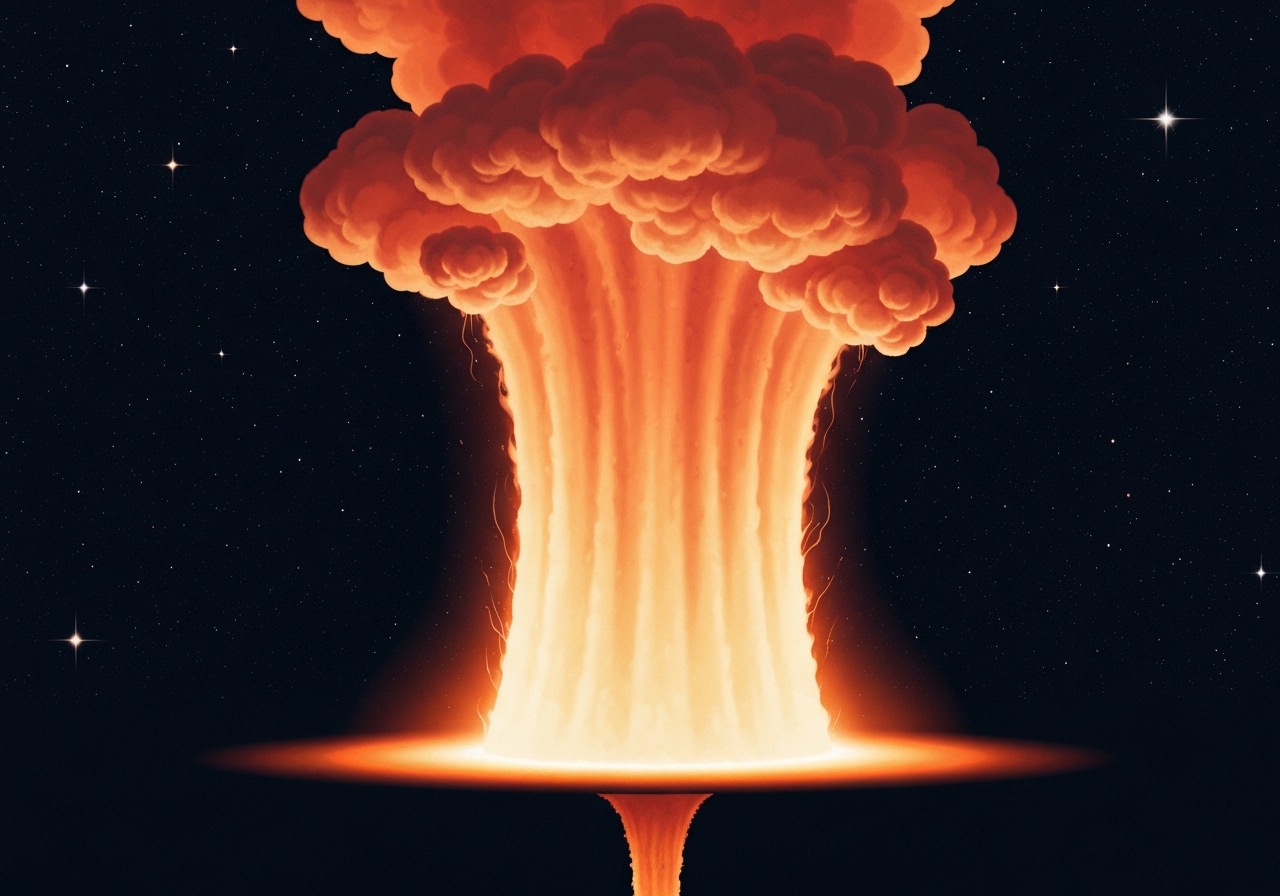
In a new James Webb Space Telescope image released this week, the dying star at the center of the Helix Nebula is revealed in unprecedented detail, its outer layers forming filamentary columns that resemble smoke or cometary plumes. The Webb NIRCam exposure, combined with ground-based data from the VISTA survey telescope, maps hot ionized gas alongside cooler molecular rings, showing material flowing outward and cooling into a red haze that will seed future star- and planet-formation. Located about 650 light-years from Earth and observed by astronomers for roughly 200 years, the Helix is a nearby planetary nebula surrounding a white dwarf in the final stages of stellar evolution. The new composite emphasizes both fine structure and chemistry, offering a striking visual and new diagnostic detail for researchers studying late stellar mass loss.
Key Takeaways
- The image is a James Webb NIRCam exposure combined with VISTA ground-based data, highlighting different temperature regimes in the nebula.
- The Helix Nebula lies about 650 light-years away and has been observed by telescopes for approximately 200 years.
- Hotter material appears blue in the composite while cooler gas and molecular regions show orange-to-red coloring from Webb and VISTA filters.
- Filamentary, comet-like structures stream away from the central white dwarf and cool into a diffuse red haze that will later contribute to future star and planet formation.
- Previous observatories including Hubble and Spitzer imaged the Helix; Webb’s resolution and infrared sensitivity reveal smaller-scale knots and shock interfaces.
- Image credits include NASA, ESA, CSA and STScI for Webb data and ESO/VISTA contributions for the ground-based component.
Background
The Helix Nebula, cataloged as NGC 7293, is one of the closest and most studied planetary nebulae. It formed when a Sun-like star exhausted its nuclear fuel, ejected its outer layers, and left behind a dense white dwarf; the expanding shell of gas and dust glows as it is ionized by the hot remnant. Because of its proximity—about 650 light-years—astronomers have imaged the object with many facilities, from optical telescopes to infrared platforms such as Spitzer, producing the famous “eye-like” appearance that has captured public imagination.
Planetary nebulae like the Helix are key laboratories for understanding late stellar evolution and the enrichment of the interstellar medium. They display layered structures where fast, hot winds interact with previously shed, slower material, producing shocks, ionization fronts and sites where molecules and dust can form. Different instruments and wavelength bands isolate these processes: optical instruments emphasize ionized gas, while infrared detectors reveal warm dust and newly formed molecules.
Main Event
Webb’s NIRCam image resolves fine, elongated knots and radial plumes in the Helix’s inner ring. Bright, ionized streaks appear to point away from the central star, but when the infrared view is overlaid with the VISTA near-infrared/visible mosaic, the geometry clarifies: the comet-like caps are streams of gas heated and launched from inner regions, colliding with a cooler circular ring where hydrogen and heavier molecules form. The composite colors represent temperature and chemistry rather than literal coloration.
Observers describe hotter material near the star as taking on bluish tones in Webb filters, while deeper orange and red hues trace cooler molecular regions seen by VISTA. The bright radial features are interpreted as shocks or photoevaporative flows—gas being heated, accelerated, and then cooling as it expands into surrounding space. Over time—on scales of tens of thousands to millions of years—this material will mingle with the interstellar medium and contribute to the raw materials for future star and planet formation.
The Webb data were processed by STScI staff and imaging specialists to balance spatial detail and color mapping, and the VISTA data were incorporated to extend the wavelength coverage and provide context for the larger-scale ring. Together the datasets make it possible to distinguish regions of active ionization, shocked gas, and cooler molecular clumps, allowing astronomers to trace mass-loss history and local chemistry with greater fidelity than before.
Past missions, notably Hubble and Spitzer, revealed the Helix’s broad morphology and many cometary knots, but Webb’s combination of angular resolution in the infrared and sensitivity to warm molecular lines exposes finer structure inside the inner ring and sharper interfaces where cooling and molecule formation occur.
Analysis & Implications
The Webb–VISTA composite advances understanding of how dying Sun-like stars return enriched material to the galaxy. By resolving shock fronts and molecular formation zones, the image helps constrain models of how fast winds from the central remnant interact with slower prior ejections. Improved constraints on density, temperature and composition in these regions inform chemical models that predict which molecules and dust grains survive the transition into the interstellar medium.
On a larger scale, the observations refine estimates of mass-loss rates during late stellar evolution. If more planetary nebulae show similar fine-scale behavior, theoretical rates used in stellar population and galactic chemical evolution models may be adjusted. That has downstream effects on predicting how frequently certain elements and dust types are returned to star-forming regions and on the composition of future planetary systems.
For observational astronomy, the image demonstrates the value of pairing space-based infrared resolution with ground-based wide-field coverage. Webb isolates the small-scale physics while VISTA supplies context for larger rings and halos; similar multi-instrument approaches will likely be applied to other nearby nebulae to build a comparative sample and test whether Helix-like features are common or exceptional.
Comparison & Data
| Property | Value / Instrument |
|---|---|
| Distance | ~650 light-years |
| Historical observations | ~200 years (telescopic records, optical) |
| Key infrared data | James Webb (NIRCam) — high-res infrared |
| Ground-based complement | VISTA (ESO) — wide-field near-IR |
| Prior space telescopes | Hubble (optical), Spitzer (infrared) |
The table summarizes the most relevant, verifiable numbers and instruments related to the new composite. Webb adds fine angular resolution in near-infrared bands that emphasize warm molecular and ionized gas, while VISTA supplies broader coverage useful for mapping cooler ring structures. Together they permit multi-scale analysis of the nebula’s kinematics and chemistry.
Reactions & Quotes
“The colors show the star’s final breath transforming into the raw ingredients for new worlds,”
NASA (official statement)
NASA’s public summary emphasizes the image as an example of stellar mass return to the interstellar medium and frames the observation in terms of planet-formation ingredients. That phrasing highlights the scientific narrative linking stellar death to future generations of stars and planets.
“Webb’s resolution reveals knotty structures and shock interfaces we could only infer before,”
STScI imaging team (summary comment)
STScI staff involved in Webb data processing note the technical advance: the telescope’s sensitivity in the near-infrared exposes smaller, fainter features and allows clearer separation of temperature regimes in the nebula.
“Combining space-based and ground-based data gives us both the detail and the context,”
ESO/VISTA team (project summary)
ESO’s contribution via VISTA is described as crucial for placing Webb’s inner-ring detail into the larger structural picture of the Helix, especially for tracing cooler molecular emission that spans a wider field.
Unconfirmed
- The precise three-dimensional geometry and velocity vectors of the filamentary columns require spectroscopic follow-up; current images imply outward motion but do not alone provide full kinematic maps.
- Exact timelines for when the cooled material will mix into the interstellar medium and participate in new star formation remain model-dependent and are not directly measured by the images alone.
Bottom Line
The new James Webb plus VISTA composite of the Helix Nebula offers an unusually clear view of a white dwarf’s final mass-loss phases, resolving fine plumes and cooling zones that connect stellar death to the recycling of material for future worlds. The image is both visually striking and scientifically valuable: it tightens constraints on where molecules and dust form in the wake of a dying star and demonstrates the power of combining space- and ground-based infrared data.
Follow-up work—especially spectroscopy and time-series monitoring—will be needed to convert these striking snapshots into full physical models of the flows and chemistry. Still, for astronomers and the public alike, the Webb image is a reminder that the end of one star’s life contributes directly to the beginning of others.
Sources
- Good News Network — Media report on the Webb Helix image
- NASA — Official agency (Webb mission and public statements)
- European Space Agency (ESA) — Official agency (Webb partner)
- Space Telescope Science Institute (STScI) — Science center responsible for Webb operations and image processing
- European Southern Observatory (ESO) — Observatory (VISTA instrument and data)