
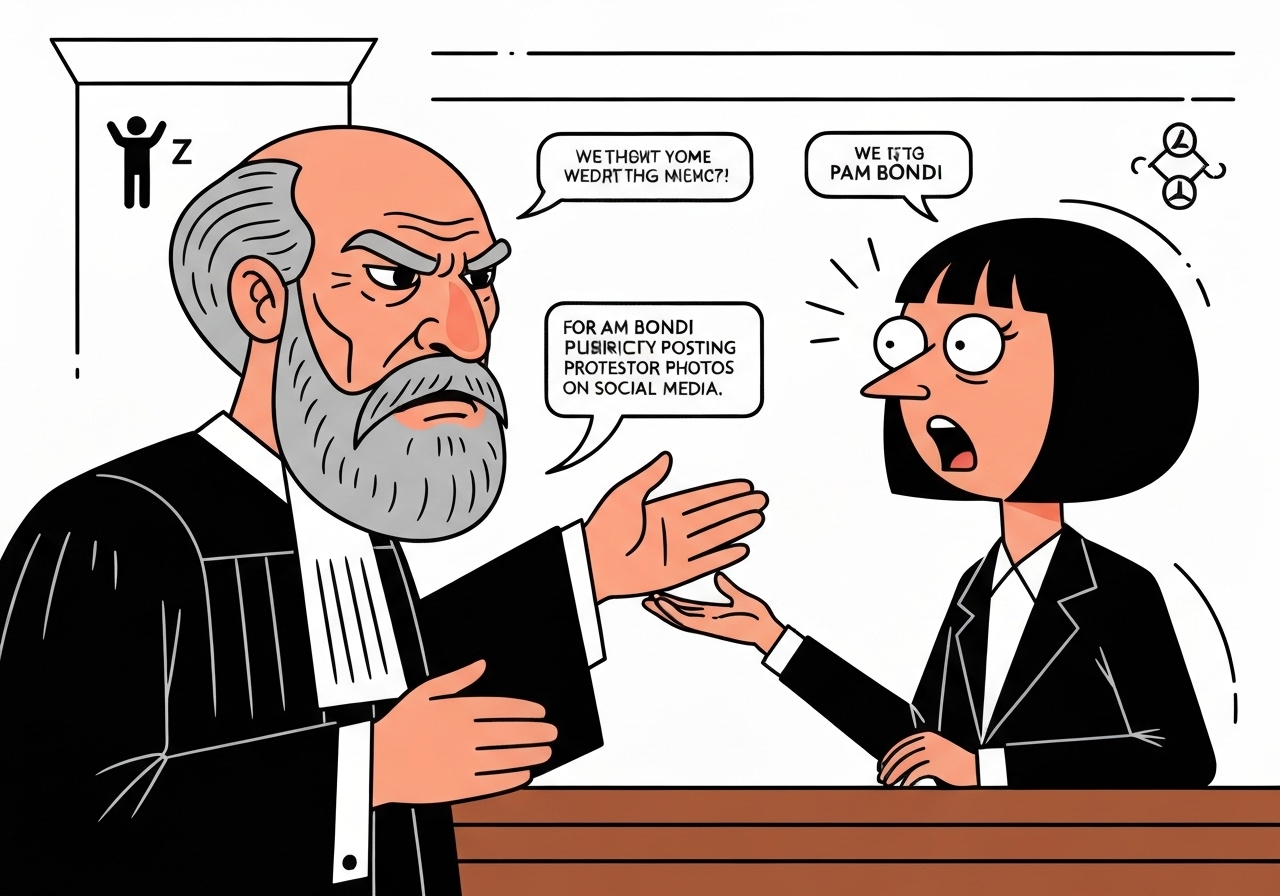
On Jan. 28, 2026, in a Minneapolis federal courtroom, U.S. District Judge Dulce J. Foster criticized Attorney General Pam Bondi for sharing images of defendants on social media after federal agents arrested protesters earlier that week. Sixteen people were charged Wednesday with assaulting immigration agents; Bondi posted photos of 11 of those charged and described some as “rioters.” The judge said publishing images of people who are presumed innocent is improper and that the court does not endorse that conduct. Prosecutors sought a protective order barring the defendants from contacting federal agents, but the judge declined because the agents’ identities were not disclosed.
Key Takeaways
- Sixteen protesters were formally charged in Minneapolis federal court on Jan. 28, 2026, with assaulting immigration agents during recent demonstrations.
- Attorney General Pam Bondi posted photographs of 11 defendants on social media shortly before the Jan. 28 hearing and labeled some as “rioters.”
- Judge Dulce J. Foster publicly rebuked the posting, saying the court does not condone sharing images of persons presumed innocent.
- Prosecutors asked for an order preventing defendants from contacting the federal agents they allegedly assaulted; the judge denied the request because agents’ identities were not revealed.
- About 50 people attended the hearing, and one arrestee experienced a seizure and required hospitalization.
- Defense counsel Lisa Lopez warned that Bondi’s social posts could endanger defendants who lack the same anonymity as masked agents.
- Family members reported injuries: Mohamed Ahmed, 55, said his daughter Nasra Ahmed suffered a concussion and was treated at a hospital.
Background
In recent months, protests and confrontations with federal immigration officers have drawn national attention and heightened scrutiny of law-enforcement tactics. Federal authorities in Minneapolis have pursued criminal charges in several demonstrations where agents say they were obstructed or assaulted. The Department of Justice has been publicly assertive about enforcing immigration-related statutes under the current administration, and senior officials have frequently commented on enforcement actions via public statements and social media.
Social-media posts by public officials have become a flashpoint in many cases where criminal defendants are also public figures or protesters. Courts have long guarded the presumption of innocence and limited extrajudicial commentary that might prejudice proceedings, but the speed and reach of online posts pose new challenges for judges, defense attorneys and prosecutors. Defense lawyers argue that identifying accused individuals publicly can expose them to harassment or threats before guilt is established.
Main Event
On Jan. 28, 2026, Judge Foster presided over an arraignment in which 16 people faced charges alleging they assaulted immigration agents. Earlier in the week, Bondi traveled to Minneapolis and shared photographs of 11 of the charged individuals via her social account, accompanying the images with language characterizing them as part of a violent crowd. The timing of the posts—hours before the arraignment—prompted immediate objections from defense counsel and concern from the bench.
At the hearing, prosecutors requested a protective order to bar defendants from contacting the federal officers they allegedly assaulted. Judge Foster refused to issue that order because prosecutors had not disclosed the names or identities of the agents, citing the court’s need for specific facts to justify such restrictions. The judge also addressed the public posting of images, calling it troubling in the context of pending criminal charges.
Defense attorney Lisa Lopez, representing several defendants, told the court that Bondi’s social-media post was “very dangerous,” arguing that exposing clients’ identities could subject them to retaliation or harassment. Family members in the gallery reacted emotionally as each defendant appeared; about 50 people attended, and one arrested woman suffered a seizure on the morning of the proceedings and was taken to a hospital.
Analysis & Implications
The judge’s rebuke highlights a growing legal tension: public officials increasingly use social media to comment on law-enforcement matters while courts strive to preserve fair trial rights. When a high-ranking official publicly identifies or labels accused individuals, it can complicate jury selection, defense strategy and the perception of judicial neutrality. That tension may spur judges to issue more frequent admonitions or, in future cases, gag or protective orders where social-media activity risks prejudicing proceedings.
Politically, the episode reflects broader dynamics in which prosecutions tied to protests are not merely legal events but also messaging opportunities for administrations. Bondi’s posts—and the explicit reference to the Justice Department’s commitment to enforcement—fit a pattern of officials linking criminal cases to policy aims. That linkage can bolster public perception of toughness on law enforcement but also invites judicial pushback when it appears to affect defendants’ rights.
Practically, defense teams will likely press for remedies when they perceive extrajudicial commentary by officials. Remedies can range from motions for change of venue or juror screening enhancements to requests for sequestration or more aggressive instructions to juries. Conversely, prosecutors may argue that public statements fall within protected free-speech or public-interest bounds; courts will have to balance those claims against the defendant’s right to an impartial adjudication.
Comparison & Data
| Item | Count |
|---|---|
| People charged at Jan. 28 hearing | 16 |
| Defendants whose photos Bondi posted | 11 |
| Attendees in courtroom gallery | ≈50 |
The simple numerical contrast—11 photos posted versus 16 charged—illustrates that Bondi’s social activity highlighted a subset of the accused. The presence of roughly 50 people in the gallery underscores the public and familial stakes for those facing charges. Courts will often weigh such public attention when considering measures to preserve fair trials and personal safety.
Reactions & Quotes
Judicial response was immediate and formal: Judge Foster addressed courtroom conduct and the implications of public commentary by officials.
This conduct is not something that the court condones.
Judge Dulce J. Foster
Defense counsel emphasized the potential harm of identifying defendants while law enforcement agents remain anonymous.
Sharing those photographs was very dangerous for my clients.
Lisa Lopez, defense attorney
A family member described the human impact: one defendant was hospitalized with a concussion after the encounter with agents.
I’m grateful she’s still alive.
Mohamed Ahmed, father of defendant
Unconfirmed
- No independent public record provided at the hearing confirmed the full scope of Bondi’s travel schedule in Minneapolis beyond her social posts.
- Claims that defendants faced targeted harassment online after the post were reported by defense counsel but lack comprehensive public documentation at this time.
Bottom Line
Judge Foster’s admonition underscores an enduring legal principle: courts are wary of extrajudicial commentary that may prejudice defendants. The episode illustrates how social media by senior officials can intersect with judicial process and raise questions about fairness, safety and the proper bounds of public comment during active cases.
In the short term, the most immediate effects will be procedural—defense teams may press for additional protections and judges may more carefully police public statements tied to pending matters. Long term, the incident may contribute to evolving courtroom norms and judicial guidance on how to handle high-profile social-media commentary from government figures.
Sources
- The New York Times (news report)