
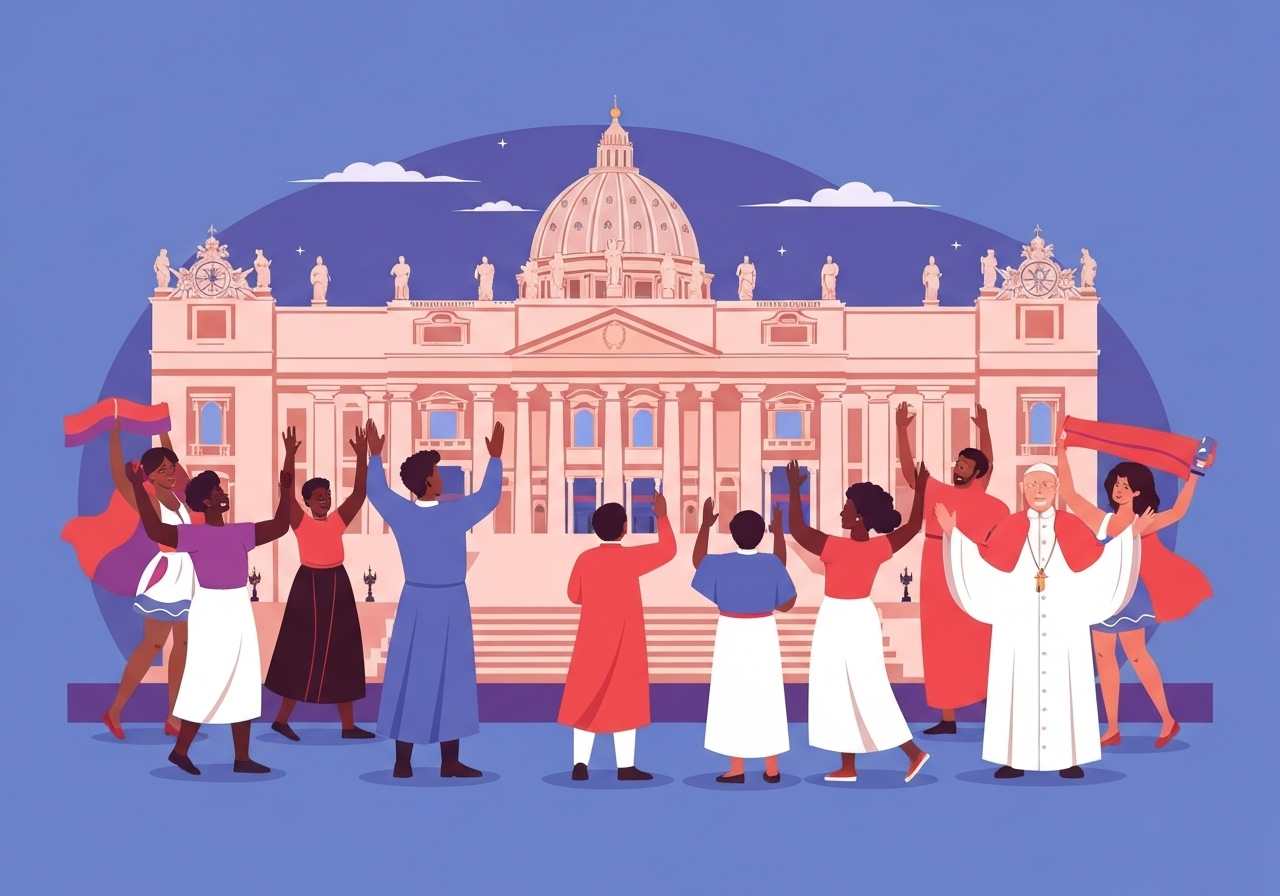
Who: Hundreds of L.G.B.T.Q. Catholics; When: Sept. 6, 2025; Where: St. Peter’s Basilica and a Jesuit church in Rome; What: a Jubilee pilgrimage through the Holy Door; Result: the group received a papal blessing through intermediaries though the pope did not meet them in person.
Key Takeaways
- About 1,400 pilgrims from 22 countries took part in an L.G.B.T.Q. Jubilee procession through St. Peter’s Holy Door.
- Pope Leo XIV did not receive the group personally but gave his blessing for a Mass celebrated for them.
- Bishop Francesco Savino framed the Jubilee as a moment to restore dignity to those historically excluded.
- Organizers say the pilgrimage appears on the Vatican calendar after years of dialogue with pastoral workers.
- Advocates contrasted this turnout with the church’s stance during the 2000 WorldPride and Pope John Paul II’s public criticism at the time.
- Pope Francis’s earlier tone shifts on inclusion helped create space for this event, even as doctrine on sexual acts remains unchanged.
Verified Facts
On Sept. 6, 2025, groups of L.G.B.T.Q. Catholics processed through St. Peter’s Basilica’s Holy Door as part of the Roman Catholic Church’s Jubilee year observances. Organizers reported roughly 1,400 participants representing 22 countries, who also gathered for a Mass at a Jesuit church in Rome.
Bishop Francesco Savino told attendees that Pope Leo XIV had given him permission to celebrate the Jubilee for these communities. In his homily Bishop Savino invoked the biblical meaning of Jubilee as a time to ‘‘free the oppressed and restore dignity,’’ a line that drew prolonged applause from those present.
While the Vatican calendar included the pilgrimage among many official Holy Year events, the pope did not receive the L.G.B.T.Q. delegation at the Jubilee audience, though he has met with individual advocates previously, including the Rev. James Martin earlier in the week.
The Catholic Church’s formal teaching on sexual acts remains unchanged; official texts still describe homosexual acts in critical terms. Yet Pope Francis’s papacy recalibrated tone and pastoral practice, from his 2013 remark about judgment to steps supporting ministerial outreach to L.G.B.T.Q. Catholics.
Context & Impact
The Jubilee procession is widely read as a sign of growing public inclusion within parts of the church after decades in which many L.G.B.T.Q. Catholics reported marginalization. Activists and pastoral workers see the Vatican’s acknowledgement of the pilgrimage as symbolic progress.
For comparison, in 2000 the Vatican publicly opposed WorldPride events in Rome; then-Pope John Paul II expressed strong disapproval. Organizers and long-time advocates framed Saturday’s pilgrimage as a reversal of the earlier exclusionary posture, though institutional doctrine and many bishops’ positions remain more conservative.
Practical impacts may be mixed: increased visibility could encourage pastoral outreach in dioceses, but doctrinal and disciplinary questions — for example, sacramental access and official blessings — will likely continue to provoke debate.
- Possible pastoral outcomes: more local ministries for L.G.B.T.Q. Catholics.
- Potential theological flashpoints: formal teachings on marriage and sacramental discipline.
Official Statements
Pope Leo XIV gave his blessing for the Jubilee celebration to be held for L.G.B.T.Q. Catholics, a move described by organizers as a gesture of welcome.
Bishop Francesco Savino / Italian Bishops Conference
Unconfirmed
- Longer-term policy changes inside the Vatican or the broader episcopal conferences as a direct result of this pilgrimage have not been announced.
- Claims that the event signals imminent doctrinal revisions are speculative pending formal statements by the pope or the Congregation for the Doctrine of the Faith.
Bottom Line
The Jubilee procession through St. Peter’s Holy Door marks a notable moment of recognition for many L.G.B.T.Q. Catholics, reflecting a pastoral shift in tone at the highest levels of the church even as core doctrine remains unchanged. Observers say the event may expand local pastoral initiatives, but institutional change will require sustained dialogue and formal decisions.