
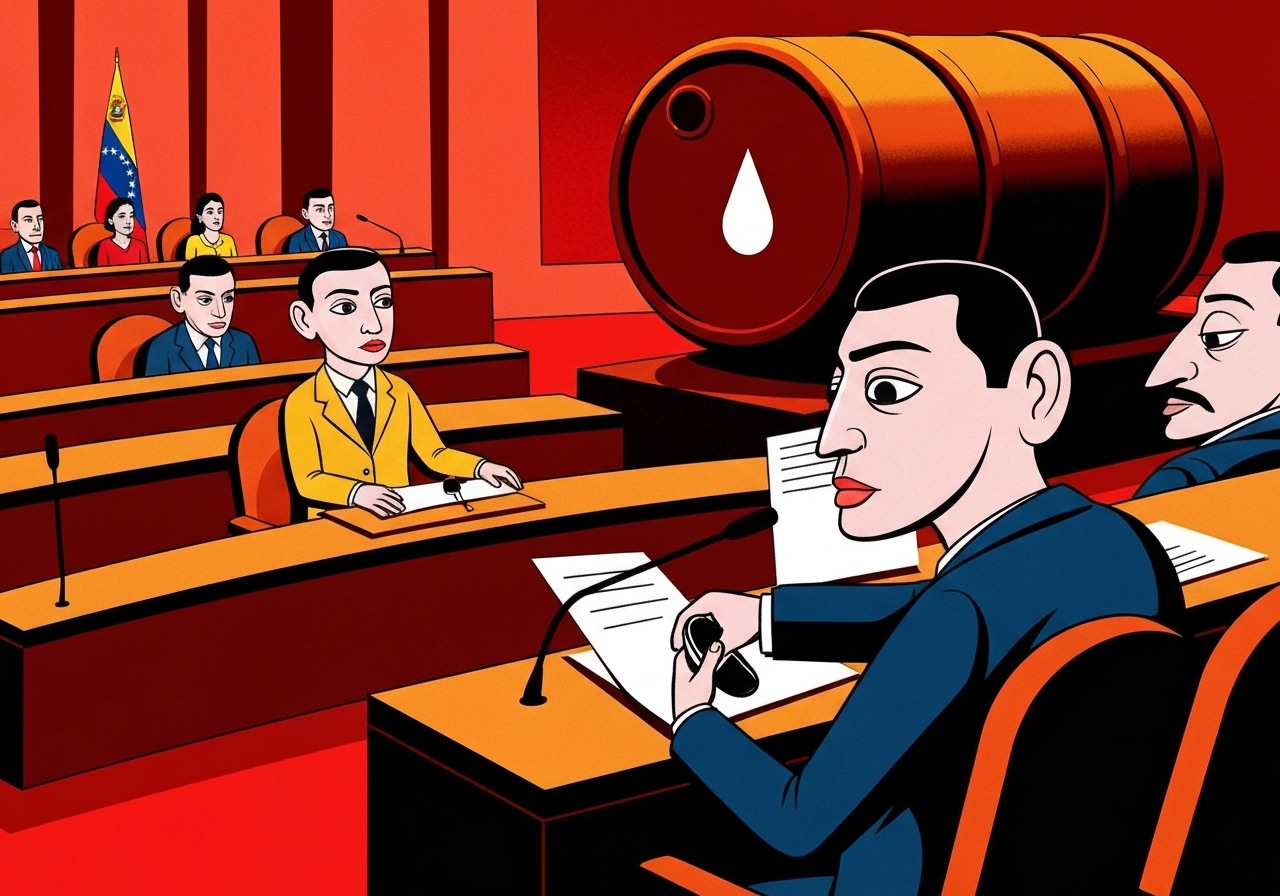
— Venezuela’s National Assembly approved a far-reaching revision of the country’s oil laws that grants foreign companies expanded operational control and opens the path to reduce royalties and taxes paid to the state. Lawmakers passed the measure amid intense international pressure and after a dramatic shift in Venezuela’s political leadership earlier in January 2026. The package preserves state ownership of Petróleos de Venezuela (PDVSA) but repositions the company beneath new contractual regimes that favor foreign partners. The vote marks a significant reversal of the 2007 nationalization that had placed PDVSA at the center of Venezuela’s oil policy.
Key Takeaways
- The National Assembly approved the overhaul on Jan. 29, 2026, changing the legal framework for oil projects and contracts.
- New provisions give foreign companies clearer operational control over production ventures while maintaining PDVSA as a state entity.
- The legislation permits arbitration in international forums, reducing reliance on Venezuela’s domestic courts for disputes.
- Provisions open the door to sharply lower royalties and taxes, though exact new rates remain to be set by implementing regulations.
- Experts say the reform reverses much of the 2007 nationalization that prompted departures by firms such as Exxon Mobil and ConocoPhillips.
- The vote occurred after a leadership change in Caracas in January 2026 and amid reported pressure from the United States.
- Investors welcomed elements of the package, but some had sought deeper privatization or breakup of PDVSA—requests not granted by the law.
Background
Venezuela’s oil industry was largely nationalized in 2007, a move central to the Chavista economic model that expanded state control over hydrocarbon resources. That nationalization prompted major U.S. and international oil companies to scale back or withdraw projects, reshaping decades of upstream partnerships. Over the past two decades, PDVSA functioned as both operator and a principal source of fiscal revenue, with contract and royalty terms designed to prioritize state take.
Tensions over Venezuela’s oil policy have long intersected with geopolitics. In January 2026, the country experienced a rapid political realignment following the removal of Nicolás Maduro from executive control and the elevation of Vice President Delcy Rodríguez to the presidency, an event widely reported and publicly linked to international pressure. Analysts say the new governing team moved swiftly to meet demands from foreign capitals and investors for clearer legal guarantees in oil operations.
Main Event
On Jan. 29, 2026, the National Assembly passed legislation that redefines contractual relations in Venezuela’s oil sector. The text provides foreign firms with explicit operational authority in joint ventures and project agreements, limiting PDVSA’s role to majority state ownership without exclusive operational control. Legislators framed the change as necessary to attract fresh capital and restart stalled projects.
Key legal changes include broad authorization for companies to choose dispute resolution in international arbitration tribunals and procedural provisions that could allow regulators to set lower royalty and tax rates than previous law permitted. The measure stops short of privatizing or splitting PDVSA, a compromise that sought to balance investor demands with political sensitivities surrounding state control over natural resources.
Government supporters argued the overhaul will unblock investment and boost production, while opponents warned that accelerated concessions to foreign firms could erode long-term public revenue. Implementation will depend on subsequent regulations, licensing rounds and how quickly the administration translates statutory language into operational contracts.
Analysis & Implications
The legal overhaul carries immediate economic and geopolitical implications. If authorities follow through with lower royalties and investor-friendly dispute clauses, Venezuela could see a faster inflow of capital and technical expertise that might increase output in the medium term. That outcome would relieve fiscal strain if production rises, but it would also reduce the state’s share per barrel unless volume gains fully offset lower per-unit take.
Politically, the reform signals a pragmatic pivot by the new leadership toward market-friendly policies. Retaining PDVSA under state ownership preserves symbolic control of resources, which may help stabilize domestic politics, but giving operational primacy to private partners could diminish the company’s technical and managerial centrality over time.
Regionally, analysts warn the move could recalibrate relations across Latin America. Countries that previously criticized Venezuela’s resource nationalism may welcome the shift, while domestic constituencies aligned with Chavismo may view concessions as a betrayal. International arbitration clauses also increase legal certainty for investors but raise the prospect of future claims against the state if disputes arise.
Comparison & Data
| Aspect | 2007 Framework | 2026 Overhaul |
|---|---|---|
| Operational control | PDVSA-led operations, limited partner control | Foreign partners may hold operational authority in many projects |
| State ownership | Strong state ownership and control | State ownership retained; operational roles eased for partners |
| Royalties & taxes | Higher state take by design | Permits regulatory reductions; rates TBD |
| Dispute resolution | Domestic courts emphasized | International arbitration explicitly allowed |
The table highlights qualitative shifts rather than firm numerical changes; final fiscal impacts will depend on implementing decrees, licensing terms and the speed of capital deployment. Market reaction will hinge on the clarity of new contract templates and the credibility of enforcement mechanisms.
Reactions & Quotes
“This reform is intended to modernize the sector and attract the investment needed to restore production,”
National Assembly (official statement, paraphrased)
The Assembly presented the measure as a practical step to revive output. Lawmakers emphasized the need for outside capital and technology to rehabilitate aging fields.
“We must open legal pathways that make long-term projects viable for international partners,”
Delcy Rodríguez, President of Venezuela (paraphrased)
In public remarks summarized by officials, the new president framed the overhaul as a sovereign decision to secure economic recovery while retaining formal state ownership of resources.
“Allowing arbitration abroad and clearer operational rules lowers political risk for investors, but the details will determine whether capital actually arrives,”
Independent energy analyst (paraphrased)
Energy specialists cautioned that high-level legal changes do not automatically translate into project finance; credible enforcement and transparent licensing are essential to convert legal openings into production gains.
Unconfirmed
- Precise new royalty and tax rates have not been published; the final fiscal package remains to be determined by implementing rules.
- Reports linking the January 2026 leadership change directly to specific U.S. military action are reported in some outlets; detailed, independently verifiable timelines and official confirmations are limited.
- The scale and timing of any incoming foreign investment commitments remain unclear until licensing rounds and contract templates are released.
Bottom Line
The Jan. 29, 2026 law represents a substantive legal pivot: it signals willingness by Venezuela’s legislature and new executive leadership to offer clearer operational roles and legal protections to foreign oil firms while stopping short of selling off PDVSA. The practical effect will depend on rapid, credible implementation—especially the setting of fiscal terms, the design of contract templates and the integrity of licensing processes.
Watch for three near-term indicators: the content of implementing regulations and model contracts, any announced licensing rounds or investor commitments, and how quickly production agreements move from negotiation to execution. Together, these will determine whether the overhaul delivers renewed output and fiscal relief or simply reshuffles contractual terms without changing on-the-ground production.
Sources
- The New York Times (news report)