
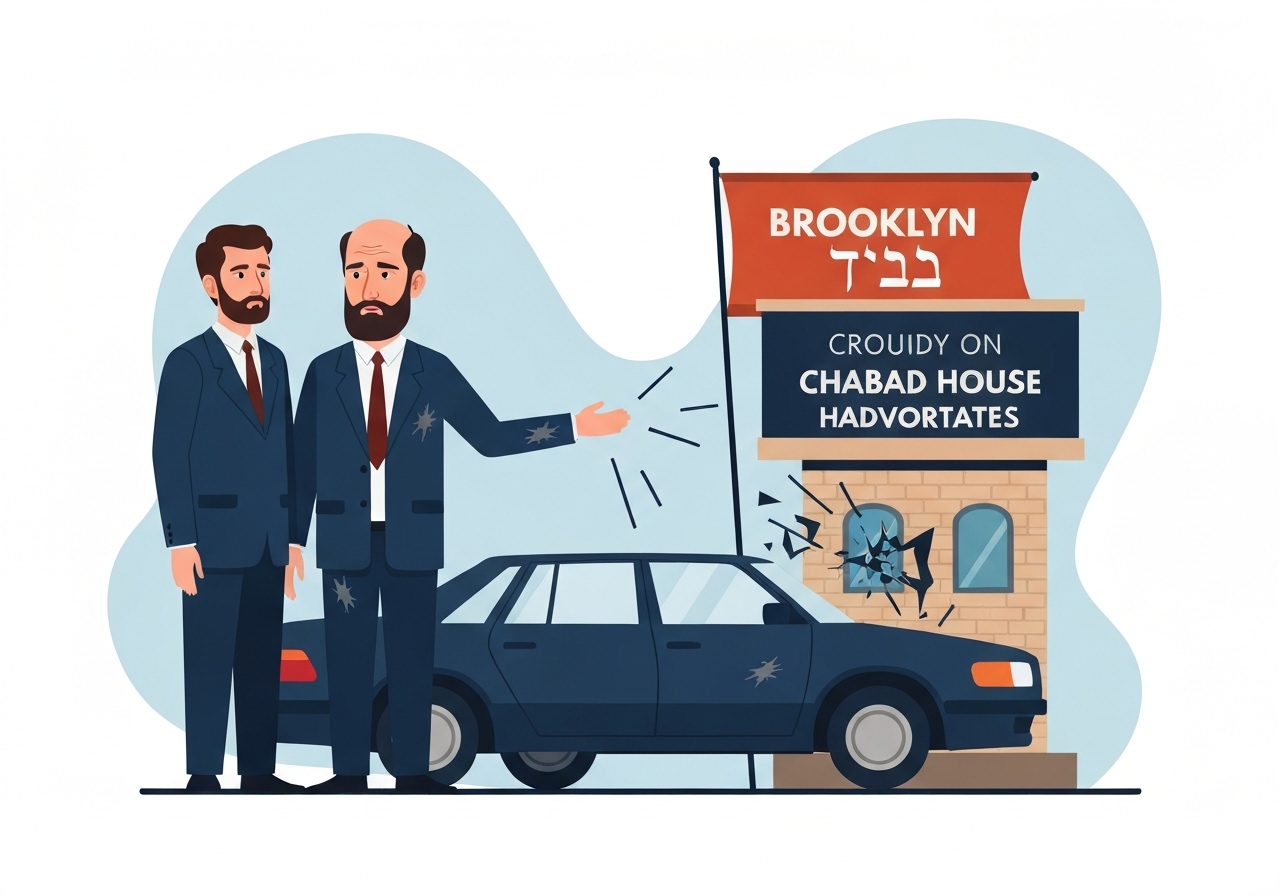
, New York City police charged 36-year-old Dan Sohail of New Jersey after he repeatedly drove his vehicle into the Chabad Lubavitch headquarters on Eastern Parkway in Crown Heights, Brooklyn. Authorities said Sohail faces counts of reckless endangerment and attempted assault, and that prosecutors are treating all four counts as hate crimes. City officials, including Mayor Zohran Mamdani, condemned the attack on the visibly marked Jewish institution and responded at the scene. People who knew Sohail — including his father and several Chabad rabbis — told reporters he had recently expressed an interest in converting to Judaism, while law enforcement officials described him as appearing emotionally disturbed during the incident.
Key Takeaways
- Suspect: Dan Sohail, 36, a New Jersey resident and former forklift driver, was charged on Jan. 29, 2026, by the New York City Police Department.
- Charges: Sohail faces reckless endangerment and attempted assault; police said all four counts are being pursued as hate crimes.
- Location: The vehicle was rammed repeatedly into the Chabad Lubavitch headquarters on Eastern Parkway in Crown Heights, Brooklyn.
- Official response: Mayor Zohran Mamdani visited the scene and local leaders publicly condemned the attack as antisemitic in nature.
- Witness accounts: Family members and Chabad clergy reported no prior outward hostility; several said Sohail had sought contact with synagogues and expressed a desire to convert.
- Mental state: Three law enforcement officials described the suspect as emotionally disturbed during the event; investigators are reviewing motive and mental-health factors.
- Public safety: No immediate fatalities were reported; charges emphasize both the risk to worshippers and the classification of the acts as hate-motivated.
Background
Chabad Lubavitch is an international Hasidic movement with a visible presence in Crown Heights, a Brooklyn neighborhood with a long, complex history of Jewish life and occasional tensions. The headquarters on Eastern Parkway serves as a central religious and community hub, hosting services, educational programs and holiday events year-round. Houses of worship in New York have been focal points for security concerns since a series of attacks and threats in recent years prompted expanded protective measures and heightened vigilance by local authorities. The city’s police and prosecutors have protocols for elevating violent acts against protected institutions to hate-crime designations when evidence supports bias motives.
Converting to Judaism is a multi-stage religious process that typically involves sustained study and rabbinic oversight; those who seek conversion often spend months or years engaging with community leaders. Officials and community members said the suspect had attended synagogues, religious schools and holiday events in New York and New Jersey in recent months, claiming interest in conversion or saying God instructed him to pray. Those contacts prompted both outreach by local rabbis and, in some cases, concern about his behavior, leading investigators to examine whether the actions were motivated by bias, personal distress, or a combination of factors.
Main Event
Police say the incident occurred on the evening of Wednesday, Jan. 28, 2026, when Sohail drove a vehicle to the Chabad headquarters and struck the building multiple times. First responders and detectives arrived after reports of a vehicle repeatedly ramming the structure; officers detained Sohail at the scene. Law enforcement officials described the building as a clearly marked synagogue, and investigators said they found evidence of deliberate strikes rather than an accidental collision.
Officials held a news conference the following day in Manhattan where Chief of Detectives Joseph Kenny announced the four counts against Sohail would be pursued as hate crimes. Kenny characterized the act as an attack on a Jewish institution and said investigators were treating the case with priority to determine motive and any wider risk. Prosecutors filed charges including reckless endangerment and attempted assault, emphasizing the potential danger to worshippers and staff inside the headquarters.
Witnesses and community leaders who interacted with Sohail in preceding months presented a mixed picture. Several Chabad rabbis and Sohail’s father told reporters that he had not exhibited overt antisemitic views and had expressed interest in conversion. At the same time, three law enforcement officials familiar with the probe said the suspect appeared emotionally disturbed during the incident, prompting investigators to examine medical and mental-health records as part of their inquiry.
Analysis & Implications
The classification of the charges as hate crimes signals a prosecutorial emphasis on bias as a potential motive and carries legal and symbolic weight. Hate-crime designations can lead to enhanced penalties and reflect a societal judgment about the targeted nature of violence; prosecutors will seek evidence that the suspect selected the building because it was a Jewish institution. If motive remains unclear, prosecutors may proceed with the existing charges while building a record that connects intent and the choice of target.
Beyond legal consequences, the incident underscores persistent security concerns for houses of worship in diverse neighborhoods. Religious institutions often balance openness with protective measures, and attacks of this nature renew debates about visible security, community outreach and law enforcement resources. Local leaders may press for increased patrols, surveillance support and coordination with federal agencies that monitor bias-motivated violence.
The suspect’s reported interactions with synagogues and statements about conversion complicate simple motive narratives. Cases in which individuals seek religious affiliation but later commit violence raise questions about mental health, radicalization, and the adequacy of community responses to troubling behaviors. Investigators will need to parse whether the acts arose from personal crisis, misdirected religious fervor, or an intentional act of bias; the distinction matters both for prosecution and for policy responses aimed at prevention.
Comparison & Data
| Item | Detail |
|---|---|
| Date | Jan. 28, 2026 |
| Location | Chabad Lubavitch headquarters, Eastern Parkway, Crown Heights, Brooklyn |
| Suspect | Dan Sohail, 36, New Jersey resident |
| Charges | Reckless endangerment, attempted assault — four counts treated as hate crimes |
The table above summarizes verified factual elements of the incident as publicly reported by police and city officials. Broader statistical comparisons to other bias-motivated incidents require caution: official hate-crime tallies are compiled annually by law-enforcement agencies and can lag, and definitions vary across jurisdictions. Nevertheless, authorities routinely reference past incidents when assessing risk to religious communities and considering resource allocations.
Reactions & Quotes
City leaders and community figures issued swift condemnations and calls for clarity about motive and safety. Officials emphasized protection for religious communities and the seriousness with which hate-related allegations are treated.
“He basically attacked a Jewish institution,”
Chief of Detectives Joseph Kenny, NYPD
The chief’s comment framed the law-enforcement view that the site was targeted as a synagogue rather than struck incidentally. Prosecutors echoed the need to establish motive while moving swiftly to hold the suspect accountable.
“Antisemitism will not be tolerated,”
Mayor Zohran Mamdani
The mayor visited the scene and used his presence to reassure the community; his statement emphasized both solidarity and the city’s intent to pursue justice. Community rabbis and Sohail’s father painted a more ambiguous portrait of the suspect’s recent behavior and religious interest, underscoring the investigatory challenge of separating intent from personal crisis.
Unconfirmed
- Whether the suspect intended to target the Chabad headquarters specifically because it was Jewish remains under investigation and has not been conclusively established.
- Claims that Sohail sought conversion to Judaism are supported by family and clergy accounts but do not by themselves explain motive or state of mind.
- Details about the suspect’s medical or psychiatric history have not been publicly released and are being examined by investigators.
Bottom Line
The incident at Chabad Lubavitch’s Crown Heights headquarters on Jan. 28, 2026, prompted immediate criminal charges and a hate-crime designation that signals both legal seriousness and community alarm. Key factual points — the suspect’s identity, the timing, and the charges — are public, while motive and mental-health context remain under active review. The case will test the ability of prosecutors to establish bias in a situation where personal religious interest and emotional disturbance are also reported.
For the local community, the event revives longstanding concerns about safety at houses of worship and the need for proactive protective measures. City officials and law enforcement have signaled they will pursue the case fully; observers should expect additional disclosures from investigators and prosecuting authorities as they compile evidence and determine next steps.
Sources
- The New York Times — news reporting (article summarizing police statements and community accounts)