
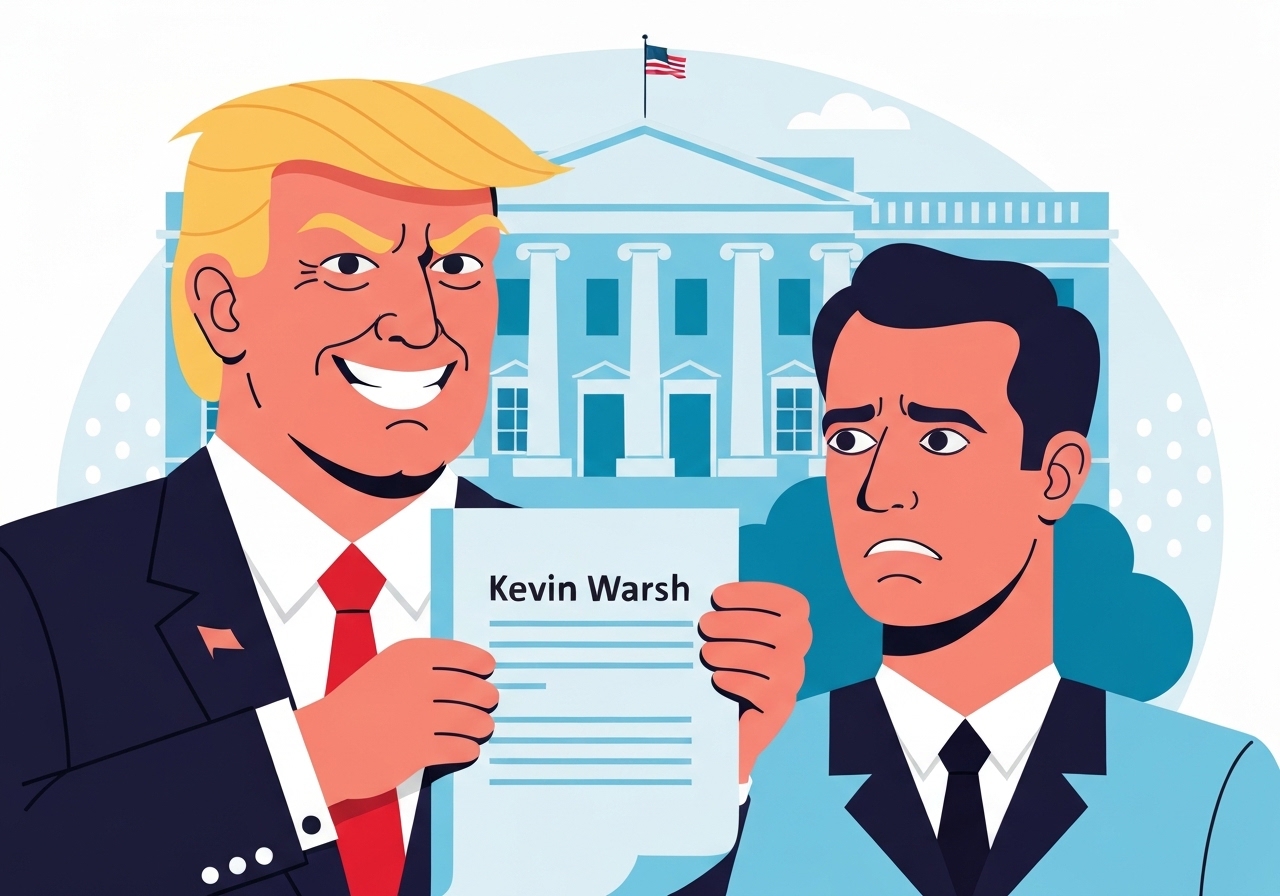
President Donald Trump is expected to announce Kevin M. Warsh as his nominee to replace Jerome H. Powell as chair of the Federal Reserve, with a public announcement slated for Friday after a Thursday White House meeting. Multiple people familiar with the plans told reporters the selection favors Warsh, a former Fed governor who was under consideration during Mr. Trump’s first term. The move, if formalized, would come as the Federal Reserve holds its target federal funds rate at 3.50–3.75 percent and follows repeated public pressure from Mr. Trump for much lower rates. No nomination is official until the White House makes the announcement and the Senate confirmation process begins.
Key Takeaways
- President Trump met with Kevin M. Warsh at the White House on Thursday ahead of a planned announcement Friday, according to people familiar with the matter.
- Warsh is a former Federal Reserve governor; he was widely discussed as a potential Fed chair earlier in Mr. Trump’s presidency.
- The Fed’s current target range is 3.50–3.75 percent (January 2026); the president has advocated cutting rates to about 1 percent.
- Mr. Trump has publicly criticized Jerome H. Powell’s rate decisions and will likely nominate someone perceived as more supportive of aggressive rate cuts.
- Any nomination will require Senate confirmation, creating a political test that could influence the Fed’s perceived independence.
- Markets will watch for shifts in guidance on inflation, labor markets and the timing of rate cuts if a new chair is confirmed.
Background
Kevin M. Warsh served as a governor of the Federal Reserve Board and has extensive experience in financial markets and policy circles; he was discussed as a potential Fed chair earlier in Mr. Trump’s presidency. Jerome H. Powell has led the Fed through a period of aggressive rate increases aimed at curbing inflation; his tenure made him a frequent target of the president’s criticism for resisting demands to lower borrowing costs. The Fed’s policy framework, established mandates and independence from day-to-day politics place the nomination and confirmation of a chair at the intersection of economic policy and partisan politics.
Interest-rate decisions since 2022 have been central to debates over inflation and growth in the United States; by January 2026 the Fed had maintained a target range of 3.50–3.75 percent after a recent pause. Presidents traditionally consider experience, views on inflation and economic growth, and likelihood of Senate confirmation when selecting a chair. Warsh’s previous tenure at the Fed and his standing in financial circles make him a recognizable figure to markets and lawmakers alike, which appears to factor into the White House’s reported preference.
Main Event
On Thursday, Mr. Trump met with Mr. Warsh at the White House; reporters were told an announcement would follow within days. Administration officials signaled the president would pick someone “known to everybody in the financial world,” language the president used to describe his expected selection. The reported choice recalls earlier deliberations in which Warsh was nearly selected during Mr. Trump’s first term, when the president ultimately named Jerome H. Powell instead.
The selection would represent an explicit shift away from Powell’s recent posture, which prioritized holding rates steady amid lingering inflation and labor-market strength. Mr. Trump has repeatedly urged the Fed to enact far deeper cuts—he has said he would prefer a policy rate near 1 percent—arguing that lower rates would reduce borrowing costs for consumers and the federal government. Fed officials argue their decisions respond to incoming data on inflation and employment rather than political pressure.
White House and anonymous administration sources emphasized that no selection is final until a formal announcement and subsequent nomination paperwork. If the president formally nominates Warsh, the Senate Banking Committee and the full Senate will undertake hearings and a confirmation vote, a process that can take weeks and involve rigorous questioning on monetary policy views and independence from political influence.
Analysis & Implications
A nomination of Warsh would likely be read by markets and analysts as a signal that the administration favors an easier monetary policy stance than the current Fed has maintained. Because Warsh has a long record in finance and government, investors may expect greater receptivity to rate cuts, which could lift risk assets and lower Treasury yields in the near term. However, expectations do not eliminate the procedural reality that the Fed’s policy committee will continue to set rates based on economic data and inflation trends.
The nomination process itself will test the boundaries of Fed independence. Senate confirmation hearings offer a forum to probe a nominee’s views on inflation targeting, the appropriate balance between price stability and full employment, and the role of fiscal policy. A politically charged confirmation could heighten scrutiny of the Fed and shape public perceptions about whether monetary decisions are being guided by data or politics.
Domestically, a confirmed chair who favors quicker rate reductions would ease borrowing costs for households and the federal government but could risk higher inflation if cuts occur prematurely. Internationally, lower U.S. rates could weaken the dollar and shift capital flows, affecting emerging markets and global financial conditions. Central banks abroad would likely monitor any policy pivot closely and respond as needed to maintain price stability and financial stability at home.
Comparison & Data
| Item | Value / Period |
|---|---|
| Federal funds target range (Jan 2026) | 3.50–3.75% |
| President’s stated preferred rate | ~1.00% |
| Jerome H. Powell | Fed chair (2018–2026) |
| Kevin M. Warsh | Former Fed governor (served in prior decade) |
The table above highlights the current policy rate band and the president’s publicly stated preference. The gap between the Fed’s operating range and the president’s target is substantial and would represent a notable policy divergence if enacted. Historical comparisons show that rapid, politically driven shifts in central-bank leadership can produce market volatility until policy clarity emerges.
Reactions & Quotes
Officials and commentators offered immediate, varied responses after reports of the expected selection.
“He is someone known to everybody in the financial world,”
President Donald J. Trump
The president used that phrase when asked by reporters about his forthcoming choice, underscoring the administration’s emphasis on a nominee with high name recognition in markets.
“No decision is final until an announcement has been made,”
Administration official (anonymous)
That comment reflected caution from people familiar with the deliberations and reiterated that a formal nomination and subsequent Senate review remain necessary steps.
“Markets will quickly parse the nominee’s record for signs of policy direction,”
Market strategist (industry analyst)
Analysts noted that Warsh’s past roles and public writings will be examined for indications of his approach to inflation and the timing of rate adjustments.
Unconfirmed
- Whether Mr. Warsh has formally accepted a nomination has not been publicly confirmed by the White House as of the latest reports.
- Specific policy commitments or a timetable for rate cuts under Warsh are not established and remain speculative until he outlines them in hearings or public statements.
- Market reactions and the Senate’s timetable for confirmation are uncertain and could change rapidly if additional information emerges.
Bottom Line
The reported expectation that Kevin M. Warsh will be named Fed chair signals a potential shift toward a leadership profile more favored by President Trump—one perceived as sympathetic to lower interest rates. If nominated and confirmed, the new chair would face the immediate task of balancing political expectations, incoming economic data and the Fed’s institutional mandate. Markets will focus on confirmation hearings and any early guidance from the nominee to assess the likely timing and scale of rate changes.
Until the White House issues a formal nomination and the Senate completes confirmation, the report remains a pivotal development with tangible consequences for monetary policy, fiscal costs, and international financial conditions. Observers should watch the official announcement, Warsh’s public statements, and the composition of questions in Senate hearings to judge how policy might evolve.
Sources
- The New York Times — news report on expected selection and White House meeting (media)
- The White House — official statements and nomination process information (official)
- Board of Governors of the Federal Reserve System — background on Fed structure, mandate and current policy rates (official)