
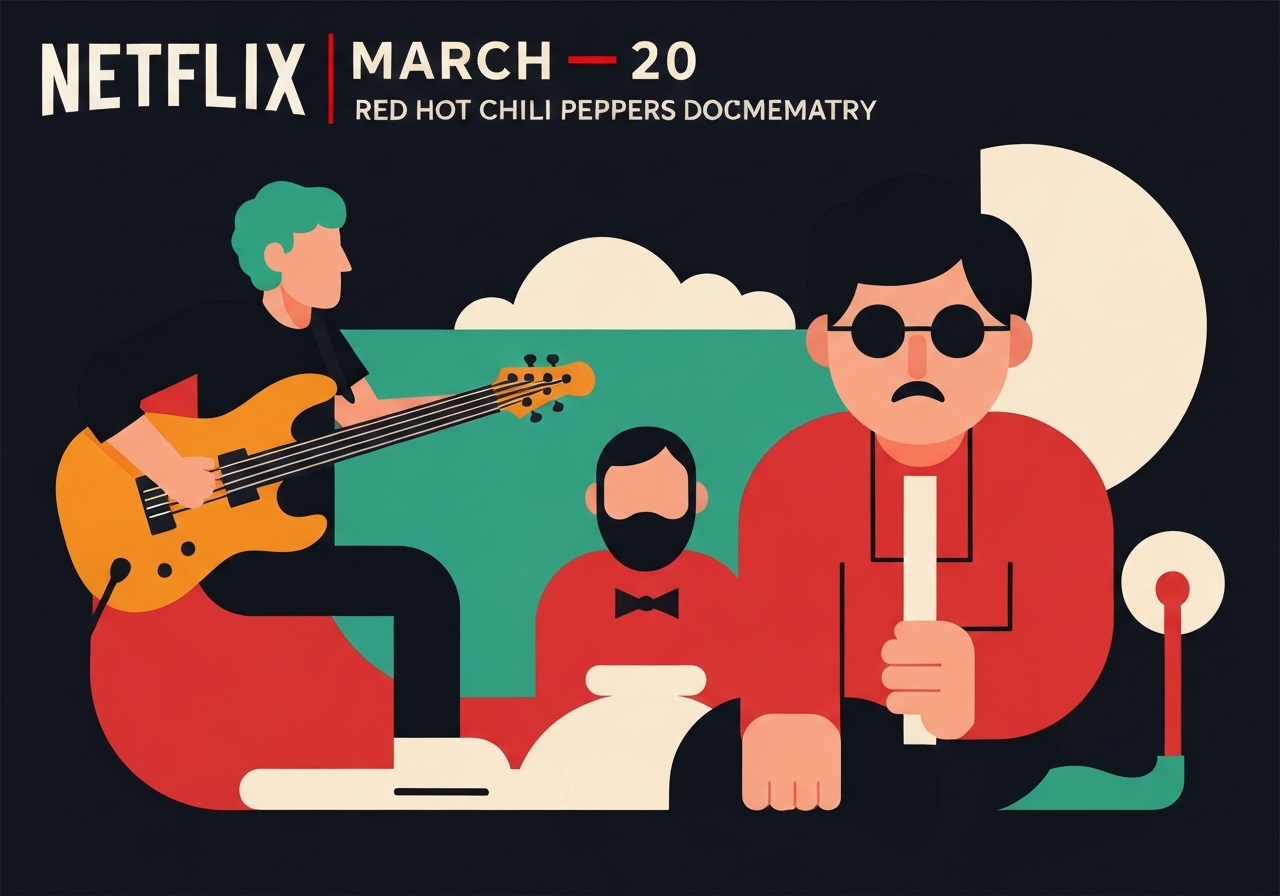
Lead: Netflix will debut a feature documentary on the Red Hot Chili Peppers on March 20, focusing on the band’s early years and the influence of original guitarist Hillel Slovak, who died in 1988. Directed by Ben Feldman, the film draws on new interviews with core members including Flea and Anthony Kiedis and promises intimate archival material. Produced by Asta Entertainment, Submarine Entertainment and Polygram Entertainment, the film was quietly screened at Cannes last year before landing at Netflix. The documentary frames the band’s youth friendships as central to their music and longevity.
Key Takeaways
- Premiere date: Netflix will release the documentary on March 20, 2026.
- Director and creative lead: Ben Feldman, known for “Bug Out” and “Rich & Shameless,” directed the film.
- Focus: The film examines the band’s formative Los Angeles years and the role of guitarist Hillel Slovak (d. 1988).
- Featured interviews: The documentary includes on-camera contributions from Flea and Anthony Kiedis and people close to Slovak.
- Production credits: Produced by Asta Entertainment, Submarine Entertainment and Polygram Entertainment; Marc D’Agostino is a credited producer and John Tarquinio is the editor.
- Executive producers: Dan Braun, Josh Braun, David Blackman, James Slovak and Ben Feldman are listed as executive producers.
- Commercial context: The Red Hot Chili Peppers have sold more than 120 million records over a career spanning more than 40 years.
- Festival run: The film had a secret screening at Cannes in 2025 and subsequent invite-only showings in Los Angeles and New York before the Netflix acquisition.
Background
The Red Hot Chili Peppers formed in Los Angeles in the late 1970s and crystallized in the 1980s into a band that married funk, punk and melodic rock. Hillel Slovak, an original guitarist, was an early creative force whose death in 1988 left a lasting imprint on the group’s trajectory and lore. Across four decades the band built a global audience with hits such as “Under the Bridge” and “Californication,” reaching sales above 120 million records worldwide.
The new documentary situates the group’s rise within Los Angeles’s vibrant and often volatile music scenes of the 1980s, tracing friendships formed in adolescence and the DIY networks that helped the band gain early traction. Producers Asta and Submarine have previously worked on music-focused documentaries, and Polygram Entertainment brings archival and distribution experience to the project. The Cannes screening last year suggests buyers and festival programmers saw early commercial and critical potential.
Main Event
Directed by Ben Feldman, “The Rise of the Red Hot Chili Peppers” concentrates on the band’s gritty early period and the creative role Hillel Slovak played before his death in 1988. Feldman assembled interviews with surviving members Flea and Anthony Kiedis, plus associates and friends who witnessed the band’s transformation from local act to international phenomenon. The film reportedly blends interview testimony with previously unseen footage and studio-era material to reconstruct the group’s first decade.
Production credits list Marc D’Agostino as a producer and John Tarquinio as editor, with executive producers Dan Braun, Josh Braun, David Blackman, James Slovak and Feldman. After an unannounced screening at the 2025 Cannes Film Festival, the documentary had invite-only showings in Los Angeles and New York, where industry attendees and select press viewed the completed film. Those private sessions preceded Netflix acquiring global rights and scheduling the March 20 premiere.
Netflix’s platform release will give the documentary immediate worldwide reach, moving the film from festival circuits and exclusive screenings into mass streaming rotation. For longtime fans the film offers a concentrated account of the band’s origins; for new listeners it functions as a narrative primer on how youth bonds and L.A.’s music ecosystem shaped the group’s sound and public identity.
Analysis & Implications
The documentary arrives at a moment when legacy acts lean on visual storytelling to reframe careers for streaming audiences. For Red Hot Chili Peppers, whose catalogue spans 40+ years and 120 million-plus sales, a Netflix premiere amplifies catalog discovery and could stimulate streaming plays and catalog sales. Platforms today can turn archival narratives into commercial uplift: past examples show that documentary exposure often correlates with renewed chart activity and licensing interest.
Artistically, the film’s focus on Hillel Slovak may recalibrate public understanding of the band’s early sound and contributions. Slovak’s role, often discussed in fan and critical circles, is here placed at the center of the origin story, which could influence future retrospectives, reissues or anniversary projects. The presence of family members (James Slovak among executive producers) suggests access to private materials and an emphasis on trusted stewardship of the subject matter.
From a rights and distribution perspective, the film’s quiet festival-to-deal path reflects a cautious sales strategy: secret Cannes showings and invite-only viewings limit early exposure while allowing producers to test responses among buyers and influencers. Netflix’s acquisition indicates confidence in both audience appeal and the documentary’s commercial utility for the platform’s music-leaning documentary slate.
Comparison & Data
| Metric | Red Hot Chili Peppers | Context |
|---|---|---|
| Career span | 40+ years | Active since early 1980s |
| Record sales | 120+ million | Global cumulative sales |
| Key events covered | Formative years, Hillel Slovak (d. 1988) | Focus of the documentary |
The table above places core figures from the doc into context: longevity and commercial scale explain why a major streamer would invest in a dedicated feature. Archival documentaries frequently highlight pivotal early years; here, Slovak’s 1988 death functions as both a narrative hinge and a focal point for interviews and archival retrieval.
Reactions & Quotes
Filmmaker Ben Feldman framed the project as a human story about friendship and creative bonds, thanking the band and Slovak’s family for access. Festival reactions were reportedly positive in private screenings, and industry attendees flagged the film’s archival depth during invite-only showings.
“At its heart, this is a deeply relatable story — about the friendships that shape our identities and the lasting power of the bonds forged in adolescence.”
Ben Feldman, director
In his public statement Feldman also expressed gratitude for the band’s cooperation and family permissions, underscoring the documentary’s personal access to memories and materials.
“I’m profoundly grateful to the band and to Hillel’s family for their trust and generosity, and to Netflix for helping bring this story to the world stage.”
Ben Feldman, director
Critical and public commentary ahead of the March 20 launch is expected to focus on how the film balances fandom, biography and archival evidence. Early trade response noted the film’s potential to reintroduce the band’s early catalog to younger listeners via Netflix’s global platform.
Unconfirmed
- Whether the documentary contains unreleased studio recordings or fully uncirculated footage remains unconfirmed and has not been detailed by producers.
- Full list of interviewees beyond Flea and Anthony Kiedis has not been publicly disclosed, so the presence of other prominent members (current or former) is unconfirmed.
- Any coordinated marketing tie-ins, reissues or catalog campaigns timed to the March 20 release have not been announced.
Bottom Line
Netflix’s acquisition and March 20 release of the Red Hot Chili Peppers documentary turns a private festival title into a global streaming event. The film’s emphasis on Hillel Slovak and the band’s adolescent friendships reframes familiar hits within a personal origin story that may broaden listener engagement and spur renewed interest in the band’s catalogue.
For fans and music historians, the documentary promises new context about the band’s early chemistry; for Netflix, it is another entry in a growing library of music documentaries that can generate both viewership and downstream music consumption. Watchers should expect further announcements about supplemental materials, interviews and platform promotion as the premiere approaches.