
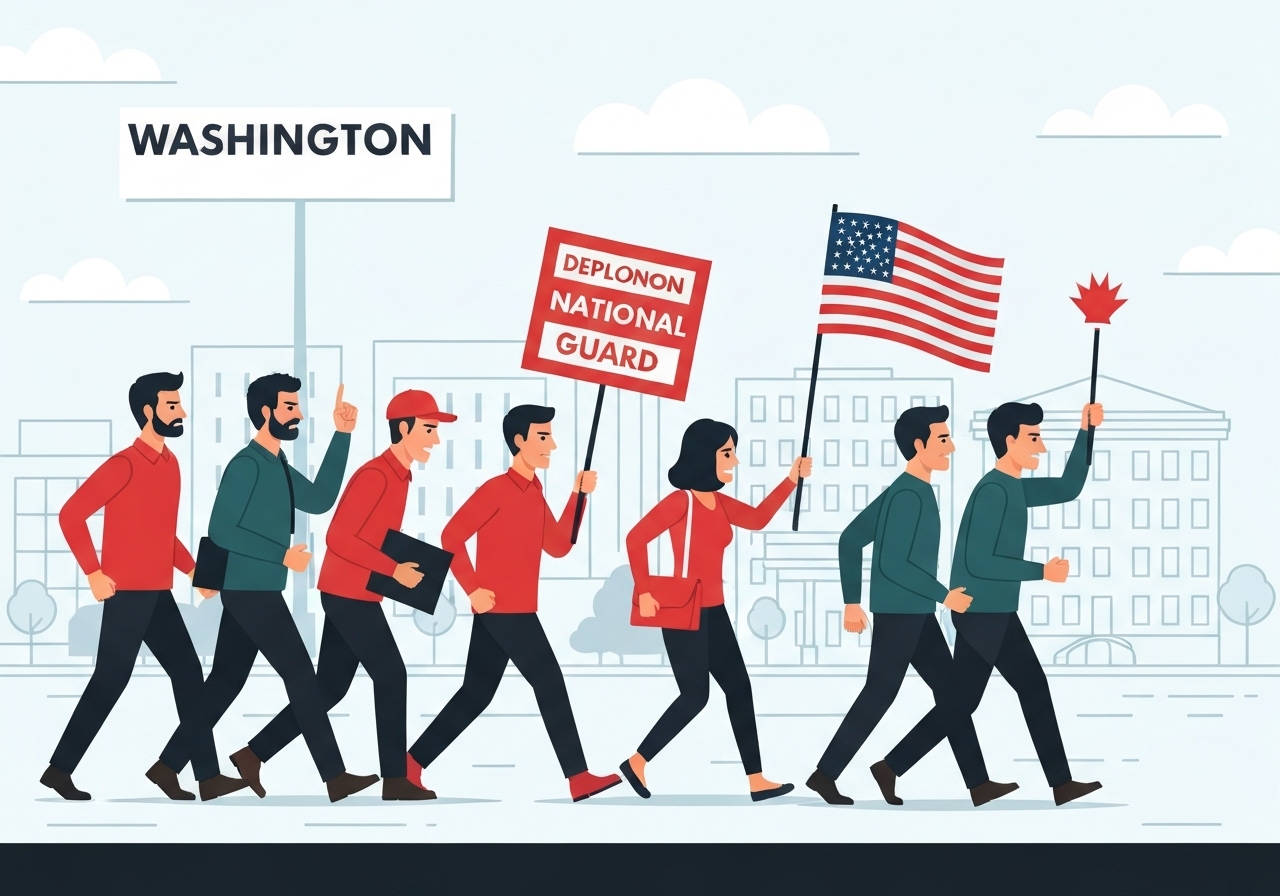
Several thousand people marched in Washington, D.C., on Sept. 6 to demand an end to the National Guard and federal law enforcement presence after the White House ordered troops and federal agents onto the capital’s streets; the protest comes as legal and political challenges to the deployment escalate.
Key takeaways
- Thousands joined the “We Are All D.C.” march on Sept. 6 opposing the National Guard patrols.
- More than 2,000 troops from six Republican-led states are reported to be patrolling the city.
- Washington, D.C. Attorney General Brian Schwalb filed a lawsuit seeking to block the deployment as unconstitutional.
- Justice Department data shows violent crime in Washington reached a 30-year low in 2024.
- Mayor Muriel Bowser has said crime has fallen in some areas since the surge but wants the mission to end.
- President Trump signaled broader plans to use troops in other cities and posted a provocative social-media message about deportations.
- Officials including Illinois Governor J.B. Pritzker raised alarms about ICE agents and military vehicles being gathered for potential deployments.
Verified facts
The demonstration, billed as the “We Are All D.C.” march, included a cross-section of residents: undocumented immigrants, activists supporting Palestinian statehood, and other local protesters chanting against the federal presence. Organizers and participants demanded that National Guard troops and federal policing units leave neighborhood streets.
Federal and local officials report that more than 2,000 National Guard members are currently in the capital, including personnel mobilized from six Republican-led states. The U.S. Army extended activation orders for the D.C. National Guard through November 30, 2025. It remains unclear whether that timeline will be shortened or extended further.
| Item | Detail |
|---|---|
| Troop count | More than 2,000 |
| Source states | Six Republican-led states |
| Order extended to | November 30, 2025 |
| Crime data | Violent crime in 2024 at a 30-year low (Justice Department) |
Washington’s Metropolitan Police Department was placed under direct federal control as part of the federal surge. Federal agencies, including agents from Immigration and Customs Enforcement (ICE), have been visible alongside military and National Guard units. Some neighborhoods reported an increased uniformed presence primarily downtown and near tourist sites.
Context & impact
The deployment marks an unusual use of federal forces in the seat of government. The D.C. National Guard is unique in that the president can directly activate it; the National Guard units of the 50 states typically answer to state governors unless federalized.
Political reactions have split along predictable lines. Mayor Muriel Bowser acknowledged reductions in certain crimes and signed an executive order to coordinate city and federal responses, while the D.C. Attorney General’s lawsuit contends the deployment violates constitutional and federal statutory limits on control of the district.
President Trump has framed the deployments as measures to “re-establish law, order, and public safety,” and also threatened similar actions in other Democratic-led cities. In a social-media post parodying a film line, he wrote about deportations and accompanied the post with a stylized military image, which independent observers described as apparently AI-generated.
Local residents are divided: some welcomed added security and urged patrols in higher-crime, less-affluent neighborhoods, while many activists and civil liberties groups criticized the move as federal overreach into a self-governing district.
Political and legal stakes
- The D.C. Attorney General’s lawsuit aims to halt the deployment on constitutional grounds.
- Illinois officials signaled they would resist any unilateral federal troop deployments in Chicago, foreshadowing likely legal conflicts.
- Public opinion in the district will shape how local leaders navigate cooperation with federal forces and litigation strategy.
Official statements
“I hope the National Guard’s mission will end soon,”
Mayor Muriel Bowser
“I love the smell of deportations in the morning,”
Donald J. Trump (social-media post)
Unconfirmed
- Whether the stylized military image posted by the president was generated by artificial intelligence is described by observers as apparent but has not been independently verified.
- Plans to deploy National Guard units to Chicago or other cities remain unfinalized and are likely to face legal and political challenges.
- The precise end date for all federal forces in D.C. beyond the Army order through Nov. 30, 2025, is not publicly set.
Bottom line
The Sept. 6 march underscored deep local resistance to a high-profile federal security posture in the capital. With a lawsuit filed by the D.C. attorney general, mixed messages from city officials, and the president signaling broader use of troops and federal agents, the dispute is poised to continue as both legal proceedings and public debate unfold.