
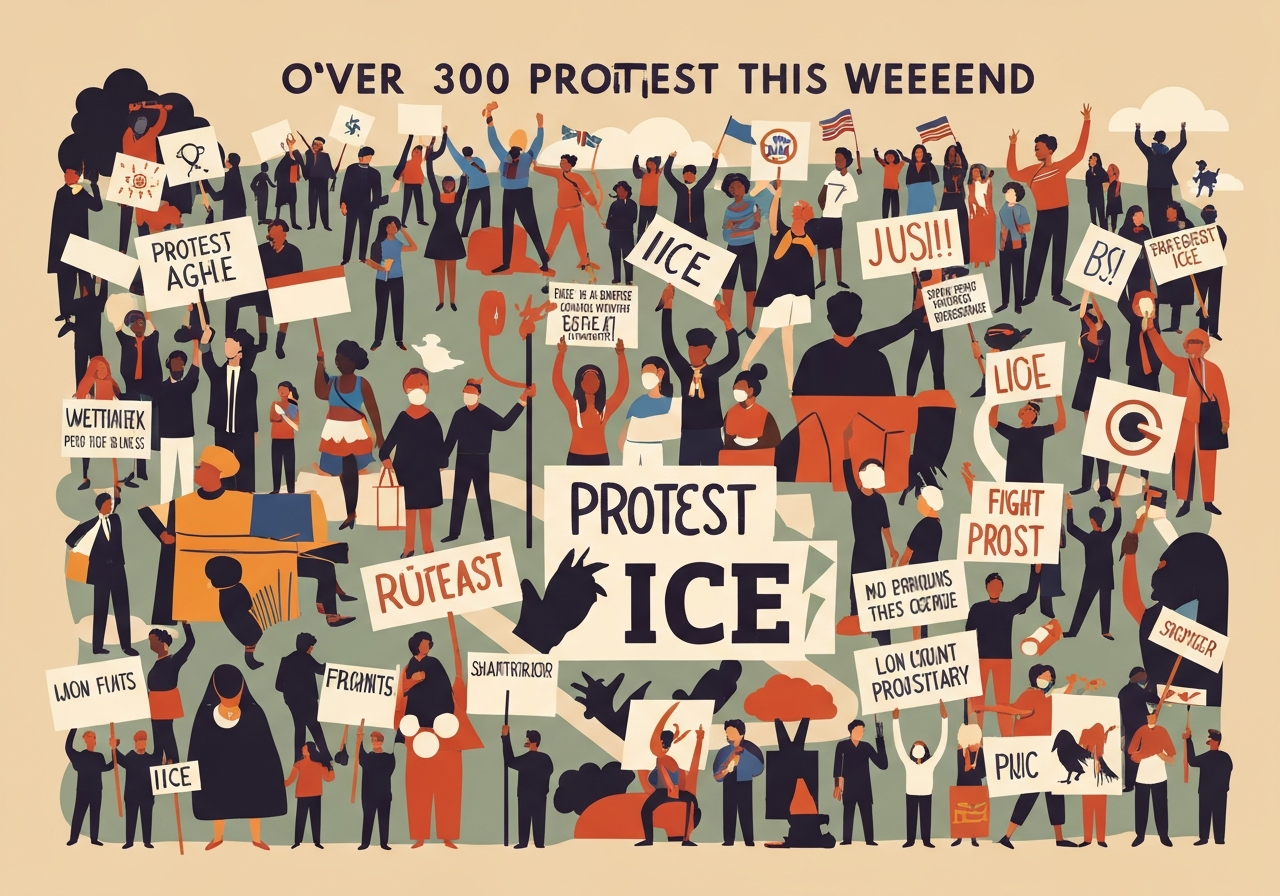
Organizers say more than 300 demonstrations are scheduled across all 50 states and Washington, D.C., this weekend in a national day of action they call “ICE Out of Everywhere.” The protests, coordinated by the grassroots group 50501, were announced as a response to several recent deaths involving federal immigration agents, including the fatal shootings of Alex Pretti and Renee Good in Minneapolis this month, the death of Geraldo Campos at a Texas detention facility, and the shooting of Keith Porter Jr by an off-duty ICE officer in Los Angeles. Actions planned for the day include vigils, marches, overpass banner drops, community trainings, and protests at ICE facilities, field offices, congressional district offices and airports. Organizers say the events aim to pressure elected officials and corporate partners that they say enable federal deportation operations.
Key Takeaways
- Organizers with 50501 expect more than 300 separate events across all 50 states and Washington, D.C., on the national day of action.
- The mobilization follows a series of deaths cited by activists: Alex Pretti and Renee Good in Minneapolis (January), Geraldo Campos in a Texas detention center, and Keith Porter Jr in Los Angeles.
- Planned tactics include vigils, overpass banners, sidewalk protests, marches, community trainings and demonstrations at airports and hotels linked to deportation logistics.
- Some protests will target specific companies—organizers named Global Crossing Airlines, Target and Home Depot—as part of economic pressure campaigns such as “No Housing for ICE” and “#DontServeICE.”
- Protesters are urging Congress to block Department of Homeland Security (DHS) funding until ICE and Customs and Border Protection (CBP) are removed from communities; Democrats are negotiating spending bills while keeping separate ICE reforms under discussion.
- Recent large actions included a January 23 Minneapolis march with tens of thousands of participants and a January 30 national day of stoppages and local shutdowns across hundreds of sites.
Background
ICE (Immigration and Customs Enforcement) has been a flashpoint in U.S. politics for years, with critics pointing to expanded detention capacity, workplace and street enforcement operations, and a growing number of confrontations with civilians. The current wave of protests has intensified after several high-profile incidents this month that organizers say reveal patterns of excessive force and systemic abuse. 50501, a national grassroots coalition, and allied faith and community groups have organized nationwide days of action before; this weekend’s events build on tactics that combine street demonstrations with targeted economic and political pressure.
Politically, the protests intersect with a fraught congressional moment. Lawmakers are negotiating spending bills to avoid a partial government shutdown, and on Thursday Democratic senators advanced several measures to keep some agencies funded while pressing for reforms. Activists argue that funding must be conditioned on structural changes to ICE and independent oversight, a demand that aligns with some progressive members of Congress but faces resistance from others who prioritize border enforcement and immigration control.
Main Event
On the day of action, organizers say demonstrations will be visible near ICE detention centers, field offices, congressional district offices and major airports—from Los Angeles and Minneapolis to smaller towns in Tennessee and Maine. Tactics described by organizers include vigils for those killed or detained by ICE, banner drops on highway overpasses, sidewalk protests, and public trainings to help people document ICE activity and pressure elected officials. In several cities, protesters plan to gather outside hotels accused of housing enforcement staff during operations and at airline counters linked to deportation flights.
In Los Angeles and Minneapolis, local leaders have framed the weekend as a continuation of recent mobilizations after the shootings and deaths that triggered widespread outrage. Organizers say they have coordinated with faith groups, student networks and labor allies to sustain turnout and broaden impact. They also emphasize nonviolent civil-disobedience training and legal-observation efforts intended to document interactions between demonstrators and law enforcement or federal officers.
Economic actions form a central part of the strategy. “No Housing for ICE” asks the public to boycott hotels that contract with enforcement operations, post negative reviews and pressure management. The “#DontServeICE” campaign encourages small businesses to refuse service to federal immigration agents. Organizers have singled out retailers such as Target and Home Depot, saying ICE has detained shoppers and employees at or near those stores in the past year.
Analysis & Implications
The scale of the planned demonstrations—300-plus events nationwide—signals a coordinated escalation in tactics by grassroots organizers aiming to convert local anger into sustained national pressure. If turnout mirrors organizers’ expectations, the visible political cost to elected officials and corporate partners could grow, particularly in districts where activists have already mobilized mass actions like the January 23 Minneapolis march. That pressure could push some Democrats to press harder for binding reforms to ICE oversight as spending negotiations proceed.
For Congress, the protests add a public-facing dynamic to otherwise technical funding talks. Activists want DHS appropriations conditioned on the removal or reconfiguration of ICE and CBP roles in communities, plus independent investigations and a code of conduct. Those demands are unlikely to be satisfied in full in the near term, but they may influence appropriations riders, oversight hearings, and public messaging from lawmakers who represent protest-heavy districts.
Corporations named by organizers face reputational and operational risks if demonstrations lead to sustained consumer pressure. Hotels, airlines and retailers may find it costly to be seen as enabling deportation operations, prompting them either to revisit contracts and policies or increase public relations efforts to clarify their roles. Local governments will also be tested on whether they support de-escalation and independent probes or prioritize collaboration with federal enforcement to maintain operations.
Comparison & Data
| Date | Event | Approx. Scale |
|---|---|---|
| 7 January 2026 | Shooting of Renee Good (Minneapolis) | — |
| 23 January 2026 | Minneapolis march | Tens of thousands |
| 30 January 2026 | National shutdown actions | Hundreds of local actions |
| 31 January 2026 | Planned national day of action | 300+ events across 50 states + D.C. |
The table shows how the current weekend’s activity follows a string of increasingly large, coordinated demonstrations. Organizers have moved from single-city mobilizations to synchronized national actions and mixed street tactics with economic campaigns aimed at corporate and logistical partners of federal enforcement.
Reactions & Quotes
Organizers framed the weekend as the next phase of a sustained campaign. Hunter Dunn, a national press coordinator for 50501, described the mobilization as an outgrowth of earlier actions and growing public awareness.
The national day of action is about fighting back against the escalations that the Trump administration has taken against the American people over the past year.
Hunter Dunn, 50501 (organizer)
Faith and community leaders emphasized persistence and accountability. At a press conference in Minneapolis, a co-executive director of the interfaith group Isaiah urged continued public pressure until agencies change course.
We need more people to continue to show up until ICE leaves.
Janae Bates Imari, Isaiah (interfaith organizer)
Unconfirmed
- Exact nationwide turnout figures for the weekend’s 300+ events have not been independently verified and will vary by site.
- Details of contractual arrangements between specific hotels or airlines and ICE (or other federal agencies) cited by organizers are not fully public and vary by locality.
- Investigations into the incidents referenced (including legal outcomes or determinations of misconduct) remain in process for some cases and are not all settled.
Bottom Line
This weekend’s planned actions represent a coordinated escalation by activists responding to recent deaths tied to federal immigration actors and a continuation of weeks of nationwide organizing. The combination of street demonstrations, targeted economic pressure, and demands tied to DHS funding creates multiple levers for influence—political, legal and commercial—that could shift public debate even if immediate policy changes are limited.
How lawmakers and corporate actors respond in the coming days and weeks will shape whether these protests translate into formal reforms, altered contracting practices, or intensified local-federal friction. For now, the actions put a public spotlight on ICE operations and the broader debate over immigration enforcement and accountability.
Sources
- The Guardian — news media report detailing planned nationwide protests and organizer statements.