
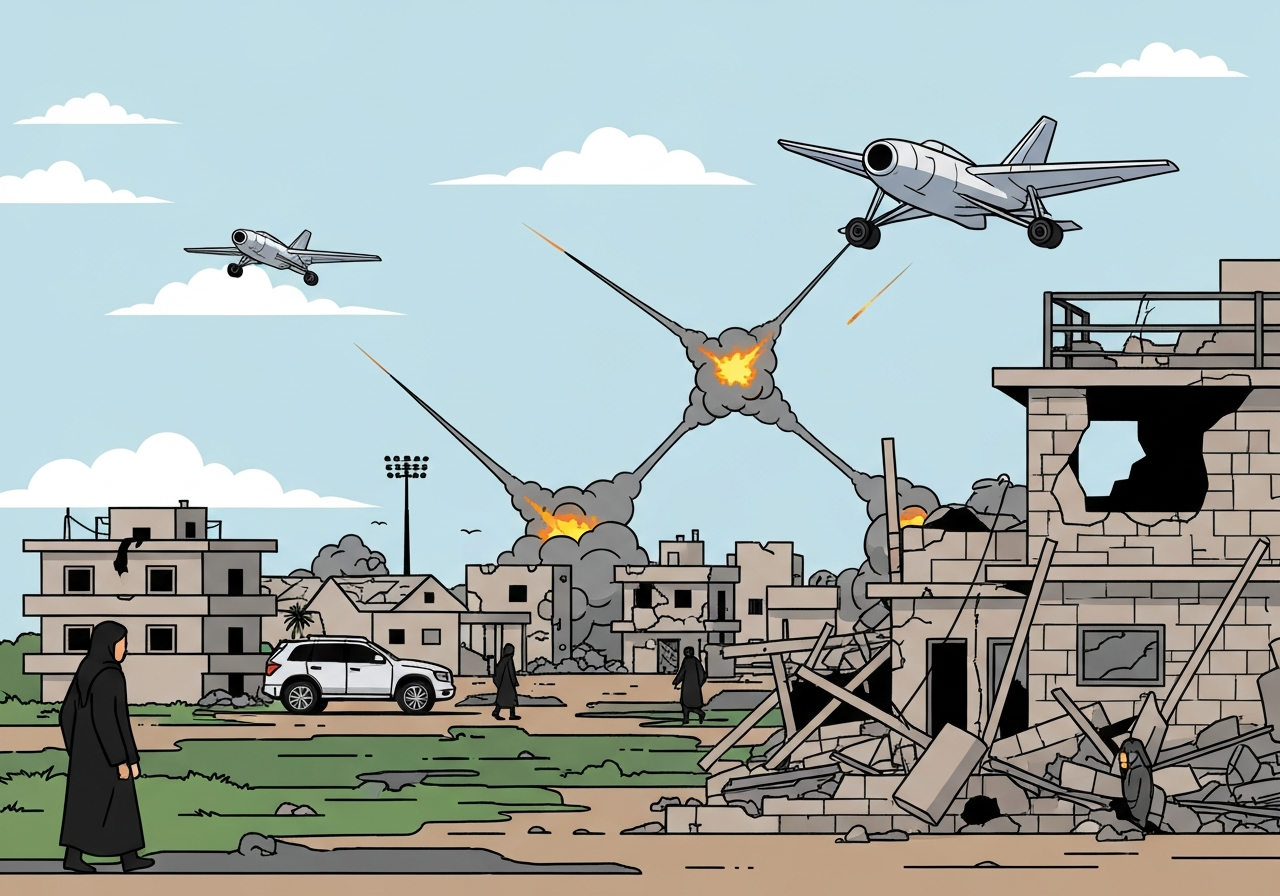
On Saturday, a wave of Israeli air strikes across the Gaza Strip killed at least 32 people, local rescue authorities said, with casualties reported in Gaza City, Khan Younis and Rafah. Gaza’s civil defence, run by Hamas, said children and women were among the dead and that one helicopter strike hit a tent sheltering displaced people in Khan Younis. The Israel Defense Forces (IDF) said the strikes were carried out in response to an alleged Hamas violation of the ceasefire and identified suspected militants leaving underground infrastructure in eastern Rafah. Aid agencies and regional governments warned the attacks risk undermining the fragile ceasefire and worsening the humanitarian crisis.
Key Takeaways
- At least 32 Palestinians were reported killed across the Gaza Strip in Saturday strikes, according to Gaza civil defence figures.
- Gaza authorities said the victims included children and women; seven victims were reported from one displaced family in Khan Younis.
- The IDF said it targeted “eight terrorists” seen exiting underground infrastructure in eastern Rafah and struck commanders, weapons storage and launch sites.
- Local reports said a police station and residential buildings were hit; Gaza City’s Shifa hospital reported three children and two women killed in an apartment strike.
- Since the ceasefire began on 10 October 2025, Gaza health authorities report at least 509 Palestinians killed; since the war began on 7 October 2023, the toll stands at more than 71,660.
- Regional actors — including Egypt and Qatar — condemned the strikes and urged restraint; international mediators fear phase-two ceasefire plans are at risk.
- Israel does not permit independent news reporting inside Gaza, limiting third-party verification of attacks and casualty circumstances.
Background
The current clashes come amid a phased ceasefire process that began after heavy fighting between Israel and Hamas. The original truce negotiated in October 2025 included a hostage-prisoner exchange, a partial Israeli withdrawal and an aid surge. In January, US special envoy Steve Witkoff announced the start of phase two, which envisions a technocratic Palestinian authority in Gaza, reconstruction and steps toward demilitarisation.
Despite the agreement, both sides have repeatedly accused each other of violations since the truce took effect on 10 October 2025. The conflict itself dates to the Hamas-led attack on southern Israel on 7 October 2023, which killed about 1,200 people and saw 251 taken hostage, and Israel’s subsequent military campaign that Gaza authorities say has killed tens of thousands.
Main Event
Local civil defence teams reported multiple strikes across the Strip on Saturday, with particularly heavy impact in Khan Younis where a tent shelter for displaced people was struck; witnesses and rescue workers recovered bodies from rubble in several locations. Gaza City’s Shifa hospital confirmed an air strike hit a residential apartment, killing three children and two women, and local authorities said a police station in the city was also hit.
The IDF issued a statement saying its forces, working with the Israel Security Agency (ISA), struck multiple targets after observing suspected militants in eastern Rafah and identifying commanders, weapons storage and manufacturing sites, and launch positions in central Gaza. The Israeli military framed the operations as a direct response to what it described as a ceasefire breach earlier on Friday.
Hamas condemned the strikes and called on the United States to intervene, describing the operations as proof, in its words, that Israel “continues its brutal war” on Gaza. Video and photographic material distributed by news agencies showed collapsed buildings and bodies being recovered, although independent, on-the-ground verification remains restricted.
Analysis & Implications
The strikes underscore the fragility of the ceasefire architecture: even limited tactical operations may unravel broader political arrangements, particularly during a sensitive phase-two transition that depends on Israeli withdrawals, a functioning intermediary authority and large-scale reconstruction funding. If either side perceives the other as repeatedly violating terms, momentum for the technocratic-government track and disarmament commitments could stall.
Humanitarian implications are immediate: the displacement of civilians, damage to shelters and strikes near hospitals exacerbate already acute needs. Reconstruction plans require secure conditions for materials and workers; recurrent military operations will likely delay rebuilding and impede the planned aid surge intended under the ceasefire deal.
Regionally, condemnation from Egypt and Qatar signals diplomatic strain. Both countries have roles as mediators and as conduits for aid and negotiations; heightened tensions may complicate cross-border coordination, border management at Rafah and the flow of reconstruction assistance.
Comparison & Data
| Metric | Reported figure |
|---|---|
| Deaths in Saturday strikes | At least 32 |
| Palestinians killed since 10 Oct 2025 ceasefire began | At least 509 |
| Palestinians killed since 7 Oct 2023 | More than 71,660 |
| Israeli soldiers killed since ceasefire | 4 |
These figures are reported by Gaza health authorities and civil defence and have been widely cited; international organisations including the UN and rights groups have treated the health ministry’s tallies as a key source. Limitations on independent reporting inside Gaza mean some details and attributions depend on local official accounts and external monitoring.
Reactions & Quotes
The IDF summarized its operational rationale and claimed it targeted militants and infrastructure in multiple locations. The statement framed the strikes as a response to an observed violation of the ceasefire.
“Eight terrorists were identified exiting the underground terror infrastructure in eastern Rafah.”
Israel Defense Forces (official statement)
Hamas issued a strong condemnation and called for international intervention, framing the strikes as evidence of broader Israeli intent. Its statement emphasized civilian suffering and appealed to mediators.
“These ongoing violations confirm that the Israeli government continues its brutal war of genocide against the strip.”
Hamas (political statement)
An affected relative described the human toll and questioned the logic of the strikes amid ceasefire rhetoric, words that were relayed by international news agencies covering the scene.
“We found my three little nieces in the street… What did those children do? What did we do?”
Samer al-Atbash (relative, quoted to Reuters)
Unconfirmed
- The IDF’s on-the-ground claim that “eight terrorists” were exiting underground infrastructure has not been independently verified due to access restrictions.
- Attribution of specific civilian deaths to particular munitions or platforms (helicopter gunship versus other aircraft) remains unverified in several reported locations.
- The exact number of displaced-family members killed in Khan Younis reported as seven has been reported by local authorities but lacks third-party confirmation.
Bottom Line
Saturday’s strikes, which killed at least 32 people, highlight both the human cost and the political fragility of the current ceasefire arrangements. The incident risks stalling the phase-two reconstruction and governance plans that rely on relative calm, credible monitoring, and cooperation from mediators.
Without independent access for journalists and monitors, verifying battlefield claims will remain difficult, leaving international actors to rely on partial reporting and diplomatic channels. The coming days will be decisive for whether mediators can restore confidence in the ceasefire framework or whether reciprocal incidents will lead to wider escalation.
Sources
- BBC (international broadcaster) — original article summarising local and international reporting
- Reuters (news agency) — frontline reporting and witness accounts cited by local media
- AFP (news agency) — reporting on regional diplomatic responses
- Israel Defense Forces (official statement) — military operations and claims
- UN OCHA oPt (UN humanitarian office) — context on humanitarian impact and verification practices
- Palestine Ministry of Health (health authority) — casualty figures for Gaza