
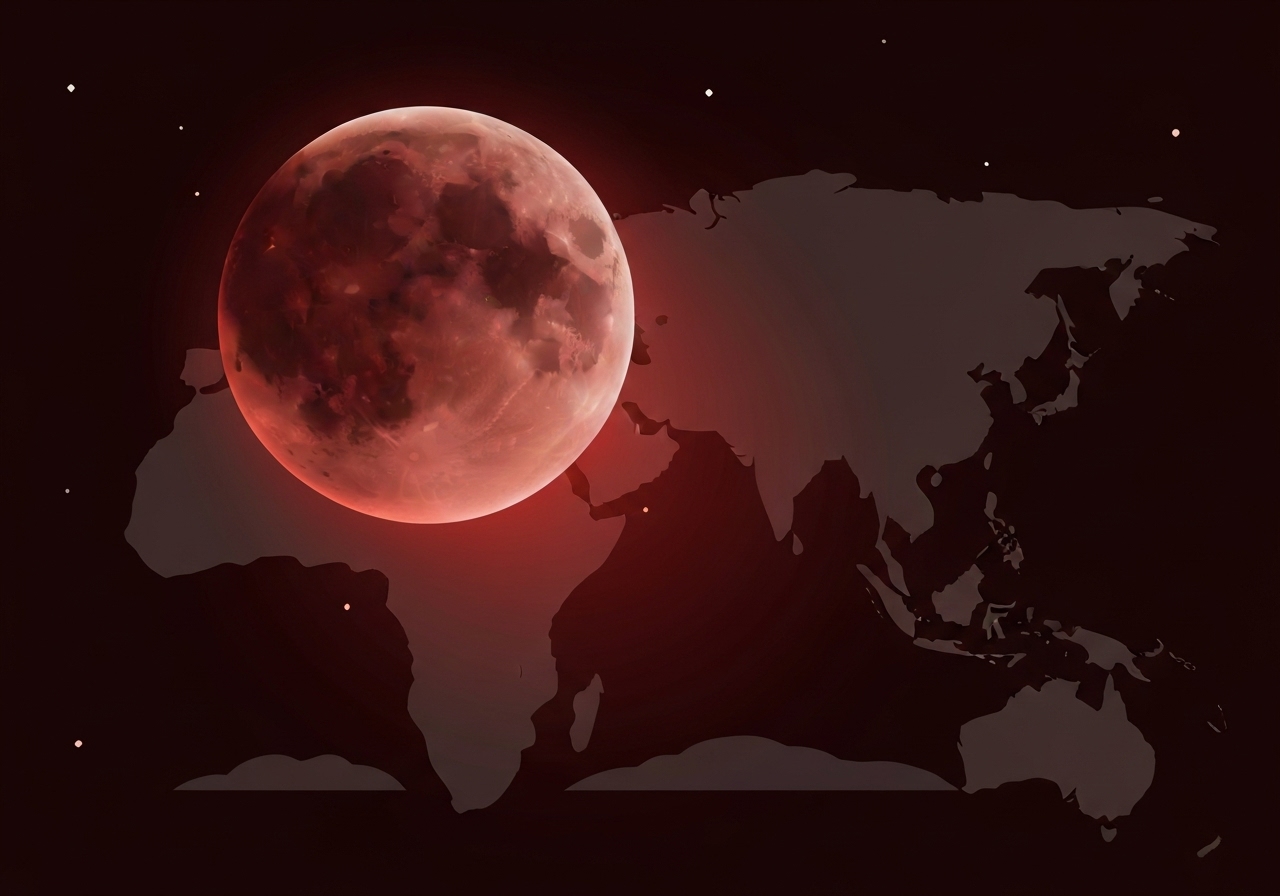
A total lunar eclipse — a “Blood Moon” — will take place on Sunday, lasting from 1730 GMT to 1852 GMT, and will be fully visible across much of Asia (including India and China), parts of eastern Africa and western Australia, while Europe and parts of Africa may see a brief partial eclipse at moonrise and the Americas will not witness the event.
Key Takeaways
- The total eclipse runs from 1730 GMT to 1852 GMT, an 82‑minute interval.
- Best visibility: large areas of Asia, including India and China, plus western Australia and eastern Africa’s edge.
- Europe and much of Africa may see only a partial event as the Moon rises; the Americas will not see the eclipse.
- The Moon turns red because sunlight is filtered and scattered through Earth’s atmosphere, removing shorter (blue) wavelengths.
- No special eyewear is needed to view a lunar eclipse — only clear skies and an appropriate location.
- This total lunar eclipse follows a March 2025 totality and a 2022 event; an unusual total solar eclipse will cross parts of Europe on 12 August 2026.
Verified Facts
The eclipse’s total phase is scheduled to begin at 1730 GMT and end at 1852 GMT, producing an overall totality of approximately 82 minutes. Observers located in central and eastern Asia will have the most complete views, with western Australia and the easternmost areas of Africa also positioned to see the Moon fully immersed in Earth’s shadow.
People in much of Europe and most of Africa will encounter the eclipse as the Moon rises; those viewers can expect only a partial view depending on local horizon and timing. The entire continental Americas will be outside the viewing zone and will not see the eclipse.
Astrophysicist Ryan Milligan of Queen’s University Belfast explains that the Moon’s red hue during a total lunar eclipse results from sunlight being refracted and scattered through Earth’s atmosphere so that longer (red) wavelengths reach the lunar surface while shorter (blue) wavelengths are dispersed.
Unlike solar eclipses, lunar eclipses are safe to observe with the naked eye. No filters or eclipse glasses are required; typical viewing needs are clear skies, an unobstructed view of the Moon and, if desired, binoculars or a small telescope for more detail.
This event follows a total lunar eclipse in March 2025 and the previous total lunar eclipse in 2022. Preparations and public interest are often ramped up because such events offer opportunities for public outreach, astrophotography and amateur observation.
Context & Impact
Lunar eclipses are predictable astronomical events that offer accessible science outreach: they are visible to large populations without special equipment and can spark public interest in astronomy and atmospheric science.
For travelers and eclipse chasers, regional cloud cover and local horizon obstructions remain the main practical obstacles. Communities in favorable zones often see increased public viewing events and tourism interest for nights with clear skies.
- Educational impact: schools and planetariums use eclipses for demonstrations on Earth’s atmosphere and celestial mechanics.
- Photography: the extended duration of totality (82 minutes) provides ample time for imaging and experimentation with exposures.
Official Statements
“The Moon takes on its red, ‘bloody’ color because blue light is scattered out by Earth’s atmosphere, leaving the longer red wavelengths to illuminate the lunar surface,”
Ryan Milligan, Astrophysicist, Queen’s University Belfast
Unconfirmed
- Local cloud cover and exact city‑level visibility remain uncertain until nearer the event; forecasts can change within 24–48 hours.
- Precise atmospheric conditions that will determine the Moon’s exact shade of red are not predictable far in advance.
Bottom Line
If you are in central or eastern Asia, western Australia or the eastern edge of Africa, plan to observe between 1730 GMT and 1852 GMT on Sunday for the best chance to see a full “Blood Moon.” No protective eyewear is needed, but local weather will determine whether the sight is visible from any given site.