
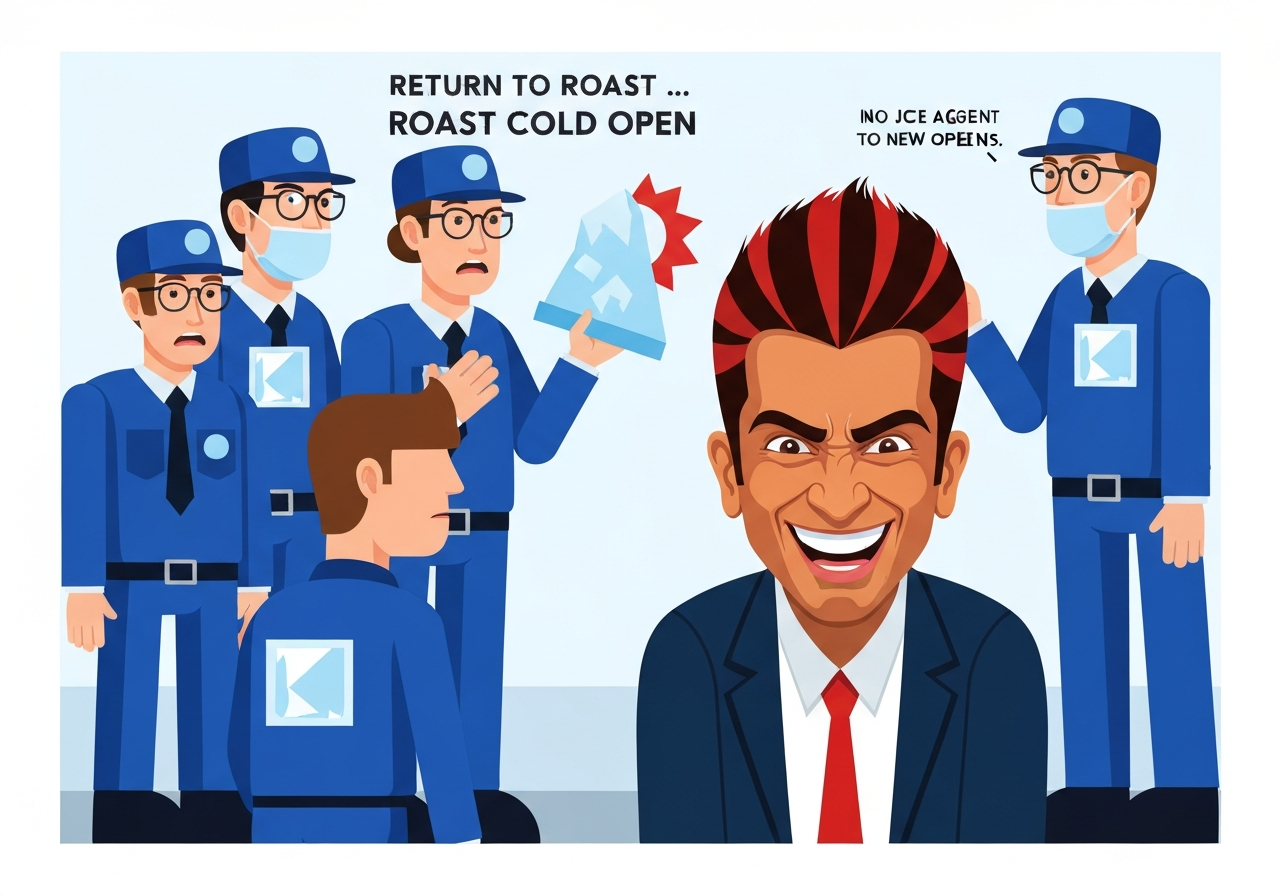
Saturday Night Live’s latest cold open, led by alum Pete Davidson, lampooned Immigration and Customs Enforcement and its onetime spokesman Tom Homan in a sketch that aired on NBC. The short satire staged Davidson as Homan attempting to defuse tensions with ICE officers in Minneapolis, only to be undermined by the agents’ attitudes and blunt answers. Cast members Jeremy Culhane, Andrew Dismukes, James Austin Johnson, Ben Marshall and Kenan Thompson played ICE officers who repeatedly interpreted the conversation in self-serving, confrontational ways. The sketch closed with a meta jab at the newly released Epstein documents, suggesting bureaucratic distraction as a political tactic.
Key Takeaways
- Pete Davidson returned to lead SNL’s cold open as a fictionalized Tom Homan; the sketch aired on NBC’s weekly show.
- Multiple cast members — Jeremy Culhane, Andrew Dismukes, James Austin Johnson, Ben Marshall and Kenan Thompson — portrayed ICE agents during the segment.
- The sketch included direct references to Homan’s controversial public reputation, including a line alluding to a past allegation about a $50,000 bribe.
- Comedy beats pivoted on questions about use of force, with agents repeatedly answering in ways that highlighted lack of training and aggressive posture.
- SNL’s piece also tied its satire to the weekend release of Epstein-related files, framing the documents as a potential political distraction.
Background
Saturday Night Live has a long tradition of opening episodes with topical sketches that lampoon federal officials and national controversies. The cold open is SNL’s most visible political moment of the week, often shaping social-media debate immediately after broadcast. Tom Homan is a familiar figure in immigration policy debates due to his former leadership at ICE under the Trump administration and subsequent public commentary; the show used that public profile as the basis for caricature. Tension between enforcement agencies and local communities — Minneapolis among them — has been a recurring national story, adjusting how late-night programs frame satire about policing and immigration.
Recent weeks saw renewed scrutiny of enforcement practices and high-profile document releases tied to other investigations, creating a climate in which late-night satire can fold policy critique into punchlines. SNL’s writers frequently compress complex policy debates into short, character-driven scenes that aim for both laughs and pointed commentary. By placing a well-known comedian in the role of a polarizing official, the show foregrounded questions about institutional responsibility and individual accountability.
Main Event
The sketch opened with Davidson portraying Tom Homan attempting a calm, managerial approach, telling officers they needed to discuss the use of force. Instead of thoughtful responses, several agents answered impulsively or comically misread the question, which the sketch used to underline a chaotic command climate. One agent suggested an immediately aggressive posture, another pushed preemptive action, and a third offered an off-target cultural reference, prompting Homan’s exasperation.
Davidson’s Homan then leapt into self-aware invective, listing the controversies attached to his name and expressing frustration that the agents’ behavior made him look comparatively reasonable. A central comic turning point came when an agent bluntly summarized the situation: the agency had allegedly hired angry, armed personnel without adequate training, and that dynamic produced the very conduct critics expected. The scene’s tempo was set by rapid-fire exchanges and carefully timed non sequiturs that highlighted institutional contradictions.
Toward the end, the cold open folded in the weekend’s wider news cycle by referencing the release of Epstein-related files, with the sketch implying that document dumps can operate as political distractions. The joke was delivered as a self-conscious aside, linking entertainment to the larger rhythms of political media and news management. The sketch closed without a tidy resolution, leaving the satire to register as a critique rather than a policy prescription.
Analysis & Implications
SNL’s choice to target ICE and Homan in a prime-weekend cold open signals how mainstream comedy continues to treat immigration enforcement as a central political flashpoint. Satire operates both as entertainment and as public framing: by compressing complex issues into a short exchange, the sketch makes a claim about responsibility, training and the consequences of delegating force. That framing may reinforce existing public skepticism about enforcement practices, particularly in localities where community relations with federal agents are strained.
Comedy like this can shape perception more efficiently than slow policy reporting because it renders institutional behavior legible through character and moment. The risk, however, is oversimplification: viewers may leave with a stronger moral judgment but less grasp of the procedural or legal contexts that govern enforcement. For advocates, the sketch provides rhetorical cover; for officials, it magnifies reputational stakes and public expectations for accountability and training reforms.
Finally, the sketch’s nod to the Epstein files underscores how late-night shows integrate the news stream into satire, suggesting that releases of documents or investigations are absorbed into a broader cultural narrative about distraction and management. That linkage can deepen public cynicism about information timing and political messaging, even as it keeps serious topics on the public agenda. Looking ahead, SNL’s approach indicates continued cultural pressure on agencies to address both conduct and public communication strategies.
Comparison & Data
| Performer | Role in Sketch |
|---|---|
| Pete Davidson | Tom Homan (fictionalized) |
| Jeremy Culhane | ICE agent |
| Andrew Dismukes | ICE agent |
| James Austin Johnson | ICE agent |
| Ben Marshall | ICE agent |
| Kenan Thompson | ICE agent |
The table above lists principal performers and their roles in the cold open to clarify who delivered the sketch’s key lines. SNL commonly assembles ensemble cast members around a single satirical premise; this episode distributed the critique across several characters rather than relying on a single straight man. That distribution allowed the sketch to dramatize institutional dysfunction as a pattern rather than an isolated gaffe.
Reactions & Quotes
Public reaction coalesced around the sketch’s blunt takedown of agency culture and the performative posture of public officials. Some viewers praised the satire for calling attention to training and accountability; others argued that comedy simplifies complex legal and operational constraints. Below are illustrative lines from the sketch, presented with context.
When the fictional Homan asks about use-of-force policy, agents repeatedly give reflexive, aggressive replies — a dynamic the sketch uses to dramatize institutional readiness for violence.
Saturday Night Live (sketch excerpt)
One agent summarizes the comedic thesis: staff were hired with an aggressive mindset, given weapons, and not adequately trained, which the sketch treats as the root of foreseeable problems.
Saturday Night Live (sketch excerpt)
Unconfirmed
- That Tom Homan is actively engaged in formal negotiations to ease tensions between ICE and Minneapolis residents — the sketch presented that premise but direct, contemporaneous confirmation of such a role was not provided in reporting.
- The suggestion in the sketch that Epstein-related document releases were deliberately timed as a political distraction is framed as satire and lacks independent evidence of intent.
Bottom Line
SNL’s cold open used comic exaggeration to critique enforcement culture, underscoring real public anxieties about use-of-force, training and oversight within ICE. By casting a recognizable comedian as a controversial official, the sketch converted policy disputes into a compact moral tableau that will likely reinforce existing views on both sides of the debate. Viewers seeking granular understanding of agency practices should consult focused reporting and official documents; satire is a prompt for scrutiny, not a substitute for documentary evidence.
In the near term, the sketch will feed online conversation about enforcement and accountability and may intensify calls for transparency around training and conduct. Regardless of comedic intent, the segment illustrates how entertainment can accelerate public demands for institutional reform and sustained journalistic attention.
Sources
- The Daily Beast — news/entertainment report summarizing the SNL cold open and lines from the sketch.
- Saturday Night Live (NBC) — official program page, source for show context and episode distribution (official media).