
Lead
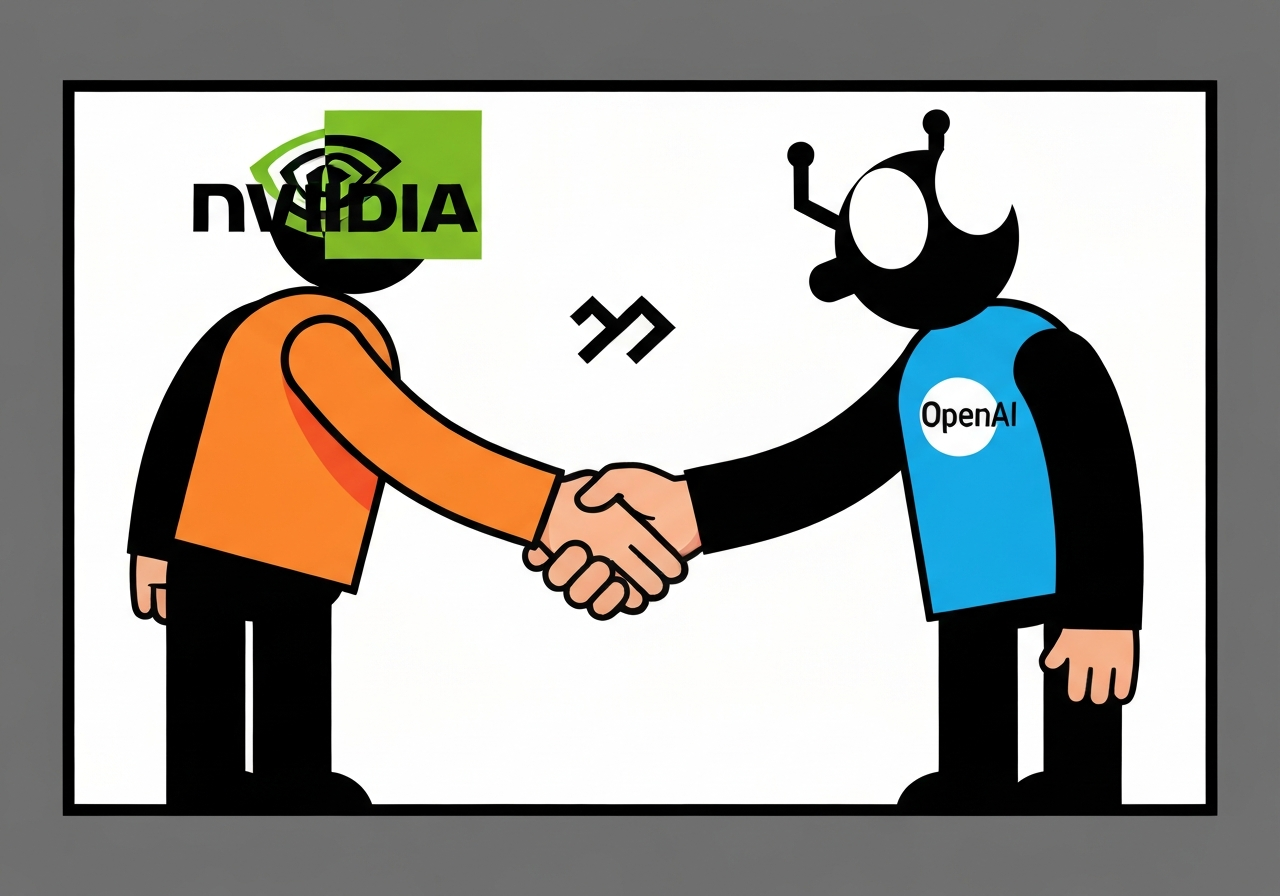
On January 31, 2026 in Taipei, Nvidia Chief Executive Jensen Huang said the chipmaker will participate in OpenAI’s current funding round and suggested the contribution could be the company’s largest-ever investment. Huang spoke during a dinner with the company’s Taiwanese suppliers and characterized the planned commitment as “huge,” while declining to give a specific dollar amount. The announcement confirms Nvidia as a backer of OpenAI’s latest capital raise but leaves the ultimate size and structure of the company’s stake unclear.
Key Takeaways
- Jensen Huang announced on January 31, 2026 in Taipei that Nvidia will join OpenAI’s current funding round and called the planned contribution “huge.”
- Huang described the commitment as potentially the largest investment Nvidia has ever made but did not disclose a dollar figure.
- The comments were made during a supplier dinner in Taipei and were first reported by Bloomberg; the report was updated on February 1, 2026.
- OpenAI’s funding round has drawn attention across the tech industry; public backers to date remain limited in publicly disclosed size and terms.
- Speculation about a $100 billion figure for the round remains unverified; Nvidia said nothing to confirm that scale.
- Nvidia’s participation signals deeper commercial alignment between chip suppliers and AI developers at a time of intensifying competition for compute and talent.
Background
OpenAI has pursued successive fundraising and partnership arrangements since its shift toward a capped-profit model. Major technology companies have previously committed substantial resources to OpenAI: Microsoft entered a multi-year commercial partnership that began with a reported $1 billion commitment in 2019 and was expanded in later years through additional, multibillion-dollar support and cloud agreements. Those deals anchored OpenAI’s access to capital and cloud compute while forging a close commercial channel for model deployment.
At the same time, hardware suppliers such as Nvidia play a central role in the AI ecosystem by providing the GPUs and software stacks that power large models. Nvidia’s chips and ecosystem have become critical inputs for leading AI developers, making strategic equity stakes a way to align incentives and secure preferential access to advanced hardware. The interplay of capital, chips and cloud capacity has reshaped commercial bargaining among developers, chipmakers and cloud providers.
Main Event
During a dinner with Taiwanese suppliers in Taipei on January 31, 2026, Huang told reporters that Nvidia will invest in OpenAI’s ongoing financing round. He said he believes in OpenAI’s work and described the investment as possibly the largest the company has made. Huang reiterated his confidence in OpenAI’s significance without laying out the mechanics or amount of Nvidia’s commitment.
Bloomberg’s coverage, updated on February 1, 2026, conveyed Huang’s remarks and an accompanying photo showing the event setting. Huang emphasized the strategic importance of OpenAI’s technology to the industry and framed Nvidia’s move as a vote of confidence rather than a short-term financial play. Company spokespeople did not provide additional detail at the time of the report.
The broader funding round has been the subject of market attention, with multiple reports and industry observers tracking potential participants, valuation implications and the round’s effect on competitive dynamics. Nvidia’s participation adds a prominent hardware supplier to the roster of financial backers and underscores the interdependence of capital and compute in scaling large AI models.
Analysis & Implications
Nvidia’s decision to invest ties the firm more directly to an important customer and partner, potentially strengthening commercial cooperation on hardware roadmaps, software optimizations and capacity planning. For Nvidia, an equity stake can help secure long-term demand for its data-center products and deepen engineering collaboration on model-first optimizations. That alignment may accelerate co-development initiatives but also raises questions about conflicts of interest in supplying competing cloud and enterprise customers.
For OpenAI, securing capital from a key supplier reduces execution risk around access to cutting-edge accelerators as model sizes and training runs grow. It may also lower unit compute costs and shorten procurement lead times. However, dependence on a single major hardware partner can concentrate strategic leverage and invite scrutiny from other customers who rely on neutral access to infrastructure.
Market and regulatory watchers will monitor whether such supplier-investor relationships prompt changes in procurement practices, pricing or antitrust review. Governments and large customers concerned about vendor concentration could press for transparent terms and non-discrimination clauses. The deal’s legal and contractual contours — equity vs. convertible instruments, board representation, exclusivity provisions — will determine its competitive and regulatory footprint.
Comparison & Data
| Investor | Year | Publicly reported size |
|---|---|---|
| Microsoft (partnership) | 2019 | $1 billion (reported) |
| Nvidia | 2026 | Undisclosed (company confirms participation) |
The table highlights two publicly noted items: Microsoft’s reported $1 billion commitment in 2019 and Nvidia’s confirmed but undisclosed investment in 2026. Public disclosure around the current OpenAI round remains limited, so precise comparisons are constrained until more details are released.
Reactions & Quotes
Context: Jensen Huang spoke to reporters on site in Taipei during a supplier event and framed Nvidia’s move as strategic and supportive.
“We will invest a great deal of money,” Huang said, signaling a substantial commitment while withholding a specific figure.
Jensen Huang, Nvidia CEO
Context: Huang emphasized his view of OpenAI’s significance to the industry when explaining the rationale for participation.
“I believe in OpenAI. The work that they do is incredible. They’re one of the most consequential companies of our time,” he said, characterizing the investment as “huge.”
Jensen Huang, Nvidia CEO
Unconfirmed
- Reports circulating about a $100 billion size for the overall funding round have not been substantiated by Nvidia or OpenAI; the $100 billion figure remains unverified.
- The precise dollar amount and legal terms of Nvidia’s contribution have not been disclosed publicly; the company described the planned stake as “huge” but gave no figures.
- Any details about board seats, preferential pricing or exclusive supply commitments tied to this investment have not been confirmed.
Bottom Line
Nvidia’s public confirmation that it will take part in OpenAI’s current funding round is a notable development that signals closer commercial alignment between a leading GPU supplier and a prominent AI developer. While Nvidia framed the move as a substantial, potentially record-sized investment for the company, it withheld concrete financial details, leaving analysts and customers to assess strategic implications based on limited public information.
Observers should watch for formal disclosures that clarify the size and terms of Nvidia’s stake and any contractual arrangements affecting hardware access or competitive neutrality. Those details will determine whether the investment accelerates collaborative innovation with limited frictions or raises new questions about market concentration and customer treatment.
Sources
- Bloomberg — news report (media): coverage of Jensen Huang’s comments in Taipei, Jan 31, 2026; article updated Feb 1, 2026.