
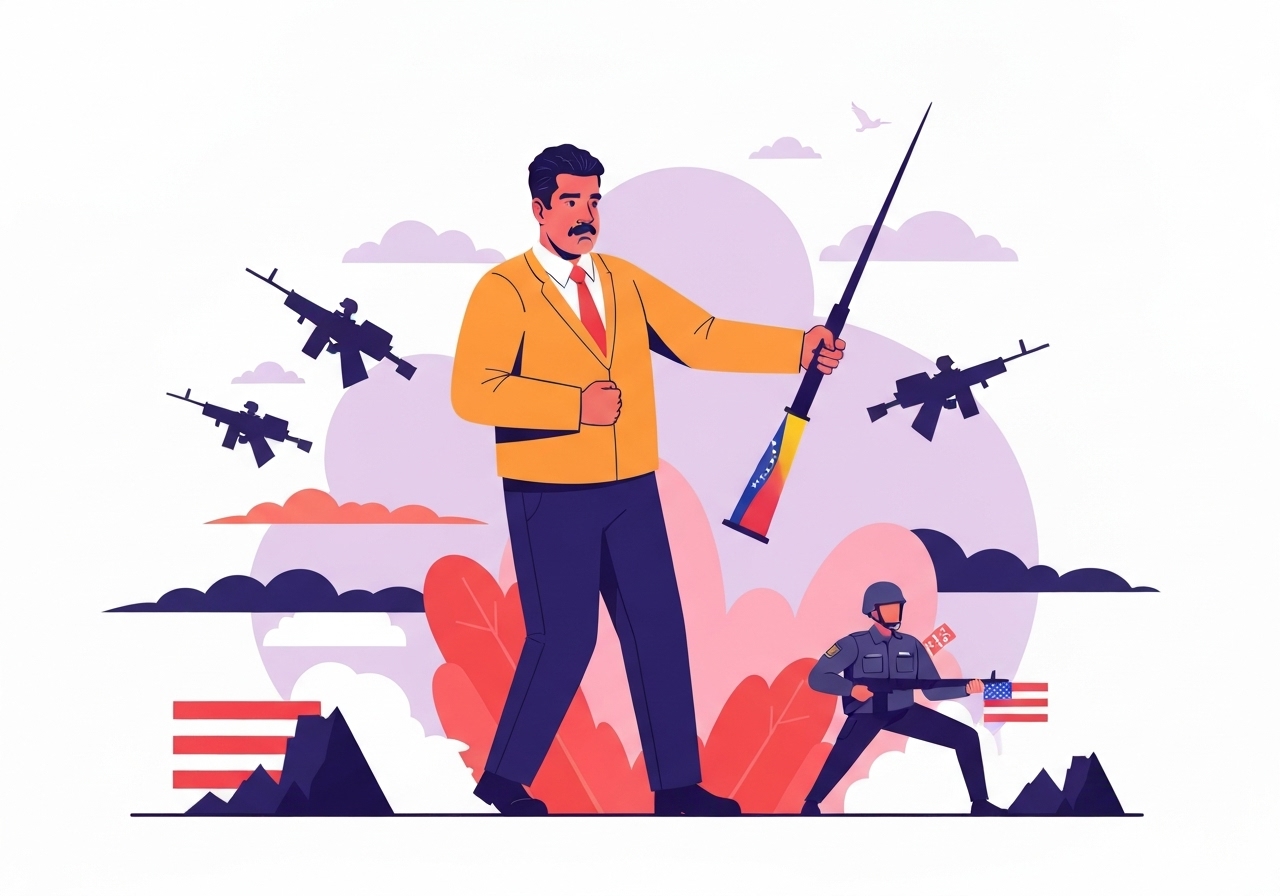
CARACAS — On Sept. 6, 2025, President Nicolás Maduro said Venezuela will defend its sovereignty after the United States deployed warships and other forces to the Caribbean following a U.S. strike three days earlier that sank a boat claimed to be linked to the Tren de Aragua and killed 11 people. Maduro called for dialogue with U.S. President Donald Trump while warning against what he described as a threat of invasion.
Key Takeaways
- Maduro vowed to protect Venezuela’s territorial sovereignty amid a U.S. military buildup in the Caribbean.
- The U.S. says it struck and sank a vessel tied to the Tren de Aragua drug gang; 11 people died in the strike.
- Caracas disputes the U.S. account and questions the origin and intent of the targeted boat.
- Washington has deployed more than 4,000 troops and naval assets to the region, citing operations against drug trafficking.
- Maduro ordered the mobilization of civilian militias and warned of an “armed struggle” if Venezuela is attacked.
- U.S. actions come after Washington doubled its arrest reward for Maduro to $50 million last month.
Verified Facts
On Sept. 3, 2025, U.S. forces carried out a maritime strike in the Caribbean that Washington says sank a boat it identified as belonging to Tren de Aragua, a Venezuelan criminal organization accused of smuggling narcotics. U.S. officials reported 11 fatalities in that operation.
The Trump administration has since moved additional naval assets and more than 4,000 military personnel into the region. U.S. officials have described the deployments as part of broader efforts to disrupt transnational drug trafficking in Latin America and the Caribbean; they have not announced a plan for a ground invasion of Venezuela.
President Maduro spoke at a military base in Caracas on Sept. 6, criticizing the U.S. buildup and saying Venezuela remains open to talks but demands respect. He ordered the mobilization of civilian militias and framed the buildup as a possible pretext for regime-change efforts, referencing the U.S. decision last month to raise the reward for his arrest to $50 million.
Latin American governments and regional observers have expressed concern about escalating military activity near Venezuela, recalling past U.S. interventions that left long political and social impacts across the region.
Context & Impact
The U.S. strike and subsequent deployment come amid heightened U.S.-Venezuela tensions after years of mutual accusations. Caracas has long accused Washington of seeking to destabilize the Maduro government; U.S. officials cite Venezuela’s links to illicit networks and human-rights concerns as rationale for pressure.
Escalation in the Caribbean could complicate regional security cooperation on drug interdiction and migration, and risks hardening domestic political narratives in Venezuela on both sides. Opposition and government supporters may interpret foreign military moves differently, potentially affecting internal stability.
International responses will matter: calls for independent investigations or multilateral mediation could reduce the risk of miscalculation. Conversely, further unilateral military actions or inflammatory rhetoric could deepen the confrontation.
“Venezuela is always ready for dialogue, but we demand respect. None of our differences justify a high-impact military conflict in South America.”
Nicolás Maduro, President of Venezuela
Unconfirmed
- Whether the boat struck by U.S. forces definitively belonged to Tren de Aragua and was en route to the United States, as claimed by U.S. officials; Venezuelan authorities dispute that account.
- Full details about the identities and affiliations of the 11 people killed have not been independently verified in public reporting.
- Any potential plans by the U.S. for further kinetic operations or a shift from maritime to ground actions have not been confirmed by U.S. officials.
Bottom Line
The incident has sharpened already tense U.S.-Venezuela relations: Washington frames its moves as anti-drug operations, while Caracas frames them as threats to national sovereignty and possible steps toward regime change. The coming days will likely show whether diplomatic channels can reduce the risk of further military escalation or whether both sides deepen defensive postures.