
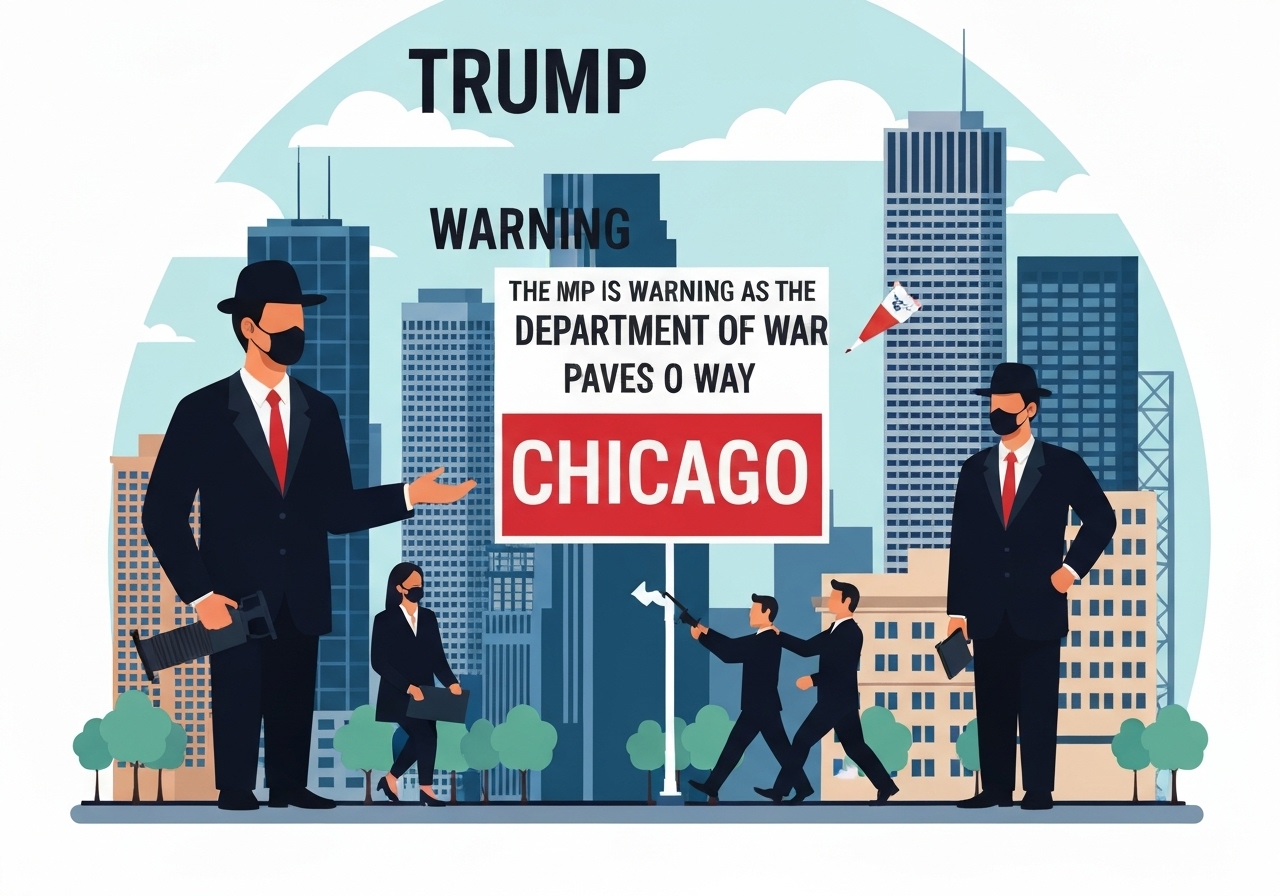
President Donald Trump on Saturday, Sept. 6, 2025, posted a social-media message saying Chicago “will find out why it’s called the Department of WAR” as federal authorities prepare a planned immigration enforcement operation that officials said could begin this week; the post followed an executive order he signed Friday to rebrand the Pentagon.
Key Takeaways
- Trump posted a message on Sept. 6 asserting Chicago would learn “why it’s called the Department of WAR” amid plans for an immigration enforcement operation.
- The president signed an executive order Friday to relabel the Defense Department as the “Department of War.”
- Federal personnel from ICE and CBP have begun arriving in Chicago, according to administration officials.
- The operation is modeled on a June deployment to Los Angeles that a judge found violated limits on military involvement in domestic law enforcement; that ruling is under appeal.
- State and city Democrats, including Gov. JB Pritzker and Mayor Brandon Johnson, sharply condemned Trump’s message as threatening and unconstitutional.
- The White House said the Chicago immigration operation is separate from a broader crime crackdown the president has discussed using federal law enforcement and National Guard forces to carry out.
Verified Facts
On Sept. 5, 2025, the White House released an executive action renaming the Department of Defense the “Department of War,” a move announced by the president and posted on his social channels the following day. The social post included an image of the president in a hat and sunglasses with the Chicago skyline behind him and the caption referencing deportations and “Chipocalypse Now.”
White House and federal officials told reporters that personnel from U.S. Immigration and Customs Enforcement (ICE) and U.S. Customs and Border Protection (CBP) have begun to arrive in Chicago ahead of a targeted immigration enforcement operation. Officials said the operation is being modeled on a June deployment in Los Angeles.
Court action has followed the June deployment: a federal judge recently ruled that that deployment violated federal law restricting military participation in domestic law enforcement in most circumstances. The administration has appealed that ruling and maintains it has legal authority to proceed under specific exceptions and with nonmilitary federal law enforcement.
The White House said the Chicago immigration operation should not be conflated with a separate proposal the president has discussed to use federal law enforcement and National Guard troops for a broader crime crackdown in the city; officials have said the immigration action and any broader crime response would be distinct programs.
Context & Impact
Local and state Democrats responded immediately. Illinois Gov. JB Pritzker called the post “not normal” and said the president is threatening an American city, while Chicago Mayor Brandon Johnson accused the administration of seeking to “occupy our city” and violating constitutional limits. Illinois Sen. Tammy Duckworth criticized the imagery and tone of the post.
Legal experts warn the use of military or National Guard forces for domestic law enforcement raises constitutional and statutory issues, including the Posse Comitatus Act and related judicial precedents. Civil-rights advocates and immigrant communities say the operation risks large-scale detentions, community fear, and erosion of trust between residents and local public safety institutions.
Municipal officials have been preparing operational and legal responses. City and state leaders say they will defend local residents and monitor federal actions closely; police and social-service groups are planning outreach to inform immigrant communities about legal rights and resources.
If the operation proceeds at the scale described by officials, possible effects include increased detentions and deportation proceedings, litigation over the use of military forces or federal agencies in cities, and heightened political conflict between the federal government and city or state authorities.
Official Statements
“The President of the United States is threatening to go to war with an American city. This is not a joke. This is not normal.”
Gov. JB Pritzker, statement on X
“We must defend our democracy from this authoritarianism by protecting each other and protecting Chicago from Donald Trump.”
Mayor Brandon Johnson, social post
Unconfirmed
- Whether the image in the president’s post was generated by artificial intelligence has not been independently verified.
- The precise start date, scale, and personnel composition of the Chicago operation have not been publicly disclosed; officials said it could begin this week but provided no firm timeline.
- Whether the National Guard will be federally activated for this operation remains undecided and contingent on on-the-ground developments, according to administration statements.
Bottom Line
The president’s post and the recent executive order have intensified a standoff between the federal government and local authorities in Chicago, raising legal questions and practical concerns for immigrant communities. Watch for court challenges, further federal disclosures about the operation’s scope, and state and city preparations to protect residents’ rights.