
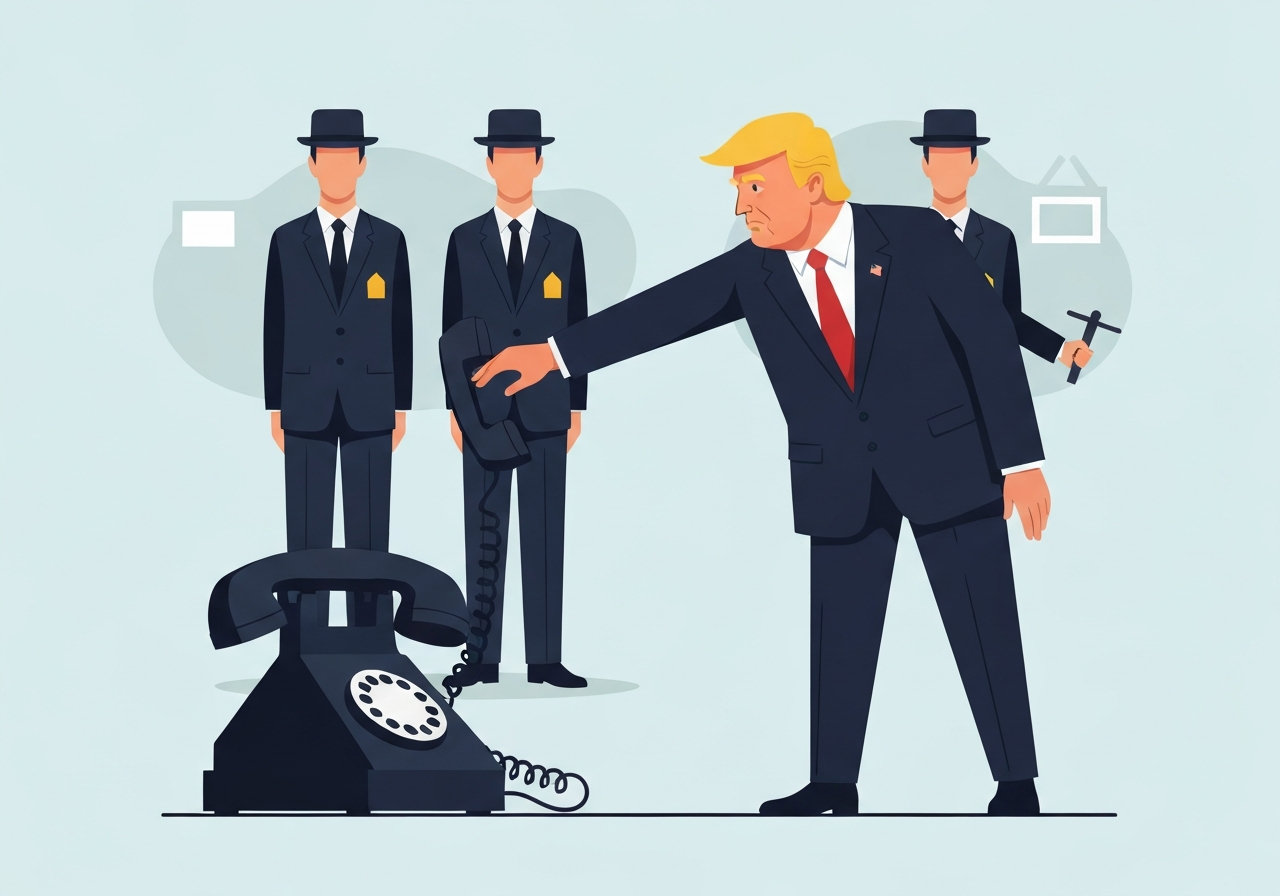
Lead: On Feb. 2, 2026, days after the F.B.I. executed a search of a Fulton County, Ga., election center, President Donald J. Trump spoke by phone with members of the Atlanta field office who had worked on the inquiry. The director of national intelligence, Tulsi Gabbard, was on site for the search and later placed the call to agents that connected to Mr. Trump on speakerphone. Officials described the exchange as brief and highly atypical for normal law enforcement practice, and the episode has prompted questions about the roles of political appointees in active criminal inquiries. The Department of Justice has not publicly disputed the basic contours of the account reported by The New York Times.
Key Takeaways
- The F.B.I. searched a Fulton County election center in late January/early February 2026 and seized multiple boxes and truckloads of materials tied to 2020 ballots, according to reporting dated Feb. 2, 2026.
- Tulsi Gabbard, serving as director of national intelligence, appeared at the search site and later met privately with some Atlanta field agents involved in the probe.
- During that meeting, Ms. Gabbard used her cellphone to call President Trump; he returned the call and spoke to agents on speakerphone, praising their work.
- Officials described the call as short — roughly a minute by one account — and compared its tone to a pep rally rather than operational direction; one official said Mr. Trump gave no substantive investigative instructions.
- A U.S. official told reporters that Mr. Trump personally directed Ms. Gabbard to go to Atlanta and coordinated her presence with Andrew Bailey, a deputy F.B.I. director.
- The involvement of the director of national intelligence in an on-site law enforcement meeting departs from customary boundaries between intelligence oversight and criminal investigations.
- The episode has generated scrutiny from ethics and legal analysts about separation between political leadership and active investigative teams.
Background
The F.B.I. search in Fulton County followed a broader, high-profile inquiry into events connected to the 2020 presidential election. In recent years, searches of politically sensitive locations have drawn intense public attention and legal scrutiny, particularly when they involve materials such as ballots or classified documents. Law enforcement practice generally separates operational investigative teams from high-level political actors to preserve impartiality and protect investigative integrity.
The director of national intelligence traditionally oversees the U.S. intelligence community and coordinates intelligence policy rather than directing domestic criminal probes. When senior officials or the White House seek information about ongoing investigations, formal channels — such as the Department of Justice and designated supervisory contacts within the F.B.I. — are normally used. Departures from that division of labor have in the past prompted policy reviews and, in some cases, congressional inquiries.
Main Event
The sequence began with the F.B.I.’s search of an elections office in Fulton County, Ga., during which agents removed a large volume of election-related materials. The next day, Ms. Gabbard met privately with some of the Atlanta field agents involved in that inquiry, according to multiple people with knowledge of the meeting. Those sources did not provide a full public accounting of the meeting’s agenda or duration.
During the closed-door meeting, Ms. Gabbard called President Trump on her cellphone. Mr. Trump did not pick up immediately, but returned the call shortly thereafter; the conversation connected to the agents on speakerphone. According to people briefed on the exchange, Mr. Trump asked questions, offered thanks and praise, and spoke in an encouraging tone to the squad working the case.
Participants said the field supervisor — the team that had developed evidence supporting the search and investigates alleged public corruption and civil-rights violations — answered the president’s questions. One U.S. official characterized the call as brief, roughly a minute, and said the president provided encouragement but no operational directions. Other officials confirmed Mr. Trump’s coordination of Ms. Gabbard’s travel to Atlanta with Andrew Bailey, a deputy F.B.I. director, though details of that coordination remain limited.
Analysis & Implications
The direct telephone contact between a sitting president and front-line agents is rare and raises questions about norms intended to keep political influence separate from criminal investigations. Even if the call contained no explicit orders, the mere contact can create the appearance of pressure on investigators and could prompt internal ethics reviews or congressional oversight actions. Perception matters in preserving public confidence in the rule of law.
Ms. Gabbard’s presence at an on-site criminal-investigative meeting further complicates the institutional picture. The director of national intelligence’s portfolio centers on foreign intelligence and interagency coordination; on-site involvement in domestic investigative actions is not customary and may blur lines between intelligence and law-enforcement functions. Legal scholars and former agency officials say such overlaps merit careful documentation and review to prevent conflicts with established protocols.
Practically, investigators and supervisors involved in the Fulton County inquiry will be mindful of preserving a clear record of decisions, chain-of-command communications, and any external contacts. If concerns escalate, they could trigger internal Justice Department inquiries or formal oversight by Congress. The political context — including Mr. Trump’s persistent claims about the 2020 election — increases the stakes for how agencies explain and defend their procedures.
Comparison & Data
| Event | Location | Date (reported) | Seized Items (reported) | Presidential Direct Contact? |
|---|---|---|---|---|
| Fulton County election-office search | Fulton County, Ga. | Reported Feb. 2, 2026 | Multiple boxes/truckloads of 2020-related materials | Yes — brief speakerphone call |
| Mar-a-Lago search | Palm Beach, Fla. | Aug. 2022 | Classified documents (reported) | No public presidential call to agents |
Comparing high-profile searches underscores a difference in public-facing presidential contact. While searches of politically sensitive sites are not unprecedented, direct, real-time presidential engagement with line agents is uncommon. That distinction helps explain the heightened attention from legal analysts and the media.
Reactions & Quotes
“It was more like a pep rally — a short, encouraging exchange — than operational direction,”
U.S. official briefed on the call
“The president thanked and praised the agents for their work on the inquiry,”
Person familiar with the meeting
“The presence of a national intelligence official at an on-site criminal investigation departs from usual boundaries and merits explanation,”
Former law-enforcement official (commenting on customary practice)
Unconfirmed
- Precise motives for Ms. Gabbard’s on-site presence — sources described her attendance but did not provide a public, official explanation.
- Whether any follow-up communications from the White House altered the investigators’ handling of evidence or case strategy; reporting indicates no substantive direction was given, but formal records have not been released publicly.
- Full content of the president’s questions during the call beyond general praise and brief queries — participant accounts are summarized, not transcribed.
Bottom Line
The reported phone call, and the involvement of a senior intelligence official at a local criminal-investigative meeting, represent an unusual convergence of political leadership and front-line law enforcement. Even absent explicit instructions to agents, the incident may erode public confidence in institutional separation and prompt formal reviews of conduct and communications. Agencies will likely emphasize documentation of the episode and may face requests from oversight bodies for more detailed accounts.
For the public and policymakers, the key questions are whether norms were maintained in practice and how agencies will respond to perceptions of political entanglement. Expect scrutiny from congressional committees, ethics watchdogs and legal analysts as they assess whether existing boundaries between political actors and investigative teams were respected or need strengthening.
Sources
- The New York Times — news report (Feb. 2, 2026) describing the search, Ms. Gabbard’s involvement, and the subsequent phone call.