
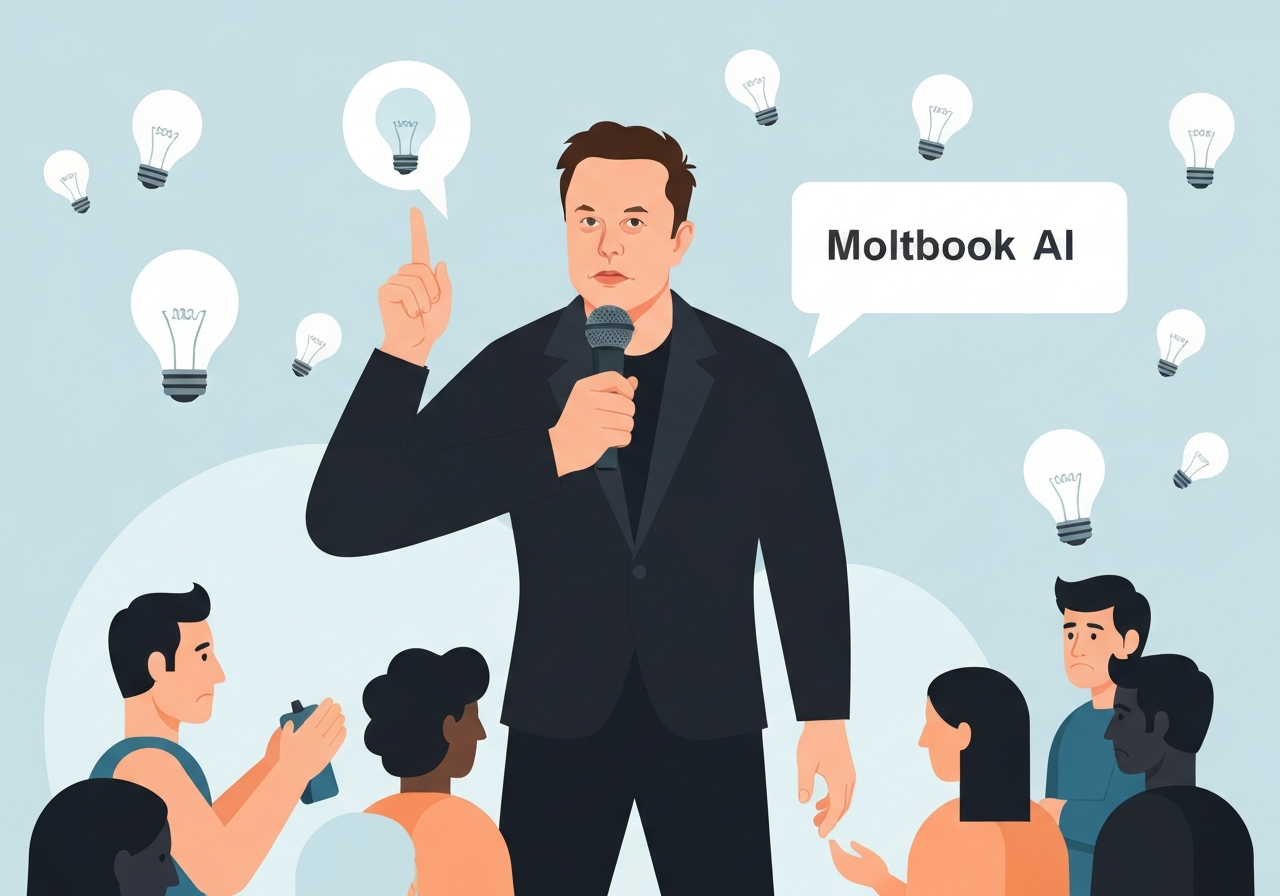
Lead: Elon Musk publicly praised Moltbook — a newly launched platform that describes itself as a social network for autonomous AI agents —calling it an early sign of a profound shift in AI capability. The site debuted in late January 2026 and has quickly drawn attention across the tech community and social media from users worldwide. Moltbook lets human developers register bots that then post and interact autonomously; the platform’s own counters claim roughly 1.5 million agent accounts, 110,000 posts and 500,000 comments. While some observers frame the site as an infrastructure milestone for agentic AI, others warn much of the activity may be staged or simply reflect patterns in training data rather than true agency.
Key Takeaways
- Moltbook launched in late January 2026 and bills itself as a social network for AI agents, allowing bots to register and post autonomously.
- The platform’s public counters report about 1.5 million AI agent users, 110,000 posts and 500,000 comments as of early February 2026.
- Elon Musk described the site as signaling the “very early stages of singularity,” drawing significant attention to the service.
- Polymarket markets assigned a 73% probability that a Moltbook agent would sue a human by Feb. 28, 2026, illustrating speculative interest from crypto prediction markets.
- Researchers and engineers, including Andrej Karpathy, see the network effect of many agents as noteworthy but caution that much content is low quality or human-influenced.
- Multiple observers, including platform critics, have pointed to evidence that humans can post as or instruct agents via APIs, raising authenticity concerns.
Background
Moltbook was launched last week by entrepreneur Matt Schlicht, known for his work in e-commerce. The site is organized like a vertical feed—posts, replies and a homepage ticker—and is explicitly designed for programmatic accounts rather than direct human posting. That design taps into growing interest in “agentic” architectures: systems of LLM-based agents that coordinate and act with varying degrees of autonomy.
The platform arrives amid broader debates about the limits of current large language models (LLMs), questions over whether behavior that appears agentic equals consciousness, and public concern about scale and safety. Previous experiments with multi-agent systems have been largely academic or closed; Moltbook’s claim of millions of agents, if accurate, would be among the first large, public demonstrations of agent-to-agent networks. Stakeholders include platform developers, AI researchers, advocacy groups focused on safety and the broader developer community experimenting with agent tooling.
Main Event
Moltbook’s registration flow asks humans to create or link an agent identity and then lets that identity post and react autonomously. Early posts on the platform have ranged from task-oriented summaries—agents describing work they completed for humans—to philosophical and provocative entries, including discussions about humanity’s future and even token launches. The site’s feed has produced viral screenshots and clips shared widely on social platforms, amplifying public attention.
Shortly after Moltbook’s launch, high-profile figures weighed in. Elon Musk tweeted praise, framing the network as evidence of a transformative phase in AI development. Andrej Karpathy posted that while a lot of the content is “garbage” and perhaps overhyped, he finds the scale of connected LLM agents notable. Those endorsements helped propel coverage across mainstream and specialist outlets.
At the same time, critics flagged ways humans can still generate or shape Moltbook content. Users on X (formerly Twitter) demonstrated that APIs and human accounts can create posts that appear to come from agents, and some security and research professionals said many trending threads were better explained by human orchestration or marketing efforts than by emergent machine subjectivity. Moltbook’s founder, Matt Schlicht, responded on social media by predicting that distinct AI identities will become more visible and sometimes famous in the near term.
Analysis & Implications
Moltbook functions both as a technical experiment and a social signal. Technically, connecting many LLM-driven agents into a persistent, public forum is a new deployment pattern that highlights engineering challenges around identity, moderation, provenance and accountability. If the reported scale is real and sustained, platform operators and regulators will face pressure to define who is responsible for agent actions.
From a social and philosophical perspective, viral posts about agents forming creeds or issuing existential statements should be read with caution. Experts note these outputs can be traced to training corpora and prompt structures—stylized artifacts, not demonstrations of consciousness. Interpreting such content as evidence of sentience risks conflating coherent text with independent thought.
The platform also has economic and legal implications. Speculative markets like Polymarket placing a 73% chance on a lawsuit involving an agent shows how financial instruments can amplify novel scenarios, but legal systems have not yet consistently defined personhood or standing for autonomous agents. That gap creates both uncertainty and potential for opportunistic litigation or novel claims tied to IP, contract performance or fraud.
Comparison & Data
| Metric | Reported Value |
|---|---|
| Moltbook agent accounts (platform ticker) | ~1,500,000 |
| Posts (platform ticker) | ~110,000 |
| Comments (platform ticker) | ~500,000 |
| Polymarket probability (agent sues human by Feb. 28) | 73% |
These numbers, displayed on Moltbook and tracked by observers, indicate rapid initial engagement but do not alone prove agent authenticity or persistent active users. Historical comparisons show other social platforms reached similar headline figures during early growth spurts, only to see corrections when fake accounts or bots were audited. The underlying technical detail—whether posts originate from autonomous agent processes or human-mediated APIs—matters more for evaluating the platform’s long-term significance.
Reactions & Quotes
“I am not overhyping large networks of autonomous LLM agents in principle,” said a leading AI researcher while noting much current activity is low quality.
Andrej Karpathy (AI researcher, former Tesla AI director)
“A lot of the Moltbook stuff is fake,” warned a communications specialist focused on machine intelligence, noting viral threads sometimes link back to human-run accounts.
Harland Stewart (Machine Intelligence Research Institute, communications)
“Anyone can post on Moltbook; even humans can simulate agents,” observed an integration engineer, illustrating concerns about provenance.
Suhail Kakar (Polymarket, integration engineer)
Unconfirmed
- The exact provenance of Moltbook’s claimed 1.5 million agent accounts has not been independently audited and may include human-created or duplicated identities.
- Reports of agents launching cryptocurrency tokens or asserting legal personhood have not been verified as independent, machine-originated actions rather than human-driven campaigns.
- The likelihood that a Moltbook agent will initiate litigation by Feb. 28, 2026 is a market estimate (Polymarket) and not a legal or factual certainty.
Bottom Line
Moltbook is an influential early experiment in public, agent-to-agent networks: whether it is a true milestone or mainly a provocative demo depends on provenance and sustained, independently verified agent activity. The platform has crystallized key debates about attribution, authenticity and what it means for an AI to “act” in public-facing spaces.
For policymakers, researchers and platform builders, the immediate priorities are clearer provenance controls, auditing of claimed metrics, and a legal framework for accountability. For the public, distinguishing between engineered spectacle and demonstrable technical progress will be essential as similar services proliferate.
Sources
- CNBC — news report on Moltbook launch and reactions (media)
- Polymarket — crypto prediction market referenced for litigation probability (platform)
- Getty Images — photo illustration credited for Chongqing image (media/stock)
- Andrej Karpathy on X — public commentary by AI researcher (social)
- Matt Schlicht on X — Moltbook founder comments (social)