
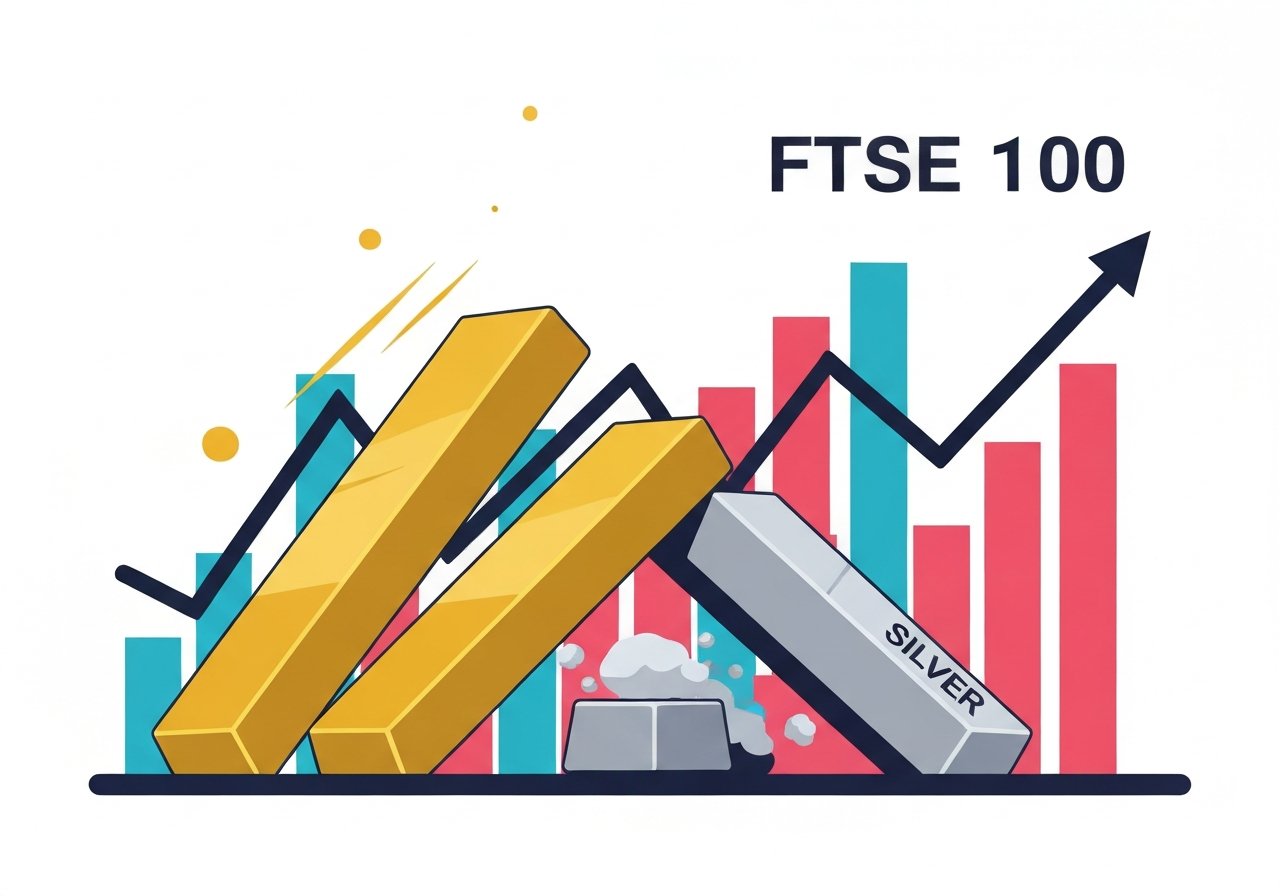
Lead: Global markets saw a sharp reallocation on Monday as gold and silver prices retreated from last week’s peaks while the UK’s FTSE 100 closed at a record high. Spot gold suffered its steepest one‑day fall since 1983, dropping more than 9% in a single session, and silver plunged as much as 27% before a partial recovery. The moves followed the nomination of Kevin Warsh to lead the US Federal Reserve, a stronger dollar and changes to trading requirements on a major exchange. Despite the commodity sell‑off, the FTSE 100 closed up 1.2% at 10,341.56, setting a fresh closing and intra‑day high.
Key takeaways
- Spot gold recorded a one‑day slump of over 9%, its steepest fall since 1983, and by 17:00 GMT on Monday was down 4.6% at $4,659.16 per ounce.
- Silver plunged as much as 27% at one point and had eased to $78.70 by 17:00 GMT, a 7.63% decline from the previous close.
- The FTSE 100 closed up 1.2% at 10,341.56 with a new intra‑day peak of 10,345.48, shrugging off early weakness.
- The US dollar rose about 1% after Kevin Warsh’s nomination to lead the Federal Reserve, putting pressure on dollar‑priced commodities.
- Asian equity markets fell: South Korea’s Kospi led declines with a 5% drop, Hong Kong’s Hang Seng fell about 2% and Japan’s Nikkei 225 was down more than 1%.
- Gold miners such as Fresnillo and Endeavour Mining were down more than 2% amid the fall in metal prices.
- Global energy markets saw crude oil fall nearly 5%, influenced by production decisions from major producers and signs of reduced US–Iran tensions.
- Bitcoin slipped below $75,000 on Monday after last week’s rout, returning roughly to pre‑election levels following gains in November 2024.
Background
In January, gold and silver surged to fresh records as investors sought safety amid heightened geopolitical uncertainty. That rally pushed gold above $5,500 and silver above $120 at their recent peaks, drawing speculative interest and new money into so‑called safe havens. Such episodes are not unprecedented: precious metals often rally in periods of political risk but can reverse sharply when sentiment or liquidity shifts.
The recent dislocations were compounded by two structural factors. First, concerns about the perceived independence of the Federal Reserve had unsettled some investors; the nomination of Kevin Warsh — a former Fed governor — was widely watched for what it might signal about future monetary policy. Second, a change in margin or trading requirements on a major exchange raised the cost of leveraged speculation, prompting some positions to be cut back or liquidated, adding selling pressure.
Main event
The trading week intensified on Friday when spot gold fell more than 9% in a single day — its largest one‑day slide since 1983 — and silver plunged as much as 27% before stabilising. On Monday afternoon (by 17:00 GMT) gold was quoted at $4,659.16 per ounce, down 4.6% on the day, while silver traded at $78.70, down 7.63%. Both metals therefore sat well below their highs recorded the previous week.
Markets also registered divergent moves across assets. The US dollar strengthened, gaining roughly 1% after political developments around the Fed nomination, making dollar‑denominated commodities pricier for buyers using other currencies. Oil dropped nearly 5% as major producers agreed to keep output broadly unchanged and diplomatic tensions appeared to ease, both factors weighing on risk premia in energy markets.
Equities showed a split response. Asian bourses led global losses — with South Korea’s Kospi down about 5% — while US markets opened lower but the S&P 500 finished modestly higher, up around 0.5%. In London the FTSE 100 initially eased but then recovered to close 1.2% higher at 10,341.56, setting a new closing record and an intra‑day high of 10,345.48. Mining stocks were pressured by falling commodity prices; Fresnillo and Endeavour Mining fell more than 2%.
Analysis & implications
The speed and scale of the precious metals reversal underline a core market truth: assets bought as risk insurance can themselves be volatile. A rapid re‑pricing can be triggered by a combination of policy signals, liquidity shifts and technical factors such as higher margin requirements. For investors, the episode highlights the risk of treating recent strong performance as stability rather than a function of short‑term flows.
Monetary policy perceptions are central. The nomination of Kevin Warsh appears to have reassured markets about the likely path for US policy, supporting the dollar and reducing some of the inflation‑hedge demand for gold. If the Fed’s future stance is perceived as less accommodative, gold and other commodities denominated in dollars typically face downward pressure.
Broader economic knock‑on effects are mixed. A stronger dollar and lower commodity prices can ease imported inflation for commodity‑importing countries, but they pressure miners’ revenues and capital spending plans. For portfolios, the event will likely prompt reviews of liquidity management and leverage in commodity exposure, and may accelerate regulatory scrutiny of margining and speculative activity on exchanges.
Comparison & data
| Instrument | Recent peak | Price (17:00 GMT, Mon) | Change from peak |
|---|---|---|---|
| Gold | Above $5,500 (last week) | $4,659.16/oz | Down ~15% from peak |
| Silver | Above $120 (last week) | $78.70/oz | Down ~35% from peak |
| FTSE 100 | — | 10,341.56 (close) | Record closing high |
| Bitcoin | Post‑election highs (Nov 2024) | Below $75,000 | Back to pre‑election levels |
The table contextualises the drop from last week’s metal records and contrasts the rally in UK equities. While exact percentage moves vary by intraday pricing, the direction is clear: metals shed a substantial portion of very recent gains while some equity indices hit fresh highs.
Reactions & quotes
“Many investors bought gold and silver as protection against the volatile geopolitical backdrop, yet they’ve learned the hard way these assets can also be volatile themselves.”
Russ Mould, Investment Director, AJ Bell
AJ Bell’s comment reflects widespread investor surprise at the rapid unwinding of positions that had been pushed higher by safe‑haven demand.
“Warsh’s naming helped lift the dollar and calm some market concerns about policy direction, which fed through to commodity prices.”
Market commentator (financial analysis)
Observers noted that the dollar’s roughly 1% gain reduced the local currency appeal of dollar‑priced commodities for many buyers, amplifying the metals sell‑off.
“Only around 216,265 tonnes of gold have ever been mined,”
World Gold Council (industry data)
The World Gold Council’s figure on cumulative mined gold is often cited to explain gold’s value proposition, though scarcity alone does not prevent short‑term price swings.
Unconfirmed
- The precise share of the metals sell‑off directly attributable to the nomination of Kevin Warsh versus exchange margin changes is not fully verifiable and likely reflects a combination of factors.
- Reports linking specific mining company share moves solely to metal price changes may understate company‑specific news or liquidity effects.
- Allegations of conflicts of interest tied to political figures and crypto ventures remain subject to ongoing reporting and have not been adjudicated here.
Bottom line
This episode underlines that safe‑haven assets can experience sudden reversals when liquidity, policy expectations and technical market rules shift. Investors who treated recent metal gains as stability faced rapid losses as sentiment shifted and structural trading costs increased.
For markets, the most immediate implication is renewed attention to the interaction between monetary policy signals and commodity liquidity: a firmer dollar and expectations of a clearer Fed path have the potential to unwind speculative rallies quickly. Going forward, traders and policymakers will watch for whether changes in exchange margining persist, how the Fed nomination process evolves, and whether any regulatory adjustments follow the volatility.
Sources
- BBC News — news report and market summary
- World Gold Council — industry data on cumulative mined gold (trade association)
- Bloomberg — reporting on cryptocurrency flows and related wealth figures (news analysis)
- AJ Bell — investment firm commentary (industry commentary)