
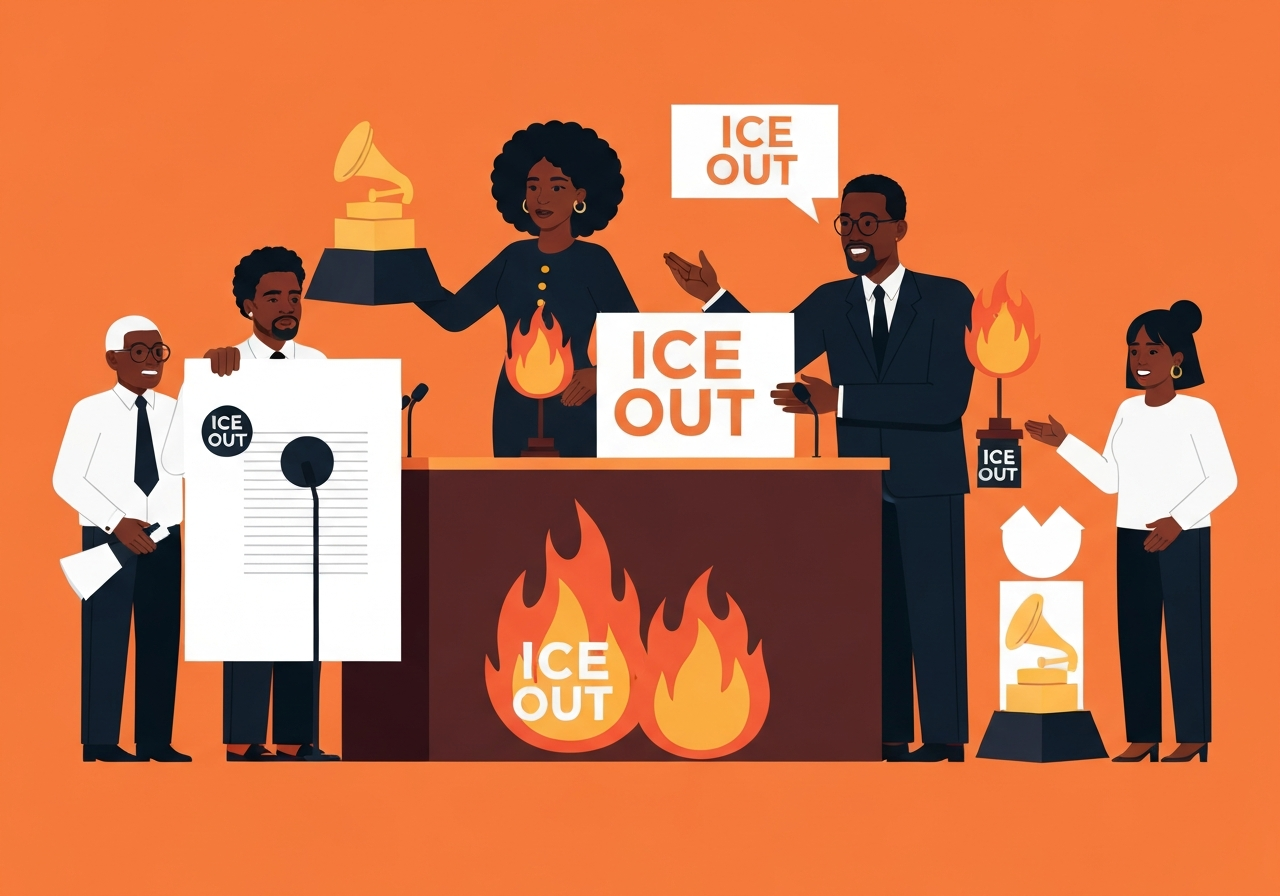
On Feb. 2, 2026 in downtown Los Angeles, music stars turned the Grammys into a platform for immigration protest, wearing black-and-white pins reading “ICE OUT” and delivering pointed onstage remarks. The shift became most visible about an hour into the telecast when Bad Bunny — greeted by a standing ovation — used his acceptance for best música urbana album to call for removing Immigration and Customs Enforcement. Billie Eilish, accepting song of the year for a record-setting third time, declared, “No one is illegal on stolen land,” and censored a profanity aimed at ICE on live television. The political tenor followed the recent killings of two protesters by federal agents in Minneapolis, a development that framed many performers’ remarks.
Key Takeaways
- Event: The Grammy Awards took place Feb. 2, 2026, in downtown Los Angeles and included high-profile political statements by multiple artists.
- Visible protest: Many attendees wore black-and-white pins reading “ICE OUT,” a message directed at Immigration and Customs Enforcement.
- Notable moments: Bad Bunny accepted best música urbana album and said “ICE out,” drawing a standing ovation; Billie Eilish won song of the year for a third time and made a high-profile anti-ICE statement.
- Context: Remarks came amid national attention to the recent deaths of two protesters in Minneapolis after encounters with federal agents.
- Other winners: Olivia Dean, named best new artist, described herself as a “granddaughter of an immigrant” and praised immigrant bravery.
- Host reaction: Trevor Noah’s hosting drew public criticism from former President Donald Trump, according to social media reactions during the broadcast.
- Television broadcast: A profanity directed at ICE during Eilish’s remarks was censored on the live telecast.
Background
The Grammys have periodically served as a stage for social and political commentary; in 2026 the ceremony intersected with an intense national debate over immigration enforcement. Immigration and Customs Enforcement (ICE) has been at the center of policy disputes for years, and the agency’s actions have become a flashpoint for artists and activists seeking to spotlight civil-rights concerns. The killings in Minneapolis — two protesters fatally shot during interactions with federal agents — heightened scrutiny of federal law enforcement and provided immediate context for performers who raised immigration and policing issues onstage.
Musicians often use award shows to amplify causes to a broad audience, and organizers have in recent years allowed brief political remarks in acceptance speeches. This year’s visible solidarity included wearable messaging as well as verbal statements, suggesting coordination among some attendees even as the full nature of any organized campaign remained unclear. Rights groups and immigration advocates have steadily increased outreach to cultural figures, seeing award shows as opportunities to influence public conversation ahead of elections and policy debates.
Main Event
The first clear sign of a collective message came early on Feb. 2, when multiple artists arrived wearing the same black-and-white “ICE OUT” pins. About an hour into the telecast, Bad Bunny used his acceptance speech for best música urbana album to foreground the phrase, telling the audience “ICE out” before offering thanks. The remark was met with a standing ovation and amplified on social platforms within minutes.
Billie Eilish’s acceptance for song of the year—her third time winning that category—contained some of the ceremony’s sharpest language. She declared, “No one is illegal on stolen land,” and went on to criticize ICE with language that was censored in the live broadcast. Her win and remarks quickly became a focal point in post-show coverage and social-media debate.
Other winners took a less confrontational tone while still addressing immigration. Olivia Dean, awarded best new artist, framed her remarks through family history, calling herself “a granddaughter of an immigrant” and urging celebration of immigrant courage. Throughout the evening, several performers and presenters referenced immigrant experiences or condemned enforcement tactics, creating a sustained thematic thread across different segments of the show.
The host, Trevor Noah, interspersed topical jokes and commentary that prompted public pushback from former President Donald Trump, who criticized Noah’s performance on social media during the broadcast. The exchange added a partisan dimension to the ceremony’s coverage and drew responses from both supporters and critics of the artists’ statements.
Analysis & Implications
The high-profile nature of the Grammys amplifies any political message delivered there; when multiple award recipients and performers coordinate visible signals, the effect is magnified in mainstream and social-media outlets. For immigration advocates, the ceremony offered national visibility to criticisms of ICE at a moment of heightened public attention following the Minneapolis deaths. That visibility can shift public conversation by reframing enforcement as a civil-rights issue rather than solely a policy or law-enforcement matter.
Politically, the stars’ statements may deepen polarization: supporters of stricter immigration enforcement interpreted the remarks as inappropriate politicization of entertainment, while critics framed them as necessary moral protest. The immediate policy impact is indirect—award-show speeches do not change statutes—but they can affect public opinion, fundraising, and activist momentum ahead of legislative sessions or elections.
For the music industry, the ceremony underscored a balancing act between commercial interests and artists’ desire to speak on social issues. Broadcasters and sponsors must weigh audience reactions, potential advertiser concerns, and the growing expectation among many performers that cultural platforms be used for advocacy. That dynamic will likely shape how future ceremonies are staged and how producers engage with artists on content and messaging.
Comparison & Data
| Artist | Award | Onstage Statement |
|---|---|---|
| Bad Bunny | Best Música Urbana Album | Used “ICE out” phrase; emphasized humanity of migrants |
| Billie Eilish | Song of the Year (third win) | “No one is illegal on stolen land,” followed by censored profanity aimed at ICE |
| Olivia Dean | Best New Artist | Described herself as granddaughter of an immigrant; lauded immigrant bravery |
The table summarizes the ceremony’s most visible intersections of awards and political messaging. While a precise count of all politically themed remarks would require a systematic transcript analysis, the three examples above dominated coverage and social-media discussion; they exemplify how individual acceptance speeches can shape the narrative of an entire broadcast.
Reactions & Quotes
Responses came from across the political spectrum and from industry observers. The following short quotes capture key moments and are accompanied by context.
“We’re not savage, we’re not animals, we’re not aliens. We are humans, and we are Americans.”
Bad Bunny
Bad Bunny framed his “ICE out” comment as part of a broader appeal to humanity and dignity for migrants; the line received a standing ovation and immediate amplification on social networks.
“No one is illegal on stolen land.”
Billie Eilish
Eilish’s condensed statement invoked long-standing critiques of immigration policy and was followed by a profanity directed at ICE that was censored on the live telecast, intensifying debate about broadcast standards and political speech.
Unconfirmed
- Whether the black-and-white “ICE OUT” pins were distributed through a single coordinated campaign or arrived through multiple informal sources remains unverified.
- Full official findings about the Minneapolis deaths and any subsequent disciplinary or legal outcomes are still pending public release and may change as investigations proceed.
- The extent to which individual artists coordinated their remarks across the ceremony has not been confirmed by representatives for all performers.
Bottom Line
The Feb. 2, 2026 Grammys became a prominent moment in the cultural politics of immigration, as multiple major artists used a mass-media stage to question enforcement practices and show solidarity with migrants. While these speeches do not directly alter policy, they shape public discourse and can influence subsequent media coverage, advocacy efforts, and voter perceptions.
Looking ahead, award shows are likely to remain contested public forums where culture and politics intersect. Producers, artists, and advocates will continue to navigate how best to communicate urgent social concerns on high-visibility platforms without alienating portions of their audiences or crossing broadcast standards.