
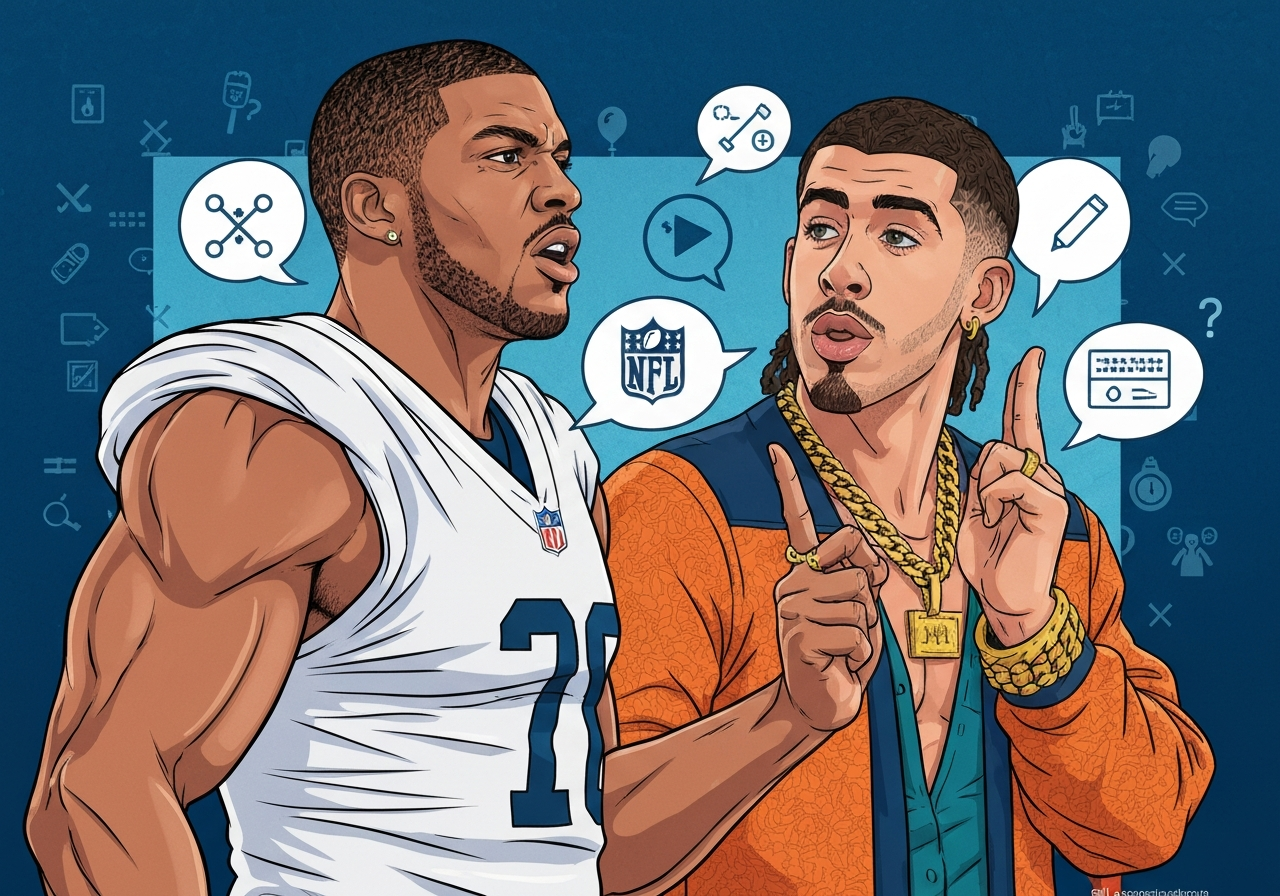
An anonymous AFC offensive player told The Athletic in a survey released Monday that he does not support Bad Bunny as the Super Bowl halftime performer, saying, “I think there are better examples of character and morality than Bad Bunny.” The survey found 58.6% of players backed Bad Bunny while 41.4% opposed him. The comment triggered debate because the NFL selected Bad Bunny to help grow its international and Latino audience, and because the artist recently won Album of the Year at the Grammys and was Spotify’s most-streamed artist in 2025 with nearly 20 billion streams.
- 58.6% of NFL players surveyed by The Athletic supported Bad Bunny as the Super Bowl halftime performer; 41.4% did not.
- An unnamed AFC offensive player told The Athletic he objects on grounds of “character and morality,” but did not specify alleged misconduct.
- Bad Bunny won Album of the Year at the Grammys (the first fully Spanish-language album to do so) and led Spotify with ~20 billion streams in 2025.
- Bad Bunny previously appeared in a Super Bowl halftime set in 2020 alongside Jennifer Lopez and Shakira.
- The NFL says it chose Bad Bunny to help expand its international and Latino viewership; executives weighed owner concerns about partnerships, including an ESPN equity matter.
- Turning Point USA is staging an “All-American Halftime Show” as counter-programming to the NFL’s choice.
- Some opposition centers on unfamiliarity with Bad Bunny or preference for acts tied to football culture rather than documented misconduct.
Background
The Athletic ran an anonymous player survey that asked about the Super Bowl halftime selection; results were released Monday. The anonymous AFC offensive player’s remark that Bad Bunny lacks suitable “character and morality” arrived without concrete allegations, and The Athletic’s write-up did not identify the player. The NFL’s halftime choices are typically driven by reach and spectacle rather than moral vetting; the league says it sought a performer who would draw new viewers, particularly across Latino and international markets.
Bad Bunny’s profile has been rising on multiple fronts. He won the Grammy for Album of the Year on Sunday, the first fully Spanish-language album to receive that honor, and Spotify data show he was the platform’s most-streamed artist in 2025 with nearly 20 billion streams. He has prior Super Bowl exposure from 2020 and has used his platform to speak on immigration and other political issues, prompting both praise and pushback.
Main Event
The Athletic’s player survey produced a split: a majority in favor of Bad Bunny, but a sizable minority opposed. The anonymous AFC offensive player told the outlet he simply does not view Bad Bunny as an exemplar of character, but offered no specifics to substantiate that judgment. Other players who opposed the selection cited unfamiliarity with the artist or a desire for performers more closely tied to football lore.
Bad Bunny’s recent Grammys remarks — calling to disband ICE and asserting the humanity of migrants — are fresh in public memory and may sharpen reactions on both sides, though The Athletic’s survey likely predated that Sunday night speech. Turning Point USA announced an “All-American Halftime Show” as alternative programming, positioning its lineup explicitly as a counternarrative to the NFL’s pick.
The NFL has stood by its choice, saying the performer fits the league’s strategic goals even as at least one owner reportedly worried the selection could complicate a partnership involving ESPN equity. League officials emphasized reach and box-office draw as primary criteria; given the NFL’s history on player conduct controversies, the league’s decision not to apply a moral litmus test to entertainers was presented as unsurprising.
Analysis & Implications
The anonymous critique raises questions about consistency: players judged entertainers on “character” while the league itself has faced longstanding criticism for its handling of on-field and off-field misconduct by players. That contrast has prompted observers to question whether standards are being applied uniformly and what “character” should mean when evaluating performers versus athletes.
Bad Bunny’s selection reflects a business calculation: expanding the NFL’s audience beyond traditional U.S. football viewers. The artist’s Grammy win and massive streaming footprint suggest strong potential to attract Hispanic and international viewers, which can influence TV ratings, advertising revenue, and the league’s global brand. For advertisers and partners, the calculus will be whether increased reach offsets any reputational friction among certain segments of the domestically focused fan base.
Politically charged reactions are predictable. Artists who take public stances—on immigration or other issues—will draw scrutiny from audiences and interest groups with opposing views. The emergence of counter-programming like Turning Point USA’s show signals that halftime choices can catalyze organized alternatives, though their reach is likely smaller than the NFL’s built-in audience.
Comparison & Data
| Metric | Value |
|---|---|
| Player support (The Athletic survey) | 58.6% support / 41.4% oppose |
| Bad Bunny Spotify streams (2025) | ~20 billion |
| Grammys | Album of the Year (first fully Spanish-language winner) |
| Previous Super Bowl exposure | Appeared in 2020 halftime set with J.Lo and Shakira |
| Estimated Super Bowl audience | ~150 million viewers (typical ballpark figure) |
The table highlights the gap between marketplace metrics—streams and award recognition—and opinion metrics among players. The numbers suggest the NFL prioritized measurable reach while a nontrivial minority of players expressed reservations rooted in unfamiliarity or perceived cultural fit rather than documented impropriety.
Reactions & Quotes
“I think there are better examples of character and morality than Bad Bunny.”
The Athletic (anonymous AFC player, sports journalism)
“We are not savage, we are not animals, we are not aliens, we [are] humans, and we are Americans.”
Bad Bunny at the Grammys (reported via Variety)
Unconfirmed
- Whether The Athletic survey was conducted before or after Bad Bunny’s Grammys remarks is unclear and may affect interpretation of responses.
- The anonymous player’s precise objections to Bad Bunny’s “character and morality” were not detailed, leaving the basis for their judgment unverified.
- Reports that at least one owner feared the selection could threaten an ESPN equity deal are secondhand in coverage and lack a named official confirmation in the cited reporting.
Bottom Line
The clash between an anonymous player’s moral critique and the NFL’s strategic choice underscores competing priorities: individual perceptions of appropriateness versus institutional goals to broaden audience reach. Bad Bunny’s commercial credentials—Grammy recognition and extraordinary streaming numbers—made him an attractive pick for the league’s international and Latino outreach.
Absent substantiated allegations, criticisms framed as judgments about “character and morality” risk appearing vague and inconsistent, particularly given the NFL’s own history with misconduct among players. The episode will be watched for two outcomes: whether the halftime performance achieves the league’s audience objectives, and whether organized counter-programming meaningfully diverts viewers or advertisers.
Sources
- Awful Announcing — media/opinion report summarizing reactions and survey coverage
- The Athletic — sports journalism outlet (source of anonymous player survey)
- Variety (tweet of Grammys clip) — media report of Bad Bunny’s Grammys remarks