
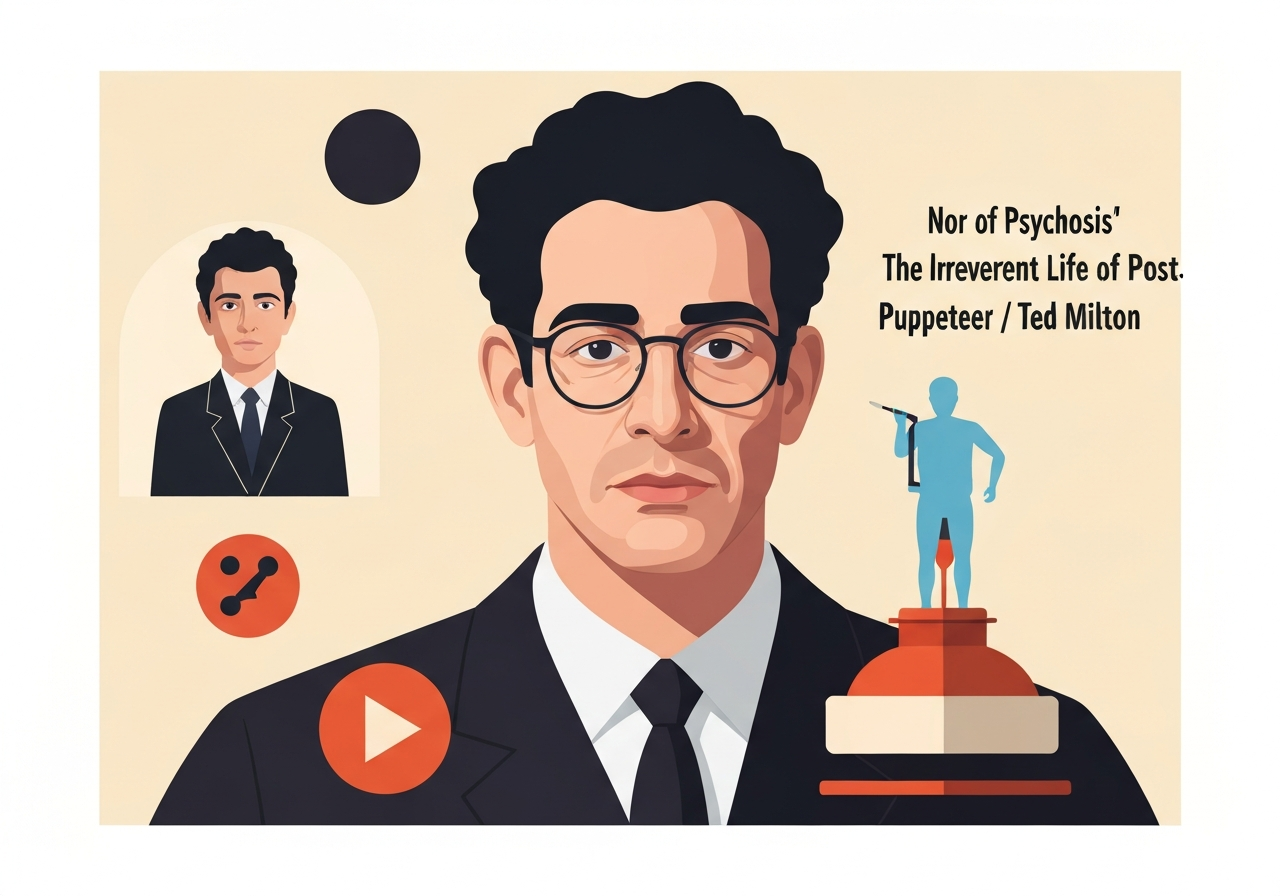
At 82, Ted Milton remains an improbably persistent figure of British counterculture: a saxophonist, poet, former avant‑garde puppeteer and the longtime leader of post‑punk trio Blurt. We met in his Deptford studio above a rehearsal space, where record boxes, poetry pamphlets and a conspicuously orange suitcase sit among tools for his woodblock prints. He is preparing tour merchandise and a new album with his duo the Odes while gearing up to tour Europe again with Blurt. A new film by his son George, The Last Puppet Show, now stages both Milton’s art and his tangled family relationships through freshly animated puppets.
Key Takeaways
- Ted Milton is 82 and based in Deptford, London; he continues to tour with Blurt and release new work with the Odes.
- He has been married three times and has five children, the youngest born when he was nearly 70.
- Milton’s puppetry and performance intersected with notable figures: he shared taxis with William S. Burroughs in the 1960s and influenced Eric Clapton’s early sense of performance.
- His puppet work appeared in Terry Gilliam’s 1977 film Jabberwocky and is linked by rumor to a lost 1967 Pink Floyd promotional film for Scream Thy Last Scream.
- Blurt—Milton’s bass‑less trio—has been praised by peers such as Graham Lewis of Wire and was championed early on by Tony Wilson and Factory Records.
- Milton’s poetry reached The Paris Review in 1963; he studied art in Cambridge and drifted into London’s bohemian scene in the 1960s.
- The Last Puppet Show, directed by his son George, functions partly as family reckoning and partly as archival rescue through new puppet work.
Background
Milton’s childhood set the tone for a life of rebellion and imaginative survival. He went to boarding school after his parents moved to West Africa when he was 11, an upheaval he links to both newfound independence and memorable repression. Records by Elvis, Carl Perkins and Little Richard fed an early musical hunger; as an adolescent he also cultivated what he calls deliberate disobedience as a way to unsettle authority. Those impulses later folded into formal art study in Cambridge, where involvement in the local jazz scene and friendships with figures such as poet Pete Brown nudged him toward performance and bohemia.
By the mid‑1960s Milton was embedded in London’s fringe culture, sharing Long Acre with a circle that included Eric Clapton and other emerging music figures. His early poetry, some of which found its way into The Paris Review in 1963, sat alongside experimental theatre and puppet work. In the late 1960s he took a post at a Wolverhampton puppet theatre, then transitioned to harsher glove and street performances that foregrounded violence and provocation. Over time Milton refined a practice he called “performance animation,” using puppets’ apparent emptiness to pry open audience psychology.
Main Event
Across the 1970s and into the post‑punk era Milton stitched together seemingly unlikely platforms: puppet stages on Brighton’s West Pier, school audiences across Europe and support slots for rock artists including Eric Clapton and Ian Dury. His shows were intentionally confrontational—part Brechtian provocation, part carnivalesque insult—prompting hostile reactions at large gigs and sometimes physical pushback even from collaborators. Yet that same edge made his work mesh with the emergent post‑punk sensibility; Tony Wilson featured his puppetry on So It Goes in 1976 and Terry Gilliam included Milton’s aesthetic in Jabberwocky (1977).
Milton later added saxophone and vocals to his theatrical arsenal and formed Blurt, a drum‑guitar‑horn trio notable for its bass‑less, improvisatory attack. Wire’s Graham Lewis described Blurt’s live groove as “utterly fabulous,” and the band circulated through a variety of labels while maintaining a cult following. A 1984 solo track, Love Is Like a Violence, resurfaced decades later as an unexpected club favorite at Glasgow’s Optimo nights, demonstrating the longevity of Milton’s influence across scenes and generations.
In recent years the arc of Milton’s life has been reframed by his family. George Milton’s film The Last Puppet Show uses newly remade puppets to interrogate both the artistry and the fraught personal history of its subject. Milton admits he made few concessions over the decades—“one person beat me up,” he allows, naming a former bandmate—yet concedes that age has altered his stage habits. He now sometimes performs seated, a constraint he says has introduced new concentration and dynamics to his work.
Analysis & Implications
Milton’s career sits at the juncture of several post‑war cultural currents: the Beat infusion of transatlantic ideas, the theatrical experimentation of 1960s Britain, and the angular energies of post‑punk. His capacity to move between poetry, puppetry and raw musical improvisation made him both marginal and indispensable as scenes shifted. That mobility allowed Milton to influence peers without conventional commercial success—an influence measured more in anecdotes and through the testimony of other artists than in chart positions.
The family film project reframes Milton’s practice as material for intergenerational dialogue, turning live puppets into instruments of memory and critique. This shift matters because it signals a broader trend: artists who once operated at the margins are now curated and reconsidered by younger relatives or archivists, producing narratives that complicate the myth of the untouchable bohemian. In Milton’s case, the puppet becomes a stand‑in for unresolved domestic dynamics as much as for theatrical provocation.
Milton’s remark that “charisma is a form of psychosis” — his candid diagnosis of the burdens of performance — points to a longer conversation about the toll of sustained stage persona. Where Clapton recalled being awakened by Milton’s physical interpretation of blues recordings, Milton describes a lifetime of feeling perpetually observed. Aging performers who once inhabited amplified personas must now negotiate reduced mobility, audience expectations and the preservation of ephemeral instruments like puppets.
Finally, the persistence of stories and rumors—about a lost Pink Floyd promo or puppets sent to Alaska—illustrates how countercultural histories are often maintained through collage: patchy records, eyewitness fragments and reanimated artifacts. Scholarly or archival attention could clarify many of these threads, but the present film functions as one provisional attempt to historicize a life that resists tidy narration.
Comparison & Data
| Year | Event |
|---|---|
| 1963 | Poetry appears in The Paris Review |
| 1960s | Encounters with William S. Burroughs and Cambridge bohemia |
| 1976 | Featured on Tony Wilson’s So It Goes; support slot for Clapton |
| 1977 | Puppetry featured in Terry Gilliam’s Jabberwocky |
| 1984 | Solo track “Love Is Like a Violence” recorded |
The table highlights recurring milestones rather than exhaustive chronology. Milton’s output spans performance modes and media; these selected dates show the crossover between literary recognition, theatrical experimentation and post‑punk music, underlining how his career threads through several cultural moments.
Reactions & Quotes
“He made music come alive with movement and theatre,”
Eric Clapton (recollection)
Clapton’s recollection—recounted in his autobiography and in accounts of the period—credits Milton with a theatrical approach to listening that left a lasting impression on peers in the 1960s and 1970s.
“If success were handed to Ted, he’d turn it down,”
Roger Law (Spitting Image co‑creator)
Roger Law, a long‑time friend from Cambridge, frames Milton as willfully contrarian—someone at ease with subversion even when it collided with opportunity.
“Blurt were utterly captivating,”
Graham Lewis (Wire)
Members of the post‑punk scene praised the band’s raw live energy; Wire invited Blurt onto bills and peers continued to cite Milton’s shows as singular experiences.
Unconfirmed
- The claim that a lost 1967 Pink Floyd promotional film for “Scream Thy Last Scream” prominently features Milton’s overcoat via animatronics remains unverified.
- Accounts that Milton’s original puppets were sent to Alaska or deliberately burned are inconsistent and lack documentary confirmation.
- Specific details about physical altercations with bandmates are recounted by Milton but not independently corroborated in public records.
Bottom Line
Ted Milton’s trajectory resists simple categorization: he is at once a nuisance, a formative performer and a custodian of a stubbornly idiosyncratic practice that bridged puppetry, poetry and post‑punk music. His influence has been felt more as a diffuse cultural energy—an approach to performance and provocation—than through commercial milestones. The Last Puppet Show, by turning family footage and newly crafted puppets into a public reckoning, reframes Milton for a new century while raising questions about memory, accountability and artistic legacy.
As Milton adapts to the limits of age—sometimes performing seated and preparing tour merchandise in a Deptford studio—his story underscores a wider pattern: the survival of marginal artists often depends on the mediation of younger curators, kin and scenes that retranslate past provocations. For audiences and historians alike, Milton’s life offers a rich case study in how countercultural practice travels across media, generations and myth.
Sources
- The Guardian (feature article, journalism)