
Lead
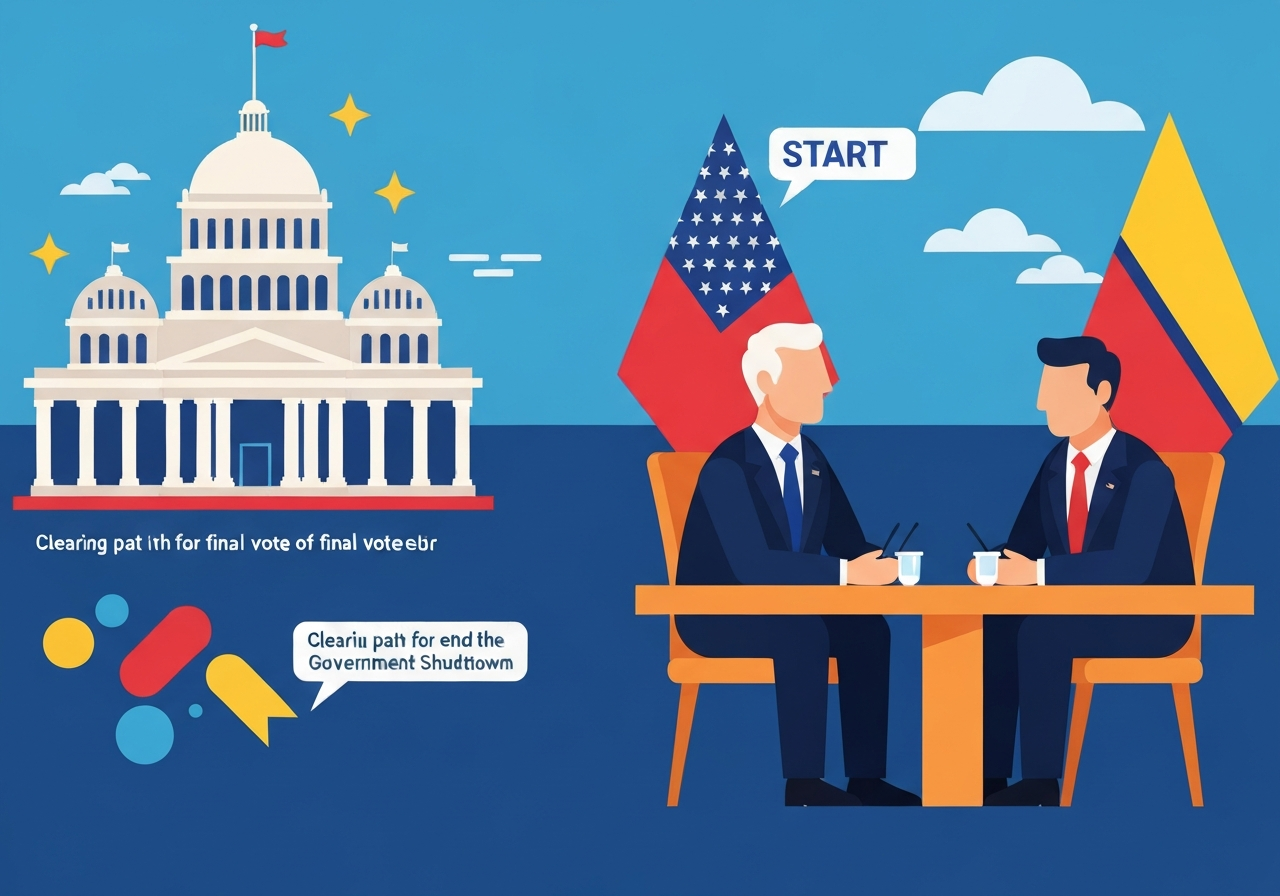
On Tuesday, Feb. 3, 2026, the House cleared a procedural hurdle that sets up a final vote on a sprawling funding package that would fully reopen the federal government within hours. The move followed intense private pressure from President Donald Trump and House leaders to bring holdout Republicans into line. The package funds multiple agencies but leaves a new Department of Homeland Security funding gap in about two weeks. Meanwhile, Trump hosted Colombian President Gustavo Petro at the White House — a meeting that comes after months of public confrontation between the two leaders.
Key Takeaways
- The House approved a key procedural vote on Feb. 3, 2026, clearing the way for a final passage vote on a funding bill that would end the partial shutdown within hours.
- Speaker Mike Johnson, with heavy outreach from President Trump, won almost unanimous GOP support; Rep. Thomas Massie remained the lone Republican voting no on the procedural move.
- The funding package restores operations for many agencies but creates another DHS funding cliff two weeks from now, requiring further congressional action.
- At the White House, President Trump met Colombian President Gustavo Petro; Petro was added to the U.S. Treasury’s SDN list in October 2025 and the meeting follows public disputes about drugs and migration.
- Trump renewed calls to “nationalize the voting,” which the White House framed as support for the SAVE Act and a national voter ID requirement—an idea sharply criticized by Democrats and some Republicans as unconstitutional or disenfranchising.
- Tensions with Iran remain elevated: U.S. forces shot down an Iranian drone near the USS Abraham Lincoln (about 500 miles from Iran) and Iranian gunboats threatened a U.S.-flagged tanker in the Strait of Hormuz.
- The FBI executed a warrant at the Fulton County election warehouse, removing roughly 700 boxes of material as part of a probe tied to the 2020 election; body-camera footage obtained by media shows officers coordinating on-site.
Background
The partial government shutdown began after congressional negotiations collapsed over policy riders and spending levels, with hard-line House conservatives demanding additional measures such as a strict voter-ID statute be attached to appropriations. For weeks, a small group of GOP holdouts threatened to block a stopgap or full-year spending bill, creating leverage for leadership and the White House to make concessions or exert pressure.
President Trump pushed intensively to persuade wavering Republicans to back the funding package, arguing swift passage was necessary to avoid a prolonged shutdown. The House procedural vote Tuesday showed the effect of that lobbying: all but one Republican voted to advance the measure. House Democrats uniformly opposed the package citing policy content and process concerns.
Main Event
On the floor Tuesday, Speaker Johnson forced a procedural test vote that required nearly unanimous GOP backing because Democrats opposed the legislation. Leadership marshalled members through personal appeals and assurances, while Representative Thomas Massie of Kentucky stood apart as the single Republican no vote on the procedural motion. Lawmakers indicated they could change their votes until the final rule vote closed, but the momentum pushed toward a final passage vote expected later the same day.
President Trump, who publicly supports the broader funding bill, told GOP holdouts to prioritize reopening the government over attaching the SAVE Act to the package. The White House said Trump will pursue the voter-ID legislation separately rather than risk a lengthy shutdown over it. That choice defused an immediate intra-party standoff but left the legislation’s backers vowing further fights.
At the White House on Tuesday, Trump hosted Colombian President Gustavo Petro, joined by Vice President J.D. Vance, Secretary of State Marco Rubio and senior Colombian officials. The visit is notable because Petro was sanctioned by the U.S. Treasury in October 2025 and the two leaders have publicly sparred over drug trafficking and migration issues for more than a year.
Outside Washington, regional security worries continued: a U.S. aircraft carrier shot down an Iranian drone after it aggressively approached the USS Abraham Lincoln in the Arabian Sea, about 500 miles from Iran’s southern coast; later, two IRGC gunboats threatened to board the American-flagged M/V Stena Imperative in the Strait of Hormuz. U.S. forces escorted the tanker to safety and reported no injuries or damage.
Analysis & Implications
Domestically, ending the partial shutdown restores immediate government services and payrolls, reducing short-term economic and operational disruption. However, the decision to leave DHS funded for only two weeks creates a near-term political deadline that will force another round of negotiations. That recurring cliff approach allows leverage for factions inside both parties and raises the odds of repeated stopgap measures rather than a durable budget compromise.
The push for a national voter-ID requirement and Trump’s call to “nationalize the voting” elevate a constitutional and political flashpoint. Legal scholars and many Democrats argue federalizing election administration would exceed Congress’s authority and risk disenfranchising eligible voters—particularly if strict ID or citizenship-verification provisions are applied unevenly. Some Senate Republicans, including Leader John Thune, have said they favor parts of the SAVE Act (citizen-only voting and ID) but oppose full federal control of elections, underscoring the legislation’s uncertain path in the Senate.
On foreign policy, Trump’s meeting with Petro signals a pragmatic—if awkward—approach: engaging a foreign leader who is also on the SDN list in order to address migration and narcotics issues. The encounter could recalibrate bilateral cooperation on security and counternarcotics, but it also risks domestic political blowback given Petro’s designation and the prior public exchange of accusations.
The confrontations with Iran and the scheduled U.S.-Iran talks later in the week illustrate the tightrope between diplomacy and deterrence. The downed drone and harassing high-speed boat maneuvers demonstrate continued risk of kinetic escalation, even as envoys prepare to negotiate. If diplomacy falters, the administration has signaled military options remain on the table, which could quickly change regional calculations and market reactions.
Comparison & Data
| Item | Reported Figure | Context |
|---|---|---|
| Fulton County materials taken | 700 boxes | Seized by FBI in probe of 2020 election-related allegations |
| Ukraine attack (reported) | 70 missiles, 450 attack drones | Russian assault on energy infrastructure across multiple regions |
| Distance of USS Abraham Lincoln from Iran | ~500 miles | Location of Iranian drone engagement in Arabian Sea |
Those figures highlight the overlapping domestic and international pressures facing the administration: a large evidence seizure tied to domestic political probes, significant Russian attacks affecting European energy security, and proximate maritime confrontations with Iran that threaten commercial and military vessels.
Reactions & Quotes
The White House defended the administration’s steps on election security and the funding bill. Press secretary Karoline Leavitt framed the president’s push for a voter-ID law as a response to public concern about election integrity.
“Tulsi Gabbard has been tapped by the president … to oversee the sanctity and the security of our American elections.”
Karoline Leavitt, White House press secretary
Leavitt also said the SAVE Act is a legislative vehicle for those goals and that Trump prefers a separate vote on the measure rather than attaching it to the funding bill.
Ukrainian President Volodymyr Zelensky condemned the recent Russian strikes as deliberate attacks on civilians and energy systems during winter, underscoring the humanitarian and strategic costs of renewed bombardment.
“Taking advantage of the coldest days of winter to terrorize people is more important to Russia than turning to diplomacy.”
Volodymyr Zelensky, President of Ukraine
Senate Democrats criticized Trump’s call to “nationalize” voting as unconstitutional and raised impeachment as an appropriate response in some quarters.
“It’s grounds for impeachment.”
Sen. Richard Blumenthal (D-CT)
Unconfirmed
- Some reports say Iran asked to relocate talks and narrow participation; those details have been reported by multiple outlets but delegations’ final agreement on format and site remained unsettled at the time of reporting.
- Claims of widespread noncitizen voting cited by supporters of the SAVE Act lack evidence of systematic fraud at the scale alleged; experts say such cases are rare.
Bottom Line
The House procedural vote Tuesday likely averts an immediate, prolonged shutdown and returns many federal functions to normal within hours — a material relief for federal workers and service recipients. Yet the short-term fix leaves a DHS funding cliff in place, ensuring another round of high-stakes bargaining within weeks rather than delivering long-term budget stability.
Politically, the episode demonstrates President Trump’s continuing influence over his party’s floor votes and the limits of intra-GOP revolt when faced with concentrated leadership pressure. On policy, the renewed push for national voter-ID measures will spark legal, legislative and electoral fights that could reshape voting rules and the 2026 midterm landscape.