
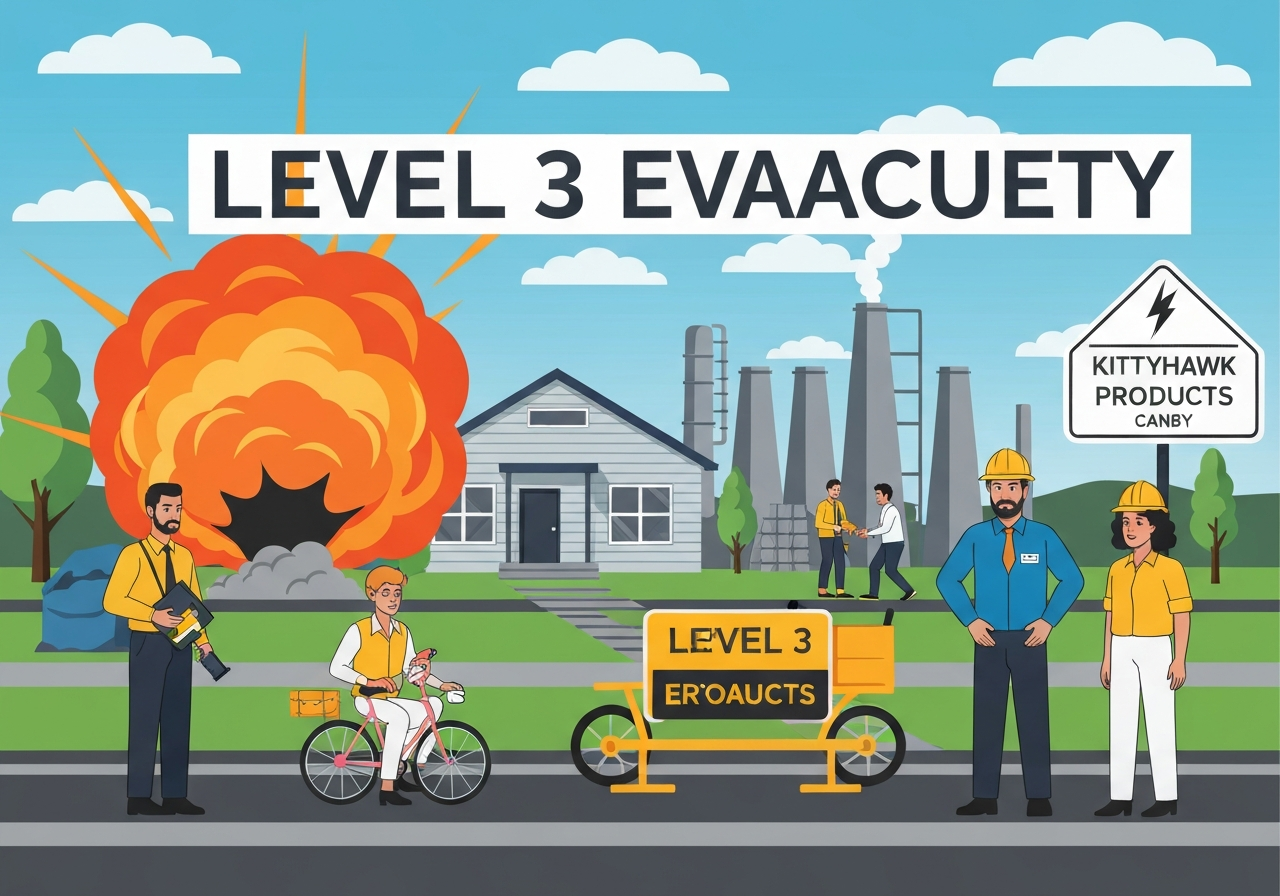
On the evening of Tuesday, Feb. 3, 2026, an explosion at Kittyhawk Products, 301 S. Redwood Street in Canby, Oregon, injured one employee and prompted a Level 3 (“Go Now!”) evacuation for the immediate area, Canby Fire officials said. One of two pressurized heat‑treating tanks at the metal‑parts shop ruptured; responders reported a risk that the second tank could fail. Fire officials kept the evacuation in place through at least 8 a.m. Wednesday while crews allow the second tank to cool, a process estimated to take roughly 12 to 16 hours. The building was heavily damaged and several nearby structures sustained some damage; authorities said no hazardous materials were released to the environment.
Key Takeaways
- Incident location: 301 S. Redwood Street, Canby, Oregon; business: Kittyhawk Products, a metal heat‑treating facility.
- Time and date: Explosion occurred Tuesday night, Feb. 3, 2026; evacuation ordered that evening.
- Evacuation level: Level 3 (“Go Now!”) issued for the immediate area and to remain at least until 8 a.m. Wednesday.
- Cause and equipment: One of two pressurized tanks exploded; officials said the second tank presented a cooling risk and could potentially fail.
- Casualties and damage: Three employees were onsite, one sustained minor injuries and was taken to hospital; the primary building was heavily damaged and nearby properties suffered some damage.
- Hazmat status: Canby Fire reported no hazardous materials released to the environment as of the latest update.
- Response timeline: Second tank cooling estimated at 12–16 hours; officials will reassess and potentially lift the evacuation after that period.
Background
Kittyhawk Products operates industrial heat‑treating equipment to harden metal parts, a process that can involve elevated temperatures, pressured vessels and controlled atmospheres. Facilities that use pressurized tanks must follow federal and state safety regulations as well as local fire codes; pressure vessel failures, while uncommon, can produce explosions and significant structural damage when they occur. Canby is a city in Clackamas County where industrial operations are intermingled with commercial and light‑industrial parcels, increasing the need for rapid emergency notification and neighborhood evacuations when incidents arise.
Level 3 evacuation orders are the most urgent municipal instruction, directing people to leave immediately for their safety. Local fire departments and emergency managers typically coordinate sheltering, traffic control and notifications to affected residents and businesses during such orders. In past regional industrial incidents, investigators from municipal fire departments, state occupational safety agencies and environmental regulators often participate in the follow‑up inquiries to determine cause and whether any regulatory or enforcement actions are warranted.
Main Event
According to Canby Fire Chief Matt Dale, the explosion occurred inside one of the two tanks used by Kittyhawk Products for pressure heat treatment. Three employees were inside the building when the blast happened; one person sustained minor injuries and was transported to a hospital for treatment. Responders arriving on scene found the primary structure heavily damaged and observed damage to some adjacent buildings.
Because responders assessed a risk that the second tank could also fail, officials issued a Level 3 (Go Now!) evacuation for the immediate area that evening and set a conservative timeline for reentry. Chief Dale said crews need roughly 12 to 16 hours to cool the remaining tank to a safe temperature; the evacuation order will remain until at least 8 a.m. Wednesday, when authorities will reevaluate conditions. Fire crews and technical specialists remained on site to monitor tank temperatures and to secure the perimeter.
Canby Fire emphasized there was no detectable hazardous materials release to the surrounding environment in initial testing and observations. Fire investigators and structural specialists were mobilized to document damage, support evidence collection and help inform the safety assessment that will guide further access and recovery work at the facility. Local utility and building inspectors were also notified to evaluate secondary safety risks posed by the structural damage.
Analysis & Implications
Public safety was the immediate priority: issuing a Level 3 evacuation limited potential exposure to a failing pressure vessel while allowing fire personnel to concentrate on cooling and securing the remaining tank. The 12–16 hour cooling window is a standard precaution for pressurized equipment; extended cooling and monitoring reduce the risk of a secondary failure during recovery operations. Residents and businesses in the evacuation zone face short‑term displacement and potential property repairs, depending on the extent of blast and fragment damage.
Economically, the primary impacts are likely localized: Kittyhawk Products will face repair and downtime costs, and nearby businesses may lose revenue while access is restricted. Insurance and municipal permitting processes will influence the timeline for rebuilding and reoccupation. Regulators such as Oregon OSHA and environmental agencies commonly become involved after incidents that damage industrial equipment; their inquiries can yield compliance orders or recommendations intended to prevent recurrence.
From an emergency‑management perspective, the incident underscores the need for clear communications and preplanned evacuation routes when industrial operations are sited near commercial areas. Short‑term disruptions to traffic and business access are expected; longer‑term community effects will depend on the final damage assessments and the speed of recovery efforts. If investigators identify systemic safety lapses, the case could prompt reviews of local inspection regimes and industry best practices for pressurized heat‑treating operations.
Comparison & Data
| Metric | This Incident |
|---|---|
| Address | 301 S. Redwood St., Canby, OR |
| Employees on site | 3 |
| Injuries | 1 (minor, hospitalized) |
| Evacuation level | Level 3 (Go Now!) |
| Second tank cooling estimate | 12–16 hours |
The table above summarizes the confirmed, concrete figures reported by Canby Fire and KATU. Those operational metrics—personnel on site, injury count, and cooling estimates—are the important parameters shaping the response and the timing of any reoccupation decisions. Historical data on similar local industrial incidents show that most immediate public‑safety risks subside once potential secondary sources are neutralized and structural integrity is confirmed.
Reactions & Quotes
“We have one injured employee being treated and no known hazardous release to the environment,”
Canby Fire Chief Matt Dale (official statement)
Chief Dale framed the immediate outcome as limiting harm to people and the environment, while noting the significant property damage. He reiterated that cooling the second tank is a critical safety step before lifting the evacuation and allowing reentry.
“Evacuation orders will remain until crews can confirm the second tank is safe to approach,”
Canby Fire (official incident update)
Fire officials told residents they should expect continued on‑scene operations overnight and that authorities would provide an update after the cooling window ends at roughly 8 a.m. Wednesday.
Unconfirmed
- The exact mechanical cause of the tank rupture has not been released; investigators have not yet announced a definitive failure mechanism.
- The full dollar amount of property damage and the timeline for Kittyhawk Products to resume operations remain unsettled pending structural assessments and insurance reviews.
- Whether state occupational safety or environmental enforcement actions will follow is not yet confirmed; regulatory involvement is common but not yet publicly stated.
Bottom Line
The immediate crisis in Canby was contained with a single minor injury and no reported hazardous materials release, but the event left a business heavily damaged and nearby properties affected. Officials prioritized a Level 3 evacuation and extended cooling period to prevent a secondary tank failure and to protect residents and responders.
Investigations into the cause and the full extent of damage will determine regulatory outcomes and the timeline for recovery. Residents and business owners in the area should follow official notices from Canby Fire for reentry guidance and watch for updates on inspections and recovery plans.