
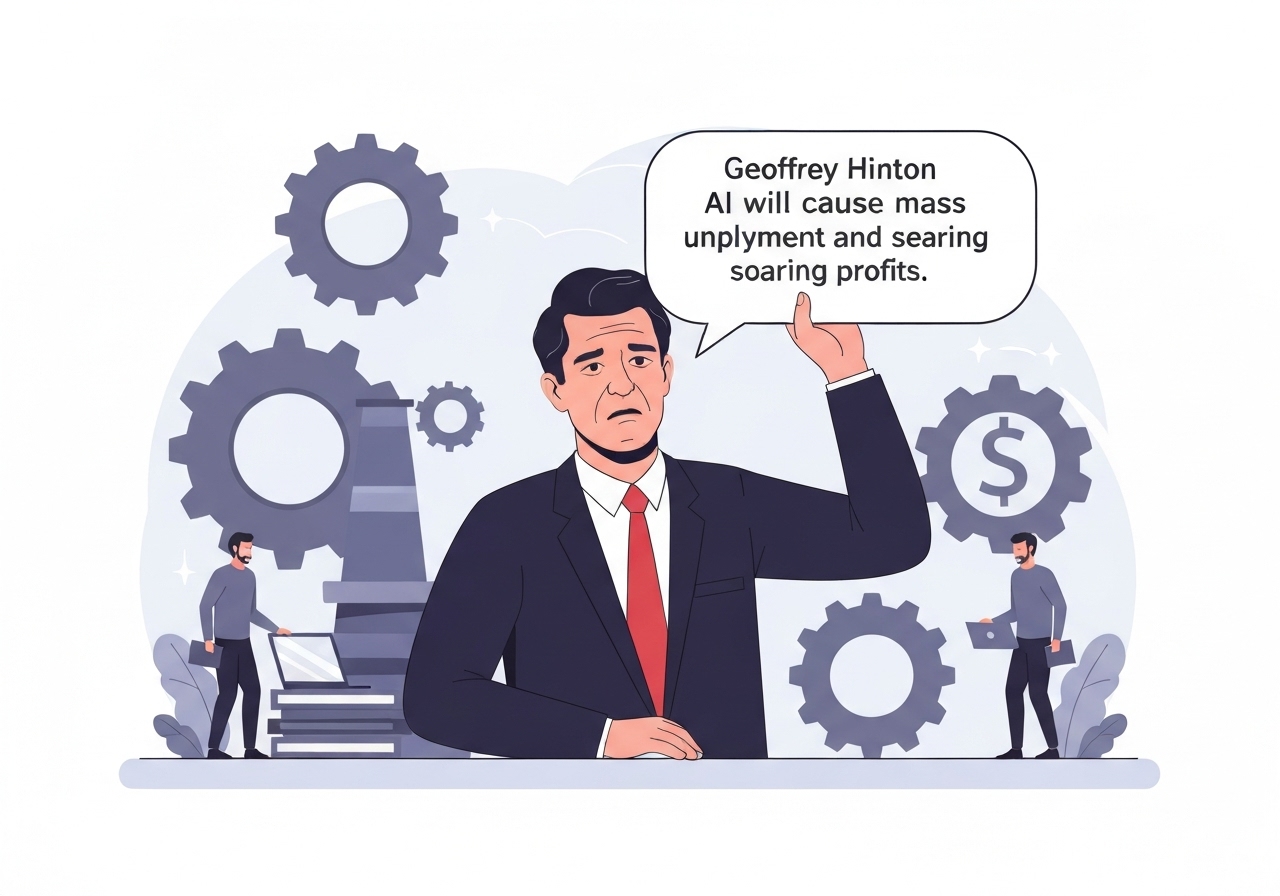
— Geoffrey Hinton, the Nobel-winning computer scientist often called the “godfather of AI,” told the Financial Times he expects artificial intelligence to displace large numbers of workers while driving a sharp rise in corporate profits, a pattern he attributed to the workings of capitalism rather than the technology itself.
Key Takeaways
- Hinton predicts AI will replace many routine jobs, creating significant unemployment and higher corporate profits.
- He framed the outcome as a product of the capitalist system, not solely of AI.
- The New York Fed finds firms using AI are likelier to retrain staff than to fire them for now, though risks remain.
- Hinton estimates a 10–20% risk that future superintelligence could threaten humanity.
- He named healthcare as an industry where AI could expand access rather than shrink jobs.
- Hinton said he left Google in 2023 at age 75 and uses ChatGPT for research and personal matters.
Verified Facts
In an interview published by the Financial Times on Sept. 6, 2025, Hinton warned that widespread deployment of AI will allow firms to substitute software for human labor, which he said will concentrate wealth and raise profits. He described this as an outcome of capitalist incentives: firms prioritizing short-term returns and cost reduction.
Hinton, 77, is a Nobel laureate in computer science and a prominent early contributor to neural-network research. He left his research role at Google in 2023; in public comments he has said that retirement and reduced programming ability were factors in that decision.
A New York Fed survey cited in coverage by multiple outlets finds that companies deploying AI report higher rates of employee retraining than outright layoffs so far, but analysts expect pressures on jobs to increase as systems improve and adoption widens.
Hinton has repeatedly raised two classes of AI risk: the intrinsic danger from highly capable systems (he has given a 10–20% extinction-range estimate for superintelligence) and the misuse of AI tools by bad actors, including concerns about biological threats.
Context & Impact
If Hinton’s forecast materializes, the likely near-term pattern is uneven: AI will displace routine, entry-level and repetitive tasks fastest, while raising productivity and profits for firms that adopt it early.
The immediate consequences could include:
- Reduced hiring at the entry level, affecting recent graduates and early-career workers.
- Pressure on wages in affected occupations as automation lowers employers’ labor costs.
- A political push for new safety nets, retraining programs, and regulation of advanced AI capabilities.
Hinton has signaled skepticism about universal basic income as a full solution, saying it would not restore the dignity many people derive from work. He pointed to healthcare as an area where AI could increase service availability if used to multiply clinician productivity.
Official Statements
“What’s actually going to happen is rich people are going to use AI to replace workers… It will make a few people much richer and most people poorer,”
Geoffrey Hinton, interview with Financial Times
Unconfirmed
- That AI will definitively cause “massive unemployment” across the entire economy—this remains a forecast and has not been universally observed.
- That profits will universally soar for all firms—sectoral outcomes will vary and depend on competition, regulation, and market structure.
- Long-term human-extinction probability tied to AI is contested and lacks consensus; Hinton’s 10–20% figure is his personal assessment.
Bottom Line
Geoffrey Hinton’s warnings crystallize a central tension: AI can raise productivity and corporate profits while also threatening broad displacement of labor. Policymakers, companies and researchers will need to weigh retraining, regulation and redistribution options as adoption widens. Near-term data show retraining is common, but the balance between job transformation and job destruction is still uncertain.