
Lead
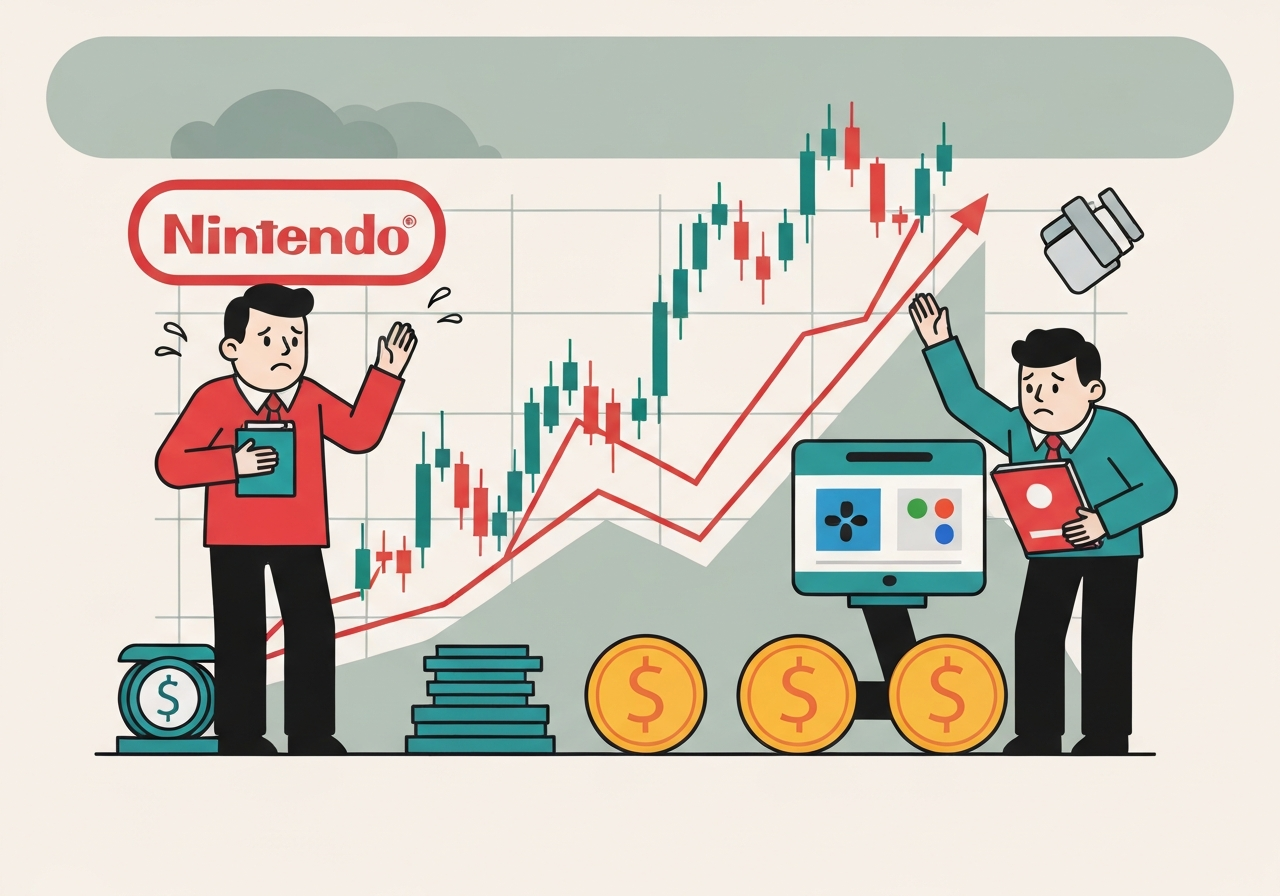
On Wednesday, Nintendo shares fell more than 10% after the company reported quarterly revenue below market forecasts and investors flagged an escalating shortage of memory chips as a threat to margins. The results showed a 24% year‑on‑year rise in profit and an 86% increase in revenue, helped by demand for the Switch platform and the new Switch 2 released in June 2025. Market commentary pointed to sharp contract price increases for conventional DRAM in the first quarter, intensifying investor anxiety about component costs. Nintendo maintained its full‑year Switch 2 sales forecast but faces scrutiny over whether its upcoming game lineup will drive upgrades fast enough to offset higher memory costs.
Key Takeaways
- Nintendo shares dropped more than 10% on Wednesday following a revenue miss versus analyst estimates, according to market trade reports.
- Operating profit rose 24% year on year while reported revenue climbed 86%, driven by ongoing Switch and Switch 2 sales.
- Market researcher TrendForce projects contract DRAM prices rose roughly 90%–95% in Q1 compared with the previous three months.
- Industry executives and analysts warn the DRAM shortage could persist through 2027, potentially keeping input costs elevated.
- Company leadership said memory price rises did not materially affect this fiscal year’s results but acknowledged longer‑term risk to profitability.
- Nintendo retained its full‑year Switch 2 sales forecast despite supply and margin concerns.
- Major upcoming releases include Mario Tennis Fever in February, Pokémon Pokopia in March, and The Super Mario Galaxy Movie in April.
- Nintendo shares are down more than 15% year to date, reflecting sustained investor unease.
Background
Nintendo’s latest platform, the Switch 2, launched in June 2025 and quickly became a high‑profile consumer debut, drawing lines from Tokyo to Manhattan. The company’s hardware business remains central to its revenue mix and uses dynamic random‑access memory (DRAM) as a critical component in consoles and cartridges. Over the past year, demand for DRAM from AI workloads and hyperscale data centers has tightened the market, compressing supply available to consumer electronics makers.
Those dynamics have translated into sharply higher DRAM contract prices and a squeeze on hardware makers’ gross margins. Nintendo historically has managed component cycles through design choices and inventory planning, but the current price spike is unusually large in both magnitude and market breadth. At the same time, Nintendo’s content pipeline and ancillary media — most notably the 2023 Super Mario movie — have proven powerful drivers of hardware sales, a factor management is counting on again.
Main Event
The immediate trigger for the stock move was a quarterly report that beat profit estimates but missed revenue expectations, prompting investor concern about growth momentum. Market participants focused on the company’s comment that memory prices had not materially hurt this fiscal year — but could erode profitability if elevated for longer. Analysts noted that DRAM represents a meaningful per‑unit cost for the Switch 2, and steep price moves can compress margins if not offset by higher retail prices or software attach rates.
Andrew Jackson, head of Japanese Equity Strategy at Ortus Advisors, flagged to investors that sustained memory price inflation poses downside risk to Nintendo’s margin profile and could weigh on free cash flow. Nintendo’s management reiterated its sales forecast for the Switch 2 but declined to revise guidance on profit sensitivity beyond acknowledging potential longer‑term effects. The market interpreted the combination of a revenue miss and elevated input‑cost risk as a reason to reprice the stock, leading to the sell‑off.
Separately, industry research from TrendForce showed contract DRAM prices spiking in the first quarter, reflecting competition between consumer electronics and data‑center demand. A top semiconductor CEO has publicly projected that the memory shortage may persist through 2027, underlining that the supply tightness is not expected to be short‑lived. Against that backdrop, Nintendo’s product cadence for early 2026 — including two major franchise releases and a high‑profile movie in April — has become central to how investors judge near‑term revenue resilience.
Analysis & Implications
Higher DRAM prices can erode gross margins on new consoles unless manufacturers absorb costs, raise retail prices, or offset through stronger software revenue and services. Nintendo has some levers: it can renegotiate supplier terms over time, increase software monetization, or accept temporary margin compression to preserve retail prices and market share. Each choice carries trade‑offs — higher console prices could slow consumer upgrades, while tighter margins would reduce the company’s earnings power and free cash flow.
For Nintendo specifically, the success of Switch 2 depends on both supply and demand factors. Supply constraints and elevated component prices risk limiting shipment economics; demand hinges on whether marquee releases persuade existing owners to upgrade. The company’s decision to keep fiscal sales guidance signals management confidence in the pipeline, but the market is assigning value to near‑term margin pressure and execution risk.
Beyond Nintendo, prolonged DRAM tightness would affect suppliers, component makers, and other consumer electronics firms that rely on the same memory pool. Companies with stronger procurement scale or long‑term contracts may fare better than smaller players. Investors will watch capex plans from major memory manufacturers and any inventory adjustments at retailers and console makers to assess when the supply/demand balance might normalize.
Comparison & Data
| Metric | Reported Change |
|---|---|
| Operating profit (YoY) | +24% |
| Revenue (YoY) | +86% |
| Intra‑day share move | ↓ more than 10% |
| Shares YTD | ↓ more than 15% |
| Projected Q1 contract DRAM change | +90%–95% vs prior quarter |
The table summarizes the quarter’s headline figures and the scale of DRAM price moves reported by industry researchers. The quarter shows robust top‑line growth and improved operating profit, but the disproportionate rise in memory costs creates a risk that margins will not expand further without offsetting measures. Comparing these data points helps explain why investors reacted strongly despite healthy profit growth.
Reactions & Quotes
Market and company voices offered differing tones: caution from analysts, reassurance from management, and broader industry signals about supply risk.
“Sustained DRAM price inflation poses a clear downside to Nintendo’s margin outlook if it continues,”
Andrew Jackson, Ortus Advisors (Japanese equity strategist)
Jackson’s comment reflects investor focus on per‑unit cost exposure and how persistent input‑price inflation can compress earnings even when sales volumes are strong.
“We do not see memory price rises having a significant impact on this fiscal year’s results, though prolonged increases could affect profitability,”
Shuntaro Furukawa, Nintendo President (company statement)
Furukawa sought to reassure markets that the current fiscal year remains on track while admitting a material longer‑term risk, a stance that left investors divided on near‑term valuation.
“2026 is a make‑or‑break year for Switch 2 as Nintendo seeks broader mass‑market appeal,”
James McWhirter, Omdia (senior analyst)
McWhirter emphasized that software momentum and mainstream uptake this year will be decisive for the platform’s commercial trajectory.
Unconfirmed
- Whether elevated DRAM prices will remain at current levels beyond 2027 is still uncertain and depends on memory makers’ capital spending and demand growth.
- The exact magnitude of margin impact for Nintendo if high memory costs persist is not publicly disclosed in detail and remains subject to internal cost management choices.
- It is not yet confirmed how many Switch 2 owners will upgrade based solely on the current game release slate; consumer response will be revealed in upcoming sales data.
Bottom Line
Nintendo reported healthy profit growth and strong revenue gains, but the market focused on margin risk from an exceptional DRAM price surge and the company’s ability to translate blockbuster franchises into sustained hardware upgrades. Management’s decision to hold the Switch 2 sales forecast signals confidence in demand, yet elevated component costs and a missed revenue estimate combined to trigger a sharp share‑price reaction.
For investors and industry observers, the near term hinges on three items: how long DRAM prices stay elevated, whether Nintendo’s upcoming games and movie can accelerate Switch 2 upgrades, and whether the company can mitigate higher component costs without damaging market share. Watch supplier capital plans, contract‑price trends from market researchers, and Nintendo’s early‑2026 sales updates for clearer signals on the path ahead.
Sources
- CNBC — (major business news outlet; company and market coverage)
- TrendForce — (market research; memory market pricing report)
- Ortus Advisors — (investment research firm; quoted strategist)
- Omdia — (industry analyst firm; gaming and device market analysis)