
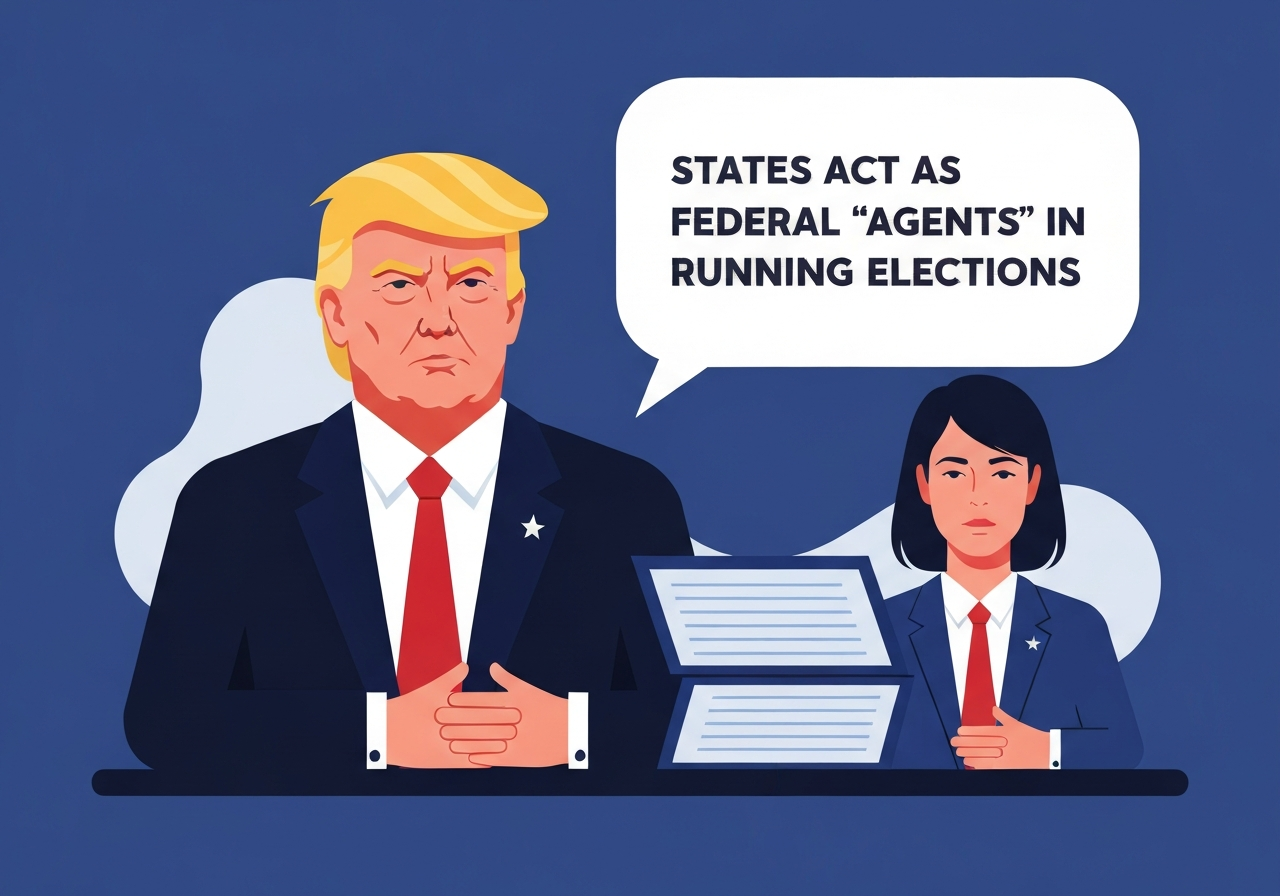
Lead: On Tuesday, Feb. 3, 2026, President Donald Trump told CNN that “a state is an agent for the federal government in elections,” arguing the federal government should intervene when states mismanage voting. Speaking in the Oval Office to CNN’s Kaitlan Collins during a bill-signing with Republican lawmakers, he repeated calls to “nationalize” aspects of voting and pointed to recent probes in Georgia as evidence. The White House framed his remarks as support for the SAVE Act and a national voter ID; Trump said federal takeover would be justified if state-run processes are not “honest.” His comments sharpen a long-running push to change how U.S. elections are administered ahead of key midterm contests.
Key Takeaways
- President Trump told CNN on Feb. 3, 2026 that “a state is an agent for the federal government in elections,” asserting federal authority to step in when he deems state systems flawed.
- The remarks came during an Oval Office signing ceremony and a separate interview with Kaitlan Collins; the White House tied the comments to support for the SAVE Act and national voter ID proposals.
- Trump criticized how some jurisdictions run elections and cited an FBI search of an Atlanta elections office less than a week earlier as part of a Justice Department probe into alleged voter fraud.
- Elections in the U.S. are primarily administered by state and local officials, with the federal government having a limited, defined role under law and longstanding practice.
- The administration has pursued rule changes and a mid-decade redistricting effort; Trump has repeatedly promoted methods he says (without verified evidence) lead to fraud.
- White House press secretary Karoline Leavitt described the president’s remarks as endorsement of voter ID and the SAVE Act, legislation that would require proof of citizenship to register.
- Noncitizens are already prohibited from voting in federal elections under existing law; critics say nationalizing administration raises constitutional and logistical questions.
Background
State and local officials have long been the primary administrators of U.S. elections. The Constitution and federal statutes assign states responsibility for setting times, places and manner of federal elections while Congress retains limited backstops—such as voting-rights statutes, funding, and oversight mechanisms. Historically, federal involvement has expanded episodically, for example through the Voting Rights Act and the Help America Vote Act, but day-to-day operations—polling places, staffing, and ballot tabulation—remain decentralized.
President Trump’s recent remarks build on a multi-year effort to reshape voting rules and election oversight. His administration and allies have promoted voter-identification requirements and other reforms they say will secure elections. Opponents argue that some proposed measures would suppress participation among demographic groups that favor Democrats and raise federalism and constitutional concerns. The debate intensified after investigators executed an FBI search of an Atlanta elections office last week as part of a Justice Department inquiry into alleged irregularities.
Main Event
On Feb. 3, 2026, during a White House ceremony with Republican lawmakers and in an interview aired with CNN’s Kaitlan Collins, Mr. Trump said states act as agents of the federal government when they run elections and that federal authorities should step in if state officials “can’t run an election” honestly. He characterized some state and local administrations as having “horrible” practices and called such outcomes a “disgrace,” urging Republican allies to consider national solutions.
The president singled out Atlanta and other Democratic-leaning jurisdictions, referencing the recent FBI search tied to a DOJ probe into alleged voter fraud. He argued the federal government should not allow what he described as corrupt vote counting and suggested federal takeover where local processes fail to meet his standard of honesty. White House Press Secretary Karoline Leavitt told reporters the president was referring to the SAVE Act and a national voter ID requirement when he urged “nationalizing” voting.
Legal and election experts note that while Congress can legislate election rules for federal contests, wholesale federal administration of elections would face constitutional questions and practical obstacles. State election officials and some governors have pushed back on the idea of federal takeover, stressing the logistical complexity of running tens of thousands of polling places and the importance of locally tailored procedures. The administration has also pursued regulatory and legislative avenues—such as backing the SAVE Act and administrative rule changes—to increase federal standards without assuming full operational control.
Analysis & Implications
Trump’s claim that states are “agents” of the federal government is a politically forceful framing but a legally loaded one. Constitutional text assigns states primary responsibility for the conduct of elections; Congress’s power is to regulate the time, place and manner for federal elections and to enforce civil-rights protections. Declaring states mere agents would imply a broader federal authority than is currently established and would likely prompt judicial challenges if implemented through executive action.
Operationally, imposing federal control over administration would be daunting. State and local election offices manage daily tasks—poll worker recruitment, ballot printing, and vote tabulation—across jurisdictions that vary widely in scale and resources. A sudden federal takeover would require rapid hiring, contracting, and logistics on a scale the federal government has rarely attempted for elections, increasing the risk of errors and legal disputes in the near term.
Politically, the rhetoric serves multiple aims. It reassures a segment of the Republican base that the administration is addressing alleged irregularities, while signaling to state Republican officials that federal backing for tighter rules exists. For Democrats and many election administrators, the message is alarming: calls for nationalization are viewed as efforts to centralize control in ways that could be used to influence outcomes. Internationally, efforts to reconfigure electoral administration can affect perceptions of U.S. democratic stability and may attract scrutiny from allies and watchdogs.
Comparison & Data
| Responsibility | Typical Lead Actor | Federal Role |
|---|---|---|
| Voter registration | State election offices/local boards | Statutory standards, funding, minimal oversight |
| Poll operations | County/municipal election officials | Technical guidance, grants (e.g., HAVA) |
| Vote tabulation | Local officials, state canvassing | Limited audits, federal observers in some cases |
The table summarizes customary roles: states and local jurisdictions lead administration while the federal government provides legal frameworks, limited funding, and civil-rights enforcement. Shifting to a model of direct federal administration would be a substantive departure from decades of decentralized practice and would require new laws, resources, and implementation plans.
Reactions & Quotes
Officials and experts responded quickly, signaling a sharp divide across political lines and among election professionals.
“A state is an agent for the federal government in elections,”
Donald Trump, President (at Oval Office ceremony)
The president’s brief remark was reiterated across his interviews and White House appearances, framed by aides as support for national voter-ID measures.
“What the president was referring to is the SAVE Act… it provides commonsense measures for voting in our country, such as voter ID,”
Karoline Leavitt, White House Press Secretary (official statement)
Leavitt framed the president’s comments as legislative endorsement; the SAVE Act would require proof of citizenship to register, according to the White House messaging. Election law scholars cautioned that calling states “agents” overstretches federal authority and would trigger legal challenges.
“Federal involvement is limited by law; operational takeover would be legally and logistically complex,”
Election law scholar (analysis comment)
Experts noted the distinction between advocating for federal standards (e.g., voter ID) and asserting operational authority to run local elections.
Unconfirmed
- Whether the administration has a concrete, legally vetted plan to transfer operational control of local elections to federal authorities is not publicly confirmed.
- Specific, substantiated evidence that the Atlanta search uncovered definitive proof of large-scale vote tampering has not been publicly released; investigations are ongoing.
- The scope and text of any immediate federal operational takeover—if proposed—have not been published and remain speculative.
Bottom Line
President Trump’s Feb. 3 remarks crystallize an administration push to increase federal standards for voting and to challenge the decentralized status quo of U.S. election administration. Framing states as “agents” of the federal government is politically resonant but would require substantial legal and logistical changes to become reality. For now, the administration appears to be pursuing a mix of legislative proposals like the SAVE Act and regulatory maneuvers rather than an immediate operational federal takeover.
Observers should watch for formal legislative text, legal filings, and any executive directives that would change how elections are run. Congressional action or new federal rules could prompt lawsuits that will test constitutional boundaries and shape how elections are administered ahead of the coming midterms.