
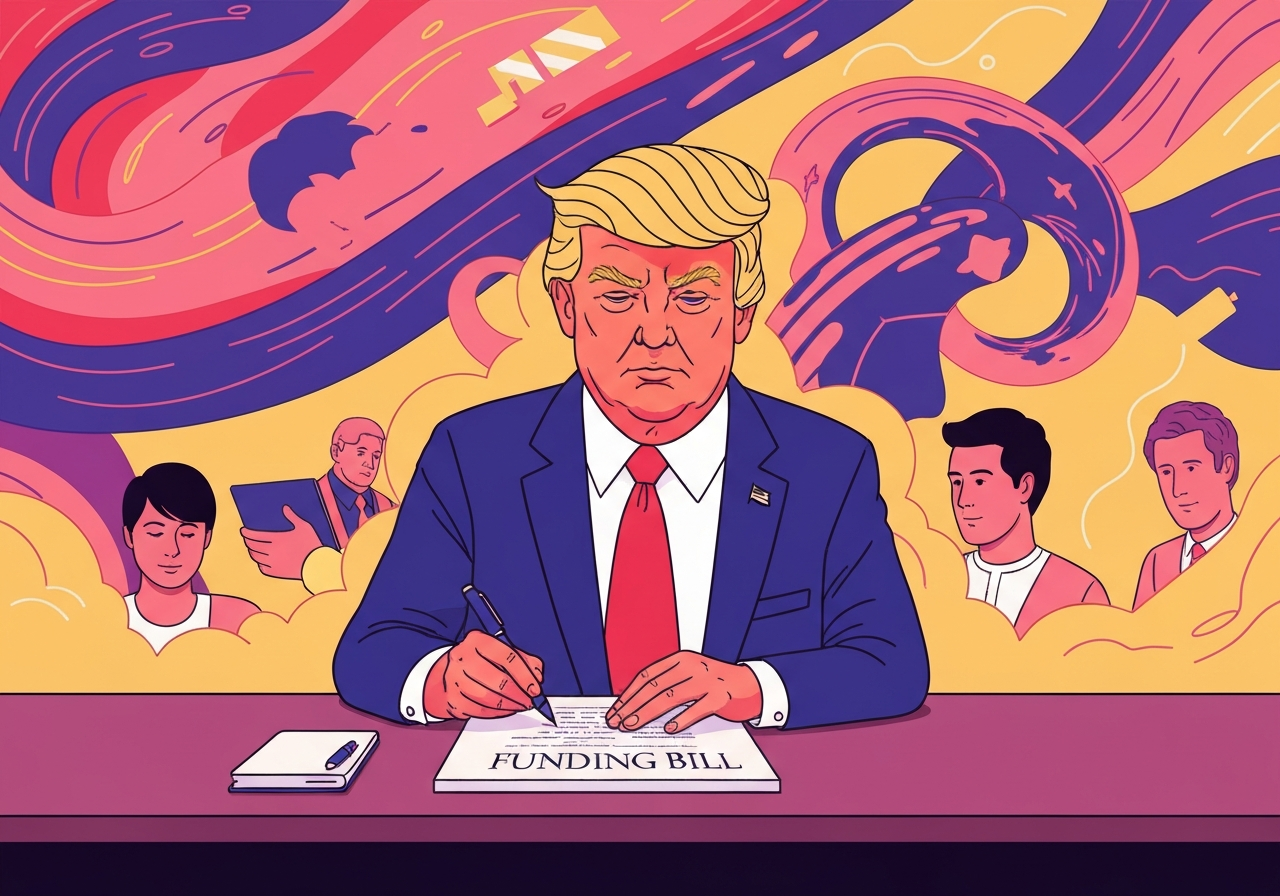
Lead: On Feb. 3, 2026, President Donald Trump signed legislation that reopened most federal functions, ending a partial government shutdown in the Oval Office as lawmakers and administration officials continued negotiating tougher immigration enforcement measures. During the signing, Mr. Trump spoke about a wide range of issues from Jeffrey Epstein case developments to international diplomacy and university disputes, at times attacking reporters and repeating disputed claims. The bill restored funding while raising immediate questions about planned immigration crackdowns and related oversight fights in Congress. The day produced new political flashpoints including public exchanges with journalists, the Clintons agreeing to deposition dates, and renewed pressure on universities and agencies.
Key Takeaways
- The president signed a funding bill on Feb. 3, 2026, ending a partial government shutdown and restoring most federal operations.
- Mr. Trump attacked CNN correspondent Kaitlan Collins in the Oval Office, criticizing her demeanor while answering questions about the Epstein file releases.
- The Clintons agreed to sit for videotaped depositions in the House Oversight Committee, with Hillary Clinton set for Feb. 26 and Bill Clinton for Feb. 27.
- Judge Ana C. Reyes temporarily blocked the administration from ending Temporary Protected Status for more than 350,000 Haitians pending further litigation.
- Mr. Trump renewed fluctuating demands in talks with Harvard, at one point calling for as much as 1 billion dollars in damages after earlier negotiations involved $200M, $300M and $500M figures.
- A federal judge signaled willingness to temporarily enjoin disciplinary action against Senator Mark Kelly over speech to service members, citing novel legal questions.
- The White House reiterated support for federal measures tied to voter verification, while allies pressed the stalled SAVE Act that would require proof of citizenship for voter registration.
- Ed Martin, the Justice Department official heading a so-called weaponization group, was marginalized as DOJ leadership sought to reassert control over politically charged investigations.
Background
The signing ended a partial government shutdown that had produced uncertainty for agencies, contractors and federal employees. Negotiations over Homeland Security funding and policy riders — particularly measures tied to immigration enforcement and voter rules — had driven weeks of intra-GOP bargaining, with some conservatives demanding stricter measures such as proof-of-citizenship requirements for voter registration.
The administration has simultaneously pursued a series of high-profile confrontations: a broad review of elite universities, a campaign to press public figures about ties to Jeffrey Epstein, and stepped-up immigration enforcement actions that have drawn congressional and public scrutiny. Those initiatives sit alongside the Justice Department reshuffle and presidential statements that repeatedly challenge institutional norms, raising questions about long-term policy direction and legal exposure.
Main Event
At the Oval Office signing, Mr. Trump fielded questions on multiple fronts. He rebuked CNN White House correspondent Kaitlan Collins for not smiling, a remark that followed questions about the Justice Department release of documents connected to Jeffrey Epstein. The exchange highlighted the president’s repeated confrontations with media figures and his tendency to personalize press interactions.
Mr. Trump also reacted to news that former President Bill Clinton and former Secretary of State Hillary Clinton had agreed to be deposed in the Oversight Committee investigation into Epstein materials, calling the development a shame and praising aspects of Mr. Clinton and Mrs. Clinton’s abilities before pivoting to claims of his own political victimization. House Republicans canceled a contempt vote after the Clintons agreed to testify on Feb. 26 and 27, requesting that their depositions be public and videotaped.
The president reiterated that the federal government should intervene where he alleged election corruption, reviving talk of federal involvement even as the White House attempted to frame the comments around the SAVE Act. That legislation, passed by the House but stalled in the Senate, would require proof of citizenship to register and would not itself federalize election administration.
On other fronts, Mr. Trump floated renewed pressure on Harvard, reversing earlier private signals of flexibility and escalating to calls for as much as 1 billion dollars in damages on social media. The president also released a new rendering for a planned White House ballroom project, and officials disclosed personnel moves including the marginalization of Ed Martin at the Justice Department and Stephen Miran’s resignation from his White House role while remaining at the Federal Reserve.
Analysis & Implications
The funding bill buys Congress and the White House breathing room, but it does little to resolve the political conflicts that prompted the shutdown pressure. Immigration enforcement tactics, the administration’s approach to oversight and prosecutions, and efforts to reshape higher education policy are likely to remain front-burner items that will fuel litigation and congressional fights.
The Clintons agreeing to videotaped depositions removes an immediate procedural impasse for House Republicans, but it also raises the stakes for how the Oversight Committee handles sensitive testimony. Public depositions may blunt selective leaks, but they also make any contentious exchanges more visible and politically consequential ahead of November.
The administration’s oscillating posture toward universities illustrates a broader pattern: negotiating positions shift rapidly and publicly, increasing uncertainty for institutions and courts. That volatility can pressure campuses toward compromise but also mobilize their alumni and legal defenses, complicating any enforceable settlement that survives judicial review.
Judicial interventions — from Judge Reyes on TPS to the judge hearing Senator Kelly’s free-speech claim — underscore that courts will be central arbiters of the administration’s most contested policies. Temporary injunctions and preliminary rulings will shape immediate outcomes while appeals could carry many disputes toward higher courts, including the Supreme Court.
Comparison & Data
| Trump Demands or Offers | Amount |
|---|---|
| Initial demand reported (fine) | 200 million |
| Negotiation concept for job training | 500 million |
| Compromise reported later | 300 million + 200 million fine |
| Late social media escalation | 1 billion |
The table summarizes shifting financial figures tied to the administration’s pressure campaign against Harvard and other universities. That range, from $200 million to $1 billion, illustrates both the tactical leverage the White House seeks and the administrative unpredictability that has alarmed university leaders and some lawmakers.
Reactions & Quotes
Reporters, lawmakers and institutional leaders responded quickly to the day’s events.
She never smiles, I don’t think I have ever seen you smile.
President Donald Trump, Oval Office exchange with a CNN correspondent
The comment followed questions about the Justice Department’s release of files tied to Jeffrey Epstein and drew a prepared statement from the reporter’s network defending her reporting.
We cannot miss the signs that he is going to try again.
Senator Adam B. Schiff, criticizing presidential conduct on election matters
Senator Schiff’s remark reflected Democratic concerns that repeated claims about election irregularities and proposals to change voting rules are designed to erode public trust ahead of midterm contests.
Although the government will probably appeal, today’s ruling allows Haitian T.P.S. holders to breathe a sigh of relief.
Geoff Pipoly, attorney for plaintiffs in T.P.S. litigation
Pipoly’s comment followed Judge Ana C. Reyes’s order temporarily preserving status for more than 350,000 Haitians while the courts consider the administration’s termination decision.
Unconfirmed
- Specific allegations of election fraud in several named cities cited by the president remain unsupported by public evidence and have not been substantiated by nonpartisan investigations.
- Claims that large numbers of Democrats were involved with Jeffrey Epstein were made by the president during remarks but lack corroborating evidence in the public record.
- The potential for immediate, broad criminal prosecutions of university officials as threatened on social media is unproven and would face substantial legal obstacles.
Bottom Line
Monday’s funding bill ended an immediate budget crisis but did little to quiet the administration’s broader agenda. Immigration enforcement, voting-rule proposals, high-profile probes and the White House’s campaign against universities will continue to generate legal fights and political backlash. Courts have already intervened on several items, and their role is likely to expand as disputes move through appeals.
For stakeholders — from affected immigrant communities to universities and election officials — the near-term horizon will be defined by litigation outcomes, congressional maneuvers and the administration’s next public demands. Voters should expect these controversies to remain central to the political debate ahead of the fall midterms.