
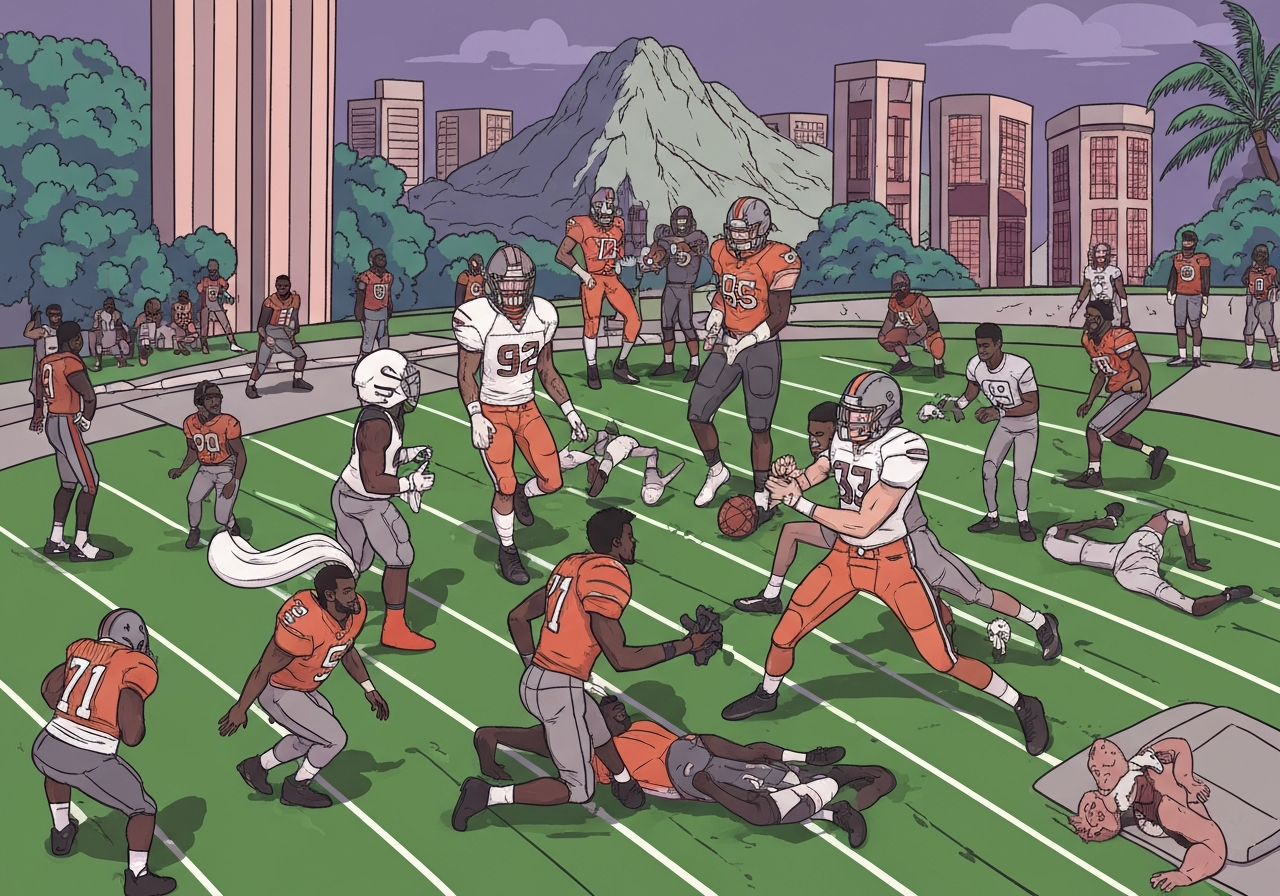
Lead: On Tuesday night in San Francisco at the Moscone Center, the NFC erased a 52-36 third-quarter deficit to beat the AFC 66-52 in the fourth annual Pro Bowl Games — the first edition staged during Super Bowl week. A two-quarterback deployment and late scoring by several Cowboys receivers keyed the comeback, while George Pickens was voted Offensive MVP and Buccaneers safety Antoine Winfield Jr. took Defensive MVP after a decisive end-zone interception. The event also highlighted experimentations in roles and renewed attention to flag football ahead of its inclusion in the L.A. 2028 Olympics.
Key Takeaways
- The NFC rallied from a 52-36 deficit in the third quarter to win 66-52, outscoring the AFC 30-0 in the second half.
- Coaches used a two-QB system for the NFC: Jalen Hurts threw three touchdown passes and Dak Prescott accounted for four TDs, combining to destabilize the AFC defense.
- Four Cowboys players combined for five receiving TDs; KaVontae Turpin, George Pickens and CeeDee Lamb caught the final three scores that finished the comeback.
- George Pickens earned Offensive MVP honors after a go-ahead touchdown, and Antoine Winfield Jr.’s end-zone interception on Joe Burrow sealed the win and the Defensive MVP award.
- Positional experimentation produced notable moments: Broncos LT Garett Bolles caught a 1-yard TD and a two-point conversion, while Ja’Marr Chase intercepted Jared Goff and returned it roughly 50 yards for a score.
- Micah Parsons, recovering from a torn ACL, was highly visible on the sideline — including riding a mobility scooter that became a lighthearted subplot to the night.
- The game doubled as an early showcase for flag football ahead of the L.A. 2028 Olympics, coming after owners allowed NFL players to compete in the Games.
Background
The Pro Bowl Games entered their fourth edition in 2026, and for the first time the league scheduled them during Super Bowl week, bringing the event to the Moscone Center in San Francisco. What began as a skills-and-fun alternative to the traditional Pro Bowl format has evolved into a staged, competitive exhibition that mixes flag football rules with creative rosters and experimental coaching approaches. NFL owners recently approved a policy permitting players to appear in the L.A. 2028 Olympic flag football tournament, raising the stakes for standout performances in events like this. Coaches and front offices are watching tape for both entertainment value and potential scouting information; players are using the event to showcase versatility by testing out-of-position reps and situational plays.
Stakeholders include league officials who view the Games as a platform to grow a new format, players who can raise their public profile or make a case for Olympic selection, and fans who appreciate a different, faster-paced style of play. The NFC’s fourth straight win in this iteration underlines competitive continuity even amid the exhibition atmosphere. While the scoreboard was high and entertainment-focused, the contest provided actionable data for coaches about personnel flexibility and situational decision-making under modified rules.
Main Event
The AFC arrived at the third-quarter break with a commanding 52-36 lead, but the second half belonged entirely to the NFC. Offensive adjustments and a rotation at quarterback changed the momentum: NFC coach Jerry Rice alternated Jalen Hurts and Dak Prescott in red-zone sequences that resulted in quick scoring and confused the AFC coverage assignments. On back-to-back drives, Hurts used a red-zone snap to pitch to Prescott, who then targeted Dallas receivers for touchdowns; the second of those plays produced George Pickens’ go-ahead score.
Pickens’ touchdown gave the NFC its first lead since early in the game and ultimately earned him Offensive MVP recognition. The AFC threatened on the next possession, but Buccaneers safety Antoine Winfield Jr. intercepted Joe Burrow in the end zone, ending the AFC’s final attempt to tie and ultimately securing Winfield the Defensive MVP. The play was decisive: the AFC’s scoring stalled after the third quarter while the NFC kept finding the end zone.
Individual highlights peppered an otherwise exhibition-style event. Cowboys pass-catching depth was on display as four Dallas players combined for five TD catches, a surprising volume from players typically spread across more traditional roles. Garett Bolles, a Denver offensive lineman by trade, repeatedly lined up as a red-zone receiving option and converted a 1-yard touchdown as well as a two-point reception, signaling how coaches are testing creative packages. Ja’Marr Chase, lining up occasionally on defense, produced an athletic interception and long return that energized the crowd and underscored the event’s freedom for unconventional play-calling.
Analysis & Implications
The NFC’s use of a two-QB system offers a clear test case for how alternating passers can be deployed in short-field, condensed-rule environments. Hurts’ and Prescott’s combined seven touchdown passes illustrated how differing cadence and throw patterns can complicate coverages when defenders must adjust rapidly. While the format is not directly translatable to regular-season strategy, coaches may file takeaways about red-zone formations, quick-pitch dynamics and rotational quarterback packages for situational football.
Player position swaps, like Bolles’ conversion into a red-zone target and Chase’s defensive snaps, have dual value: entertainment for fans and a scouting window for teams. Such moments may influence offseason training priorities or even prompt coaches to design spot packages that exploit a player’s athletic traits. For Bolles, repeated success in the red zone could spark offseason conversations; for Chase, the interception reinforced a prior season note that he occasionally made plays on defense.
Beyond tactical lessons, the Pro Bowl Games functioned as a soft launch for U.S. Olympic involvement in flag football. With owners approving player participation in the L.A. 2028 Games, performances at the Moscone Center served as early auditions. Players who stood out — notably Pickens and Winfield — can claim both Pro Bowl MVPs and potential Olympic consideration, though formal team selection for 2028 remains a separate process.
Comparison & Data
| Team | Third-quarter score | Final score |
|---|---|---|
| AFC | 52 | 52 |
| NFC | 36 | 66 |
The table shows the dramatic second-half swing: the NFC put up 30 unanswered points after trailing by 16 at the third-quarter break. That 30-point run was the decisive statistical factor in the outcome and highlights how quickly momentum can flip in the shorter, higher-variance format of flag football.
Reactions & Quotes
The postgame atmosphere mixed celebration with practical reflection as coaches and players weighed what the night meant beyond the scoreboard.
“We wanted to take advantage of momentum and personnel matchups; the two-QB looks were designed to create those exact chances,”
Jerry Rice, NFC coach
Rice framed the strategy as situational and experimental rather than a wholesale doctrinal shift, stressing that the format encourages creativity without promising direct carryover to regular-season schemes.
“I told the team this could be a pathway to bigger things — there’s an Olympic opportunity on the horizon,”
Steve Young, AFC coach
Young’s pregame message tied the event to L.A. 2028 prospects and explained why players were motivated to showcase flag-football skills as potential Olympic athletes.
“It felt great to help the team in that moment,”
George Pickens, Offensive MVP (paraphrased)
Pickens downplayed individual accolades and emphasized the collective surge that produced the comeback, while Antoine Winfield Jr. celebrated the interception that ended the AFC’s last chance.
Unconfirmed
- Whether standout performers at the Pro Bowl Games will be selected for the U.S. flag football roster at L.A. 2028 remains undecided and will be determined through a separate selection process.
- It is not confirmed that Garett Bolles’ red-zone snaps will lead to permanent role changes in regular-season packages; teams typically evaluate such experiments during offseason meetings.
- Micah Parsons’ conspicuous use of a mobility scooter was a sideline anecdote; it should not be taken as a definitive indicator of his rehab timeline or on-field readiness without formal medical updates.
Bottom Line
The NFC’s 66-52 comeback at the Moscone Center delivered both entertainment and practical takeaways. The two-QB approach and frequent position swapping produced high-leverage moments and useful tape for coaches, while MVP performances gave certain players boosted profiles heading into offseason discussions. The game also functioned as a timely showcase for flag football ahead of the Olympic debut in L.A., creating narrative threads that will follow several players into the next two years.
For teams and evaluators, the Pro Bowl Games are best viewed as a low-risk laboratory: creative plays and role experiments provide ideas rather than definitive strategies. Fans got a dramatic, high-scoring exhibition, and the league gained further proof that the format can carry meaningful storylines — from comeback wins to Olympic prospects — without undermining regular-season football.
Sources
- NFL.com: 2026 Pro Bowl Games recap — (media: official league coverage)
- NFL Research / Operations — (official league research and operations)