
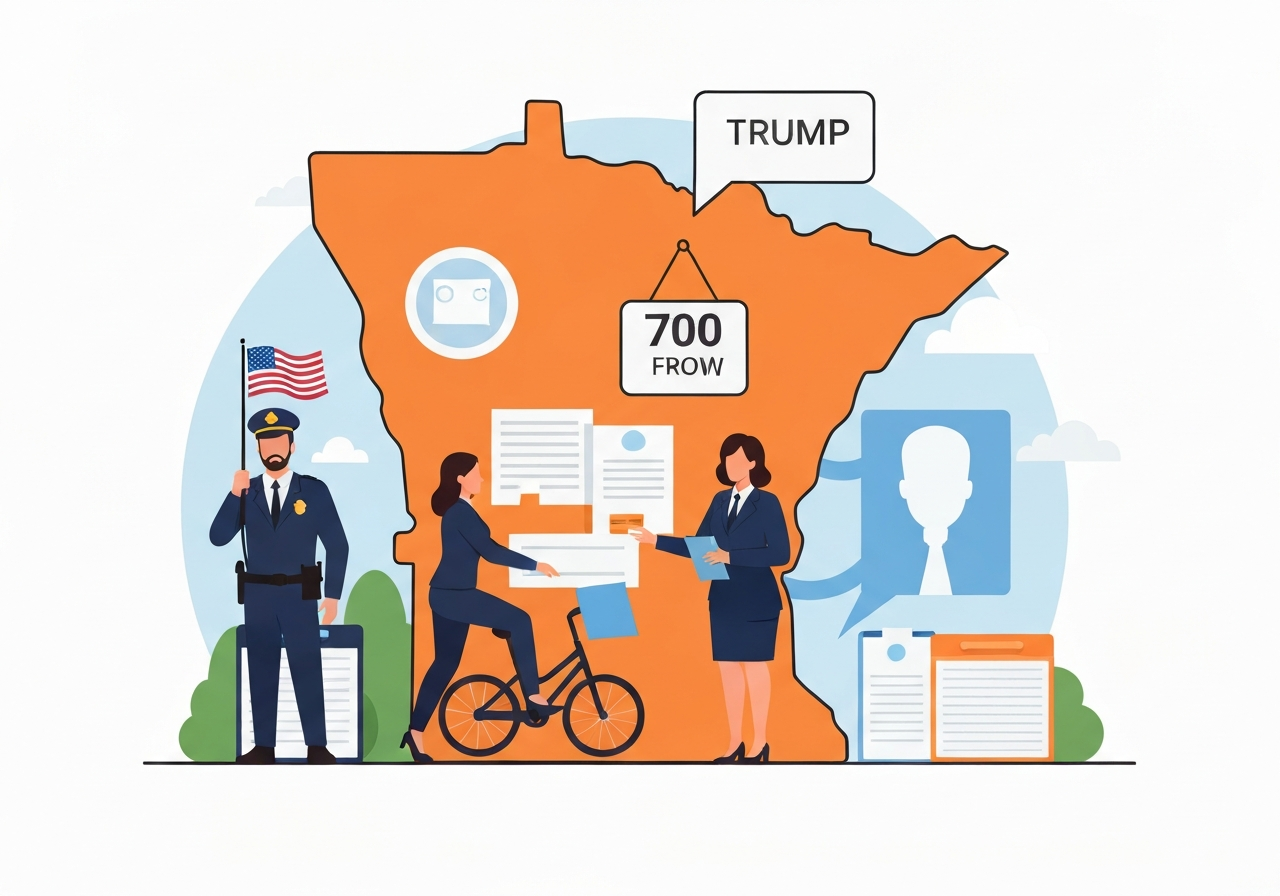
On Feb. 4, 2026, the Trump administration announced an immediate pullback of 700 federal law-enforcement officers from Minnesota, border czar Tom Homan said at a press briefing. After the reduction, about 2,000 federal agents will remain in the state, a roughly 25% decrease from the prior deployment, with most personnel concentrated in the Twin Cities of Minneapolis and St. Paul. Homan framed the move as a consequence of improved coordination with state and local authorities that lets federal officers focus on targeted custody transfers rather than street operations. The decision follows weeks of local unrest tied to aggressive immigration enforcement that included the January deaths of two U.S. citizens during encounters with federal agents.
Key Takeaways
- The administration will withdraw 700 federal officers from Minnesota effective immediately, leaving roughly 2,000 agents on the ground in the state.
- The change represents about a 25% reduction in deployed federal personnel and concentrates remaining agents in the Minneapolis–St. Paul metropolitan area.
- Tom Homan attributed the drawdown to “unprecedented cooperation” with state and local officials, which he said increases efficiency in custody transfers of targeted individuals.
- The announcement comes after protests and public concern following the January deaths of Renee Nicole Good and Alex Pretti in separate encounters with federal agents.
- DHS leadership, including Secretary Kristi Noem, initially defended the agents involved in those deaths; public outcry prompted a shift in tone and heightened scrutiny of federal operations.
- President Donald Trump dispatched Homan to Minnesota to manage on-the-ground enforcement work and to reassure federal priorities on deportation of individuals found to be in the country unlawfully.
Background
Minnesota became a focal point of federal immigration enforcement after the administration expanded targeted operations in cities with perceived sanctuary practices. Federal deployments are part of a broader strategy to locate and remove noncitizens with criminal records or outstanding removal orders. Historically, such concentrated deployments have sparked clashes with local officials, civil-rights groups and community activists who argue they strain local policing and civic trust. In January, tensions escalated when two U.S. citizens—Renee Nicole Good and Alex Pretti—were killed during separate encounters involving federal agents, prompting protests and calls for investigations.
The Department of Homeland Security initially defended the use of force in those incidents and characterized the two individuals as linked to domestic terrorism in early statements, a claim that drew criticism as public scrutiny intensified. That backlash, combined with visible protests in Minneapolis, appears to have influenced how the administration communicates operational priorities. Local stakeholders—city officials, county sheriffs and immigrant-rights organizations—have pushed for clearer rules of engagement and greater transparency about federal operations in jails and on city streets. Those demands framed part of the environment Homan cited when explaining the withdrawal on Feb. 4.
Main Event
At a Minneapolis press conference, Tom Homan announced the immediate withdrawal of 700 federal officers while stressing that roughly 2,000 agents would remain to continue enforcement activities. Homan emphasized that the reduction does not signal abandonment of the administration’s enforcement goals, saying federal efforts will remain focused and targeted. He argued that better coordination with state and local partners means fewer officers are needed to accomplish custody transfers from local jails and that those efficiencies free up resources elsewhere.
Homan described the operation as concentrated largely within the Twin Cities area and framed the move as a tactical adjustment rather than a policy reversal. He insisted the administration will continue to deport people found to be in the country illegally, saying the mission remains intact. Homan also defended the administration’s handling of recent fatal encounters while acknowledging public concern, and he reiterated the use of targeted enforcement rather than broad sweeps.
The announcement followed a period of heightened protest and legal scrutiny after the January deaths of two citizens during run-ins with federal agents. DHS leadership, including Secretary Kristi Noem, initially defended the agents involved; subsequent public reaction led to a more measured official tone and the decision to place a senior federal official—Homan—in Minnesota to manage operations. The interplay of on-the-ground unrest, political pressure and internal coordination shaped the contours of this redeployment decision.
Analysis & Implications
Operationally, removing 700 officers reduces visible federal presence but keeps a substantial force in place; the remaining 2,000 agents still represent significant enforcement capacity within the state. If Homan’s claim that cooperation allows for more jail-to-custody transfers is accurate, federal teams could achieve similar arrest and removal outcomes with fewer officers deployed publicly. That model shifts work away from proactive street operations to logistics and legal coordination with local lockups, which may reduce confrontations but could increase pressure on jails and interagency case processing.
Politically, the decision allows the administration to respond to local outcry while maintaining enforcement commitments to its national base. Drawing down some street-level visibility may ease immediate tensions in Minneapolis, but critics will view the move as a tactical retreat only if removals continue at similar or higher rates. The optics of fewer officers may be helpful in defusing protests, yet sustained enforcement that relies on local custody transfers could keep friction points alive within affected communities.
Legally and administratively, the deaths in January expose potential liability and invite federal and local investigations that could constrain operations going forward. Any internal reviews or civil inquiries could require changes in rules of engagement, oversight mechanisms, or training—factors that affect how quickly federal teams can resume more visible operations. Additionally, concentrated deployments in metropolitan areas concentrate political and media scrutiny, making every enforcement incident more consequential for the administration’s broader immigration agenda.
Comparison & Data
| Metric | Value |
|---|---|
| Federal officers before withdrawal (implied) | ~2,700 |
| Officers withdrawn | 700 |
| Officers remaining | ~2,000 |
| Reduction | ~25% |
The numerical change implies an original deployment of about 2,700 federal agents in Minnesota prior to the drawdown. That baseline places the 700-officer withdrawal in context: it is substantial in headline terms but leaves a large standing force. Past federal deployments to U.S. cities for immigration enforcement have varied widely; this configuration places Minnesota among higher-intensity operations. The table clarifies the arithmetic behind the administration’s stated percentages and highlights why officials describe the step as a tactical realignment rather than a full disengagement.
Reactions & Quotes
Federal leaders framed the decision as a refinement of tactics rather than a retreat, arguing it will preserve enforcement outcomes while reducing street-level friction.
“This is smart law enforcement, not less law enforcement,”
Tom Homan, Border Czar
Homan’s remark accompanied his claim that closer coordination with local jails lets federal agents take custody of targeted individuals more directly, reducing the need for broader street operations. Local advocates and some elected officials, however, said the withdrawal raises questions about accountability and whether fewer officers will actually result in fewer confrontations.
“We’re not surrendering the president’s mission on a mass-deportation operation,”
Tom Homan
That second citation underscores the administration’s dual message: signaling responsiveness to public concern while affirming a continued commitment to deportation priorities. Independent legal experts have called for transparent after-action reports to assess use-of-force incidents and to determine whether procedural changes accompany any operational shift.
Unconfirmed
- Internal deliberations and any explicit timeline for more withdrawals have not been publicly disclosed; it is unclear whether this is a one-off adjustment or the start of a phased pullback.
- Details about ongoing investigations into the January deaths, including findings on rules-of-engagement compliance and disciplinary outcomes, remain pending public release.
Bottom Line
The immediate withdrawal of 700 officers is a meaningful operational shift in Minnesota that reduces public-facing federal presence while leaving a large enforcement apparatus intact. Officials present the move as a consequence of improved cooperation with local partners and a tactical reallocation of duties toward custody transfers rather than street operations. For communities and local leaders, the change may lessen visible tension in the short term but does not eliminate the underlying policy conflict over immigration enforcement in cities.
Attention now turns to whether federal and local authorities will publish after-action reviews, adopt revised engagement protocols, or change training and oversight in response to the January incidents. Those follow-up actions will determine if the drawdown represents a substantive policy adjustment with lasting impact or a temporary operational reprieve amid intense public scrutiny.