
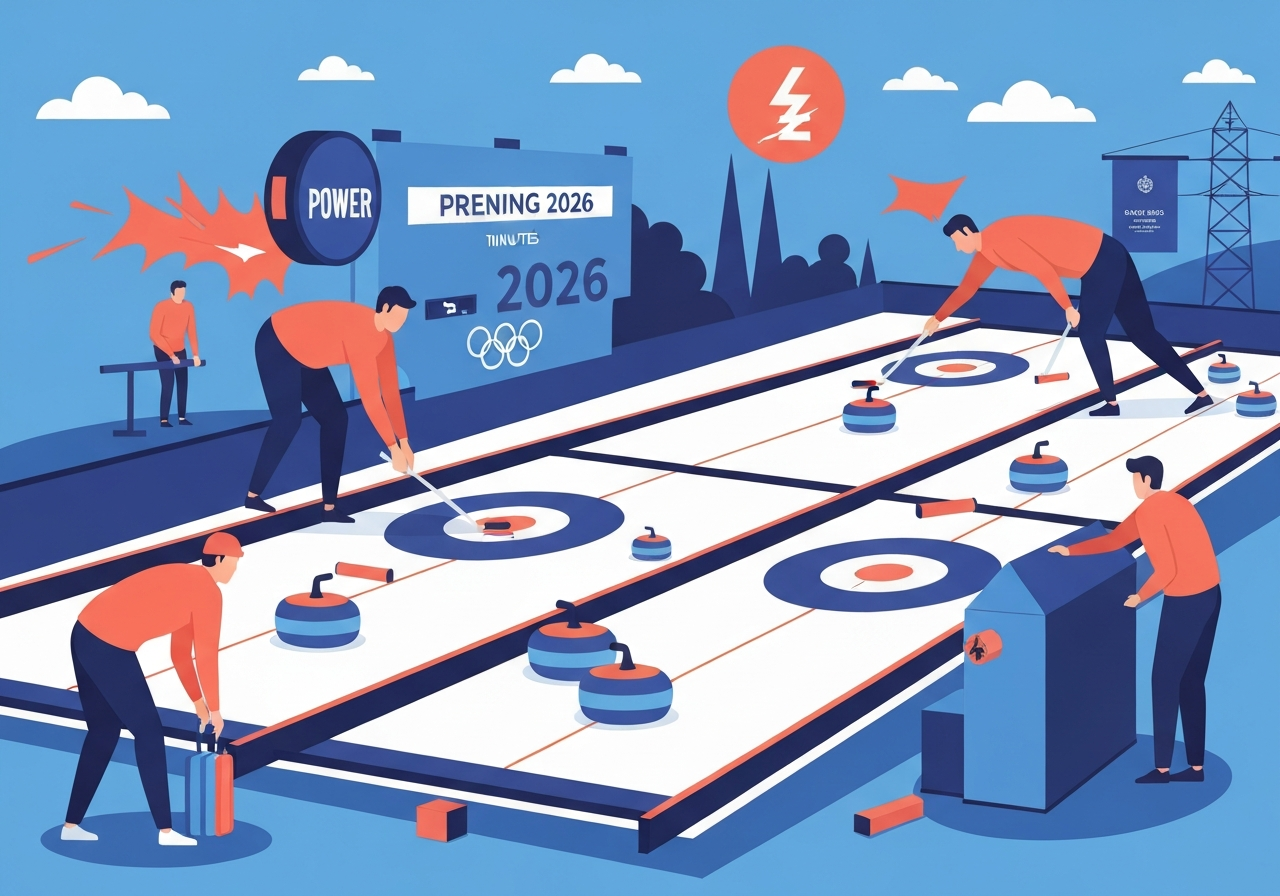
Less than five minutes into the Winter Games’ first live curling competition at the Cortina Curling Olympic Stadium in Cortina d’Ampezzo, Italy, lights briefly dimmed and play was paused on all four sheets. The interruption occurred during mixed-doubles action on Wednesday at the opening session; players and spectators waited as scoreboards and clocks went dark. Organizers later characterized the problem as an energy-related interruption that lasted about three minutes and said power was restored immediately; matches resumed after a delay of a little over five minutes. No injuries or equipment damage were reported, and competition continued as scheduled.
Key takeaways
- The incident occurred at the Cortina Curling Olympic Stadium during mixed-doubles play early in the program; only a few stones had been thrown on each sheet when the lights dimmed.
- The organizing committee said the interruption lasted approximately three minutes; overall stoppage and checks delayed play by a little over five minutes.
- All four sheets were affected: scoreboards and time clocks stopped and officials halted play across the arena.
- Several athletes reacted lightheartedly while waiting — Canada’s Brett Gallant joked with coaches; some players mimed air-guitar moves — and the crowd cheered when full lighting returned.
- The venue traces to the 1956 Winter Olympics as an outdoor facility that later received a roof and upgrades for 2026; it is officially the Stadio Olimpico del Ghiaccio.
- The outage drew attention because other 2026 venues have faced construction issues: Milan’s Santagiulia Ice Hockey Arena has been delayed and reported problems during test events, and the Cortina Sliding Centre drew scrutiny over rushed work and cost.
- Sweden, Switzerland, Great Britain and Canada won their mixed-doubles openers on the day; the United States and defending Olympic champion Italy were scheduled to debut the following morning.
- Mixed-doubles curling at these Games is scheduled to continue through Tuesday, maintaining the event timetable after the short stoppage.
Background
The Cortina curling venue has deep Olympic roots: originally built as an outdoor ice stadium for the 1956 Winter Olympics, it later received a roof and more recent upgrades to host 2026 events. The site — officially Stadio Olimpico del Ghiaccio — has been adapted over decades for skating and hockey, then modernized to meet contemporary competition requirements. Preparations for the 2026 Games have highlighted a broader infrastructure scramble across Italy, where multiple venues underwent rapid construction and retrofitting on tight schedules. Local organizers, national federations and the International Olympic Committee (IOC) all share oversight roles for venue readiness, utilities and safety systems that must operate reliably when competition begins.
Organizing these temporary and upgraded sites in mountain and city locations places particular strain on logistics and utilities. Cortina d’Ampezzo lies at elevation with a limited local grid footprint, while Milan’s venues depend on dense urban infrastructure that has suffered delays and last-minute fixes. Previous Olympics have recorded isolated technical faults, but high-profile issues during competition sessions intensify scrutiny because they can affect athlete performance, broadcast schedules and public trust. In 2026, attention on construction and testing timelines raised expectations that systems would be fully vetted before opening-day competition.
Main event
The interruption occurred within minutes of the first mixed-doubles matches starting on Wednesday. Two of the four simultaneous games were between shots when lighting dimmed: Estonia’s Harri Lill was preparing his throw and continued despite the flicker, while Sweden’s Rasmus Wranå paused. Scoreboards and shot clocks went dark, prompting officials to stop play on all sheets while technicians assessed the situation.
Players and coaches waited on the ice and around the benches; some leaned into humor to ease the pause. Canada’s Brett Gallant chatted with coaches, Korea’s Kim Seon-yeong and Sweden’s Isabella Wranå mimed air-guitar moves with their brooms, and spectators voiced a sarcastic cheer when the lights returned to full strength. Norway’s Magnus Nedregotten offered a visible thumbs-up; Great Britain’s Jennifer Dodds smiled and applauded the restoration.
After roughly three minutes the organizing committee reported power had been restored and competition resumed after a little over five minutes off the ice. The committee described the cause only as an energy-related issue and did not provide further technical details in its initial communication. Play continued without change to the official results of the opening matches, and no match outcomes were overturned due to the stoppage.
Analysis & implications
Operational reliability — particularly electrical systems that support lighting, scoreboards and timing equipment — is a crucial, often overlooked element of sports event delivery. Even brief outages can disrupt athletes’ routines in a sport like curling, where rhythm, concentration and precision are finely tuned; a sudden stoppage risks altering momentum, strategy and ice conditions through additional foot traffic during downtime. Event managers must balance rapid troubleshooting with fairness and athlete safety when deciding how quickly to restart competition.
For organizers, the episode presents a reputational risk because it shifts public attention from athletic performance to venue preparedness. With several 2026 facilities having faced construction or test-event problems — notably Milan’s Santagiulia Arena and concerns at the Cortina Sliding Centre — even a short, contained outage can amplify narratives about rushed preparation. Transparent, specific post-incident reporting (on root cause, corrective actions and steps to prevent recurrence) will be central to limiting fallout and maintaining broadcaster and public confidence.
From an operational standpoint, investigators will likely examine whether the issue stemmed from onsite distribution, temporary equipment used for upgrades, grid-level fluctuations or a redundant power system failure. Each potential source carries different remediation costs and timelines: a local fixture fault can be fixed quickly on site, while grid problems may require coordination with utility providers. The organizing committee’s initial characterization as an energy-related issue narrows causes but does not substitute for a technical report that stakeholders will expect in the coming days.
Comparison & data
| Venue | Key facts | 2026 status/problems |
|---|---|---|
| Cortina Curling (Stadio Olimpico del Ghiaccio) | Built 1956 (outdoor); roof later added; upgraded for 2026 | Brief power interruption during opening mixed-doubles; play resumed |
| Santagiulia Ice Hockey Arena (Milan) | New build for 2026 | Construction delays; reported 3 ft dimensional shortfall and holes in ice during test event |
| Cortina Sliding Centre | New/renovated sliding track | Controversy over rushed construction and cost pressure during delivery |
The table summarizes the contrasts among venues that have attracted scrutiny. Cortina’s curling stadium has a long history but required modernization; Milan’s hockey venue and the Sliding Centre faced criticism for schedule and delivery problems evident during test events. Those preexisting challenges create context for why even a minor operational hiccup draws attention beyond the sporting moment itself.
Reactions & quotes
“There was a brief interruption to competition at the Cortina Curling Olympic Stadium due to an energy-related issue. Power was restored immediately, and competition has since resumed and is ongoing as planned.”
Cortina 2026 Organizing Committee (official statement reported to the press)
“A sarcastic cheer rose from the crowd when the lights came back on, and several athletes greeted the return with thumbs-up and smiles,”
Onsite reporting / spectator accounts (press)
Unconfirmed
- The precise technical root cause of the energy-related interruption has not been publicly disclosed by the organizing committee as of initial reports.
- It is unconfirmed whether the outage originated from local venue infrastructure, temporary equipment installed for the Games, or the regional power grid.
- There is no public evidence yet that the brief interruption affected ice quality or will have measurable effects on match outcomes across the mixed-doubles schedule.
Bottom line
The brief power interruption at Cortina’s curling stadium was short-lived and play resumed with no reported injuries or match reversals, but it highlights the operational vulnerabilities that can surface even at the earliest moments of a Games. Given prior scrutiny over construction and testing at several 2026 venues, organizers will face pressure to provide technical details and demonstrate corrective steps to avoid repeat incidents. Athletes and broadcasters both depend on reliable systems: swift, transparent investigation and public reporting will be important to restore full confidence.
For spectators and teams, the practical impact appears limited: the schedule held and competition proceeded. For organizers and host authorities, however, the incident underscores the need for exhaustive systems testing and contingency planning — particularly when upgrades, temporary installations or grid constraints are part of the operational picture. Watch for a formal technical report from the organizing committee and any follow-up statements from local utilities or the IOC that clarify cause and preventive actions.