
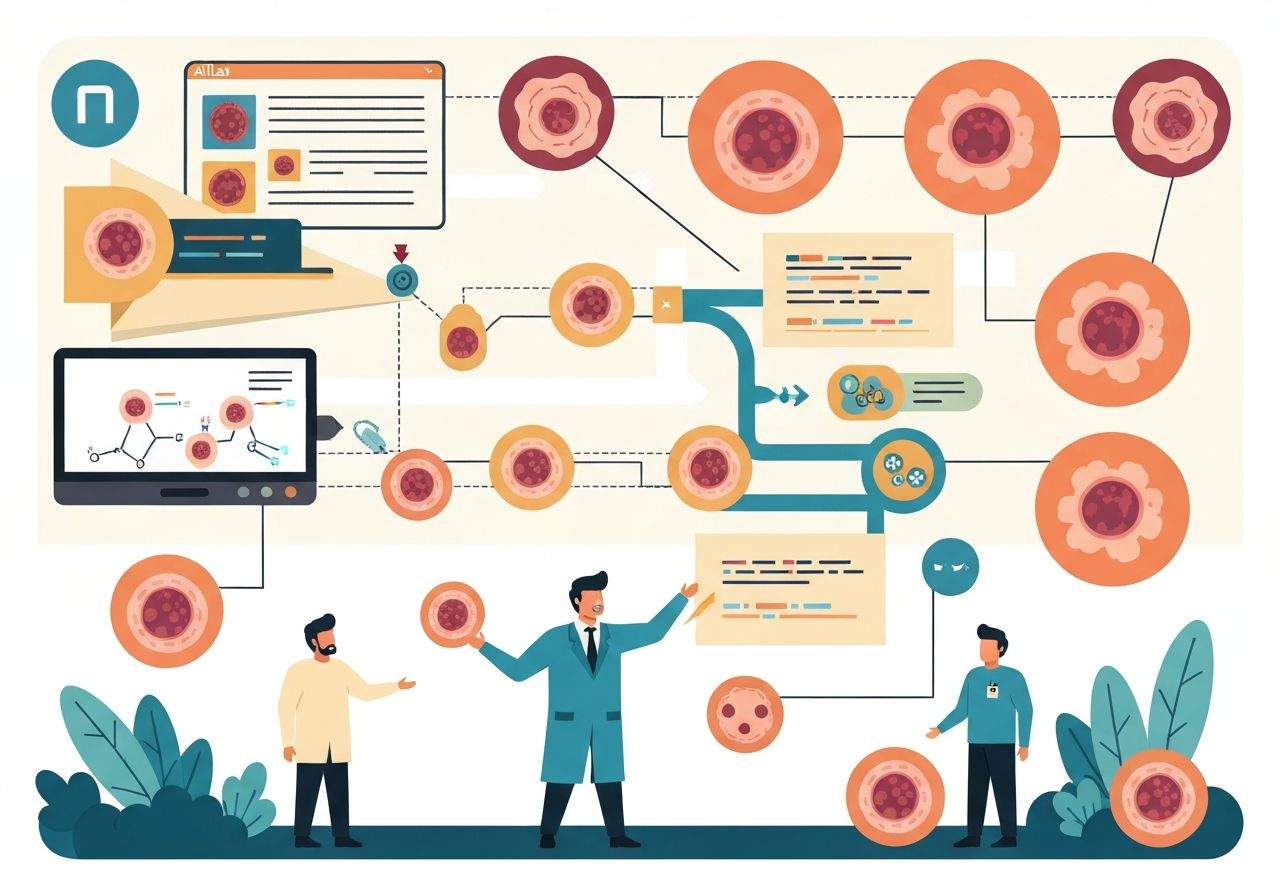
Researchers have built a multi-omics atlas and a PageRank-based pipeline (Taiji) to map transcription factor (TF) activity across nine CD8+ T cell states and used in vivo Perturb-seq to validate state-selective regulators. Integrating 52 ATAC-seq and 69 RNA-seq experiments (121 samples) revealed 136 single-state and 173 multi-state TF genes, including 34 TEXterm- and 20 TRM-selective single-state TFs. Genetic perturbation of predicted TEXterm TFs (for example, Zscan20, Jdp2, Zfp324) reduced terminal exhaustion and, in adoptive transfer models, improved tumour control; by contrast, Klf6 overexpression selectively expanded TRM cells without increasing exhaustion. Cross-species analysis and human T cell experiments support translational relevance for cell therapy engineering.
- Atlas scope: integrated 121 CD8+ T cell experiments (52 ATAC-seq, 69 RNA-seq) spanning nine defined states from acute and chronic LCMV models and tumours.
- TF catalogue: Taiji identified 255 state-enriched TF genes—136 single-state TFs and 173 multi-state TFs; TRM had 20 single-state TFs and TEXterm 34 single-state TFs.
- Perturb-seq scale: in vivo CRISPR Perturb-seq profiled 17,257 Clone-13 cells and 15,211 Armstrong cells to test 19 TF genes with 76 TF-gRNAs plus controls.
- Functional hits: KOs of multi-state TFs (Hic1, Stat3, Prdm1, Ikzf3) caused ~90% reduction in TEXterm differentiation; KOs of new TEXterm single-state TFs reduced TEXterm by 43–78% (Jdp2 43%, Zscan20 54%, Zfp324 78%).
- Therapeutic readouts: Zscan20 KO improved tumour control in B16-GP33 models and enhanced effector markers (CX3CR1, granzyme B); Klf6 overexpression produced ~15-fold enrichment of donor cells in gut and ~42× increase in CD69+CD103+ TRM-like cells without elevating terminal exhaustion.
- Proteasome link: TF network analysis connected TEXterm communities to proteasome and catabolic programmes; proteasomehigh T cells showed reduced tumour control in adoptive transfer experiments (n≥6).
- Cross-species conservation: 19 of 34 mouse TEXterm single-state TFs showed conserved activity in human pan-cancer CD8+ T datasets; human ZSCAN20 or JDP2 KO increased CCR7 and effector cytokines under chronic stimulation.
Background
Cell states arise from how a defined cell type interacts with its environment; within CD8+ T cells these include effector, memory and exhaustion trajectories. Tissue-resident memory (TRM) cells are associated with improved outcomes in many solid tumours, while terminally exhausted (TEXterm) cells accumulate under persistent antigen exposure and express high levels of inhibitory receptors such as TIM3 and CD101. Despite functional divergence, TRM and TEXterm cells share overlapping transcriptional and chromatin landscapes, making it difficult to identify TFs that can be modulated to favour therapeutic states without collateral effects.
Transcription factors control differentiation but TF activity does not always track with mRNA abundance because activity depends on chromatin accessibility, cofactors and post-translational regulation. Network-aware, multi-omics methods are therefore required to infer TF influence. The authors adapted Taiji—a PageRank-derived GRN approach that integrates ATAC-seq, motif predictions and RNA expression—to quantify global TF influence across nine CD8+ states drawn from acute (LCMV–Armstrong) and chronic (LCMV–Clone-13) infection models and tumour-infiltrating lymphocytes.
Main event
The team assembled a paired multi-omic atlas from 121 samples (52 ATAC, 69 RNA) across nine CD8+ states and computed TF PageRank scores per state. Statistical filtering classified 255 state-enriched TF genes: 136 predominantly single-state and 173 multi-state TFs. TRM and TEXterm shared many regulators but could still be dissected computationally to yield 20 TRM- and 34 TEXterm-selective single-state TF candidates, plus ~30 TFs active in both states.
Taiji-derived TF waves highlighted coordinated groups of TFs linked to biological pathways: a TRM wave enriched in AP-1 family members and TGFβ response, and a TEX wave enriched in IRF8, JDP2 and NFATC1 associated with PD1 and senescence-related programmes. TF–TF association networks and community detection exposed state-specific modules—TRM communities linked to adhesion and TGFβ response, TEXterm communities to catabolism, proteolysis and autophagy.
To validate predictions, the authors built a dual-guide retroviral Perturb-seq library targeting 19 TF genes (including controls) and carried out in vivo screens during chronic and acute infection. Single-cell readouts (17,257 Clone-13 cells; 15,211 Armstrong cells) revealed that most predicted TEXterm TF KOs reduced TEXterm representation. Notably, multi-state TF KOs (Hic1, Stat3, Prdm1, Ikzf3) caused ~90% loss of TEXterm differentiation, while novel single-state KOs (Zfp324, Zscan20, Jdp2) reduced TEXterm by 78%, 54% and 43% respectively.
Follow-up flow cytometry and functional assays showed that several TEXterm TF KOs decreased inhibitory receptor expression and shifted populations toward TEXprog or TEXeff phenotypes, with Zscan20 and Jdp2 KOs increasing IFNγ/TNF production and lowering viral titres. In separate ACT tumour experiments, Zscan20 KO cells improved tumour control and raised effector markers more than the multi-state TF Hic1 KO, illustrating practical therapeutic differences between targeting single-state versus multi-state TFs.
Analysis & Implications
The atlas-plus-Perturb-seq workflow demonstrates how integrating chromatin accessibility, motif information and expression into a network PageRank approach sharpens identification of candidate TFs that specify cell states. Because Taiji scores capture network influence rather than raw expression, the pipeline preferentially highlights regulators whose perturbation has outsized effects through their regulatee networks—explaining why some TFs with modest expression changes emerge as key state controllers.
Functionally, the distinction between single-state and multi-state TFs is critical for cell engineering. Multi-state TFs (for example, PRDM1) shape multiple differentiation outcomes and their perturbation can impair desirable states such as TRM; single-state TEXterm TFs (for example, ZSCAN20, JDP2, ZFP324) can be targeted to reduce terminal exhaustion while largely preserving TRM and other memory fates. The in vivo data support this: TEXterm single-state KOs curtailed exhaustion and in some cases increased effector function and tumour control.
Translationally, the conserved activity of many TFs in human tumour-infiltrating CD8+ T datasets and the observed functional improvements after ZSCAN20/JDP2 KO in human T cells under chronic stimulation strengthen the case for developing TF-targeted strategies for adoptive cell therapy. For ACT or CAR-T therapies in solid tumours, combining deletion of TEXterm-selective TFs with enforced expression of TRM-promoting TFs (KLF6 demonstrated here) could produce more durable, tissue-competent antitumour T cells.
Comparison & data
| Metric | Value |
|---|---|
| Samples (ATAC + RNA) | 121 (52 ATAC, 69 RNA) |
| CD8+ T cell states | 9 distinct states |
| State-enriched TFs | 255 total (136 single-state, 173 multi-state) |
| TRM single-state TFs | 20 |
| TEXterm single-state TFs | 34 |
| Perturb-seq cells | 17,257 (Clone-13), 15,211 (Armstrong) |
| Key KO effects | Hic1/Stat3/Prdm1/Ikzf3 ≈90% TEXterm reduction; Zfp324 78%; Zscan20 54%; Jdp2 43% |
These numbers come from the multi-omic atlas and in vivo perturbation experiments; replicate numbers and statistical tests are reported in the original dataset (Nature, 2026). Pathway enrichments (proteasome, autophagy, TGFβ) were validated across mouse models and human tumour single-cell datasets.
Reactions & quotes
“A network-level PageRank measure of TF activity lets us find regulators that matter for state transitions even when their mRNA hardly changes,” the study authors note, stressing Taiji’s ability to prioritize functional TFs for perturbation.
Study authors (Nature, 2026)
“Deleting Zscan20 or Jdp2 shifted cells away from terminal exhaustion and improved cytokine responses, supporting a therapeutic path to make T cells more effective in tumours,” the paper summarizes.
Salk Institute / UNC team (Nature, 2026)
Unconfirmed
- Long-term safety and functional stability of TF KOs (for example, ZSCAN20 or JDP2) in human T cells after adoptive transfer remain untested in clinical trials.
- Off-target or broader immunological consequences of deleting TFs with partially overlapping roles (even single-state candidates) need comprehensive evaluation beyond short-term mouse models.
- Cross-species conservation was partial: 19/34 mouse TEXterm single-state TFs conserved in human datasets—additional validation is required across tumour types and patient heterogeneity.
Bottom line
The study presents a rigorous, atlas-guided framework that links multi-omics TF activity mapping to functional in vivo perturbation, yielding TF candidates that can be targeted to reduce terminal exhaustion while preserving or promoting beneficial TRM and effector states. The combined use of Taiji and Perturb-seq provides a scalable blueprint to prioritize TFs for cell-engineering recipes in ACT and CAR-T approaches for solid tumours.
For translational progress, the most actionable near-term leads are TF KOs (ZSCAN20, JDP2, ZFP324) that lower exhaustion markers and improve effector function in preclinical models, and TF overexpression (KLF6) that expands TRM without worsening exhaustion. Clinical translation will require rigorous safety profiling, assessment of off-target effects, and demonstration of durable functionality in human T cell products.
Sources
- Atlas-guided discovery of transcription factors for T cell programming — Nature (peer-reviewed article, 2026)
- Taiji v.2.0 (Taiji GitHub repository; code) — computational pipeline and methods
- GEO (data repository) — referenced for datasets and accession listings in the study (Supplementary Table 1)