
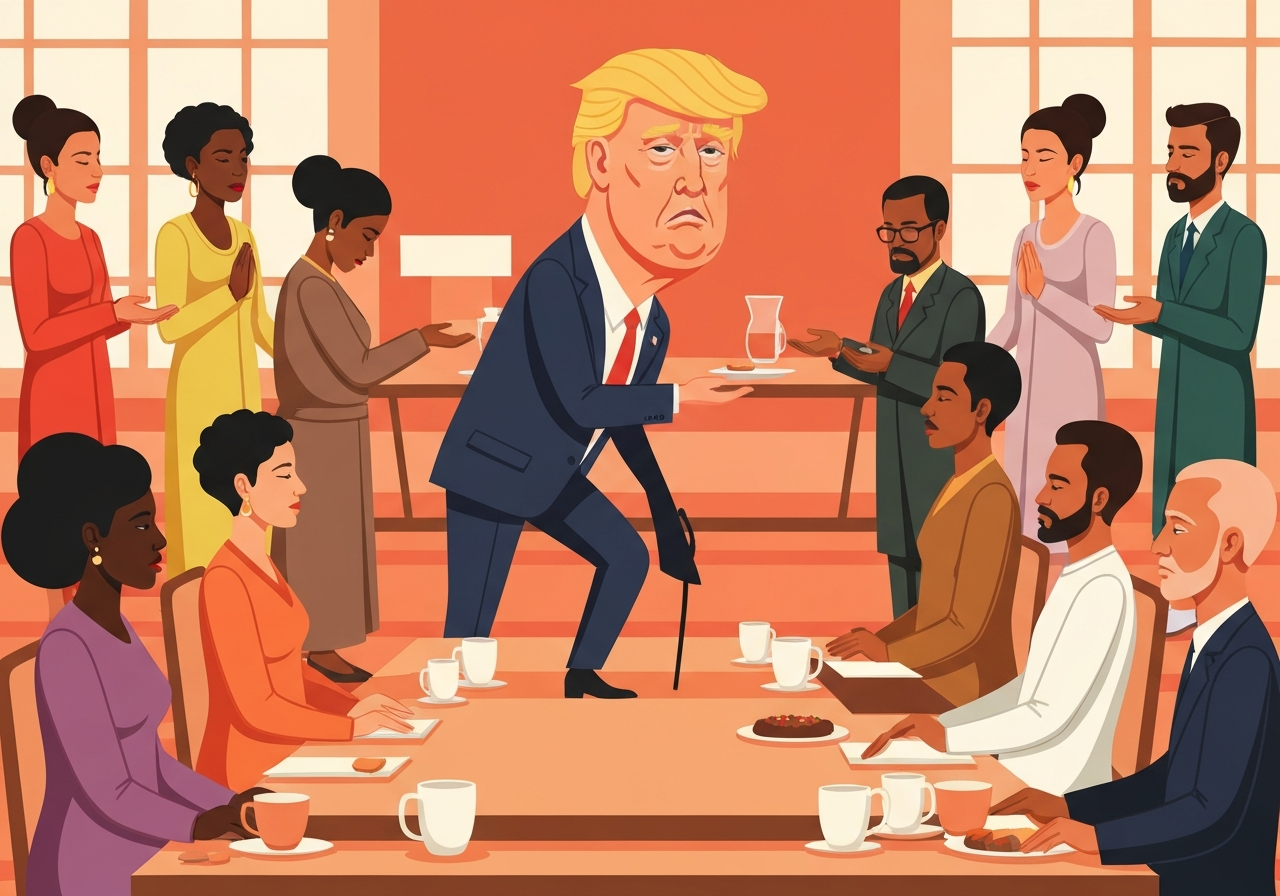
The National Prayer Breakfast on Capitol Hill on Feb. 6, 2026, featured President Donald Trump as a speaker and drew sharp late-night commentary the same day. Trump delivered an extended address attended by members of Congress and public figures, prompting jokes from hosts such as Seth Meyers and Jimmy Kimmel who framed his remarks as partisan and theatrical. Comedians highlighted several of Mr. Trump’s claims and language — including a boast that “religion is back, now hotter than ever before,” a comment about troops and criminals, and a recollection of bombing ISIS fighters on Christmas Day — and noted the presence of singer Jelly Roll among attendees. The event and the reactions underscored tensions over the line between faith-based gatherings and politics in Washington.
Key Takeaways
- Date and place: The National Prayer Breakfast took place on Feb. 6, 2026, on Capitol Hill with President Donald Trump among the speakers.
- Trump remarks: The president said “religion is back, now hotter than ever before,” and recounted military action against ISIS on Christmas Day during his remarks.
- Length and tone: Late-night hosts characterized his speech as a lengthy, 75-minute ramble and criticized its partisan tone.
- Public figures present: Singer Jelly Roll attended the breakfast; Mr. Trump made a remark about Speaker Mike Johnson and reportedly called a GOP member “a moron.”
- Late-night response: Seth Meyers and Jimmy Kimmel led the televised criticism, using the event to lampoon Mr. Trump’s blending of politics and prayer.
- Historic note: The appearance was described by commentators as Mr. Trump’s sixth time at the annual event.
Background
The National Prayer Breakfast is an annual gathering, traditionally described as nonpartisan and attended by lawmakers, religious leaders and invited guests. It has long been positioned as an opportunity for members of different parties to show public expressions of faith together, often accompanied by speeches and a guest sermon. In recent years the event has increasingly intersected with partisan debates as public figures use the platform to make political statements.
President Trump has a history of using high-profile appearances to consolidate support among his base; commentators noted that his return to the presidency has intensified attention on routine moments, turning them into political theater. Late-night hosts routinely respond to such appearances, packaging critique into monologues and segments that highlight rhetoric they view as at odds with the event’s nonpartisan traditions.
Main Event
On the morning of Feb. 6, Mr. Trump addressed the attendees at the Prayer Breakfast and delivered an extended set of remarks that mixed personal claims, praise for religious revival, and blunt language about law enforcement. According to late-night coverage, the speech included a claim that U.S. forces had engaged ISIS fighters on Christmas Day and a description of security forces “beating the crap out of” criminals — phrases that drew immediate commentary from television hosts.
Comedians singled out a moment when Mr. Trump mocked Speaker Mike Johnson for saying grace before lunch and referenced a GOP member in derisive terms; a headline summarized one jab as Mr. Trump calling a fellow Republican “a moron.” The presence of country and rock singer Jelly Roll was noted by televised commentators, who used his attendance as fodder for jokes about the event’s tone and guest list.
Later coverage emphasized the performance aspect of the president’s remarks. Hosts described the speech as meandering and unusually long for the setting, reporting a 75-minute duration that shifted from spiritual themes to combative political language. The mixture of faith-oriented rhetoric and partisan content prompted analysts to question whether the breakfast had retained its customary nonpartisan character.
Analysis & Implications
The conflation of a religiously framed event with overt political messaging raises questions about norms that have historically separated private faith practice from public partisan campaigning. If the Prayer Breakfast becomes perceived primarily as a platform for political theater, smaller organizations and faith leaders who rely on its nonpartisan reputation may find the event less effective for interfaith dialogue or civic bridge-building.
For the Republican Party, the president’s performance at a faith-centered gathering could consolidate support among voters who view public religiosity as a sign of cultural leadership, while alienating more moderate constituents who expect restrained rhetoric in such settings. The episode is likely to factor into ongoing debates within the party about strategy and tone heading into future electoral cycles.
Internationally, the use of a religious forum to announce or repeat military claims risks complicating diplomatic messaging. Allies and adversaries alike monitor presidential rhetoric for signals about policy intent; mixing faith language with operational boasts can blur the line between spiritual reassurance and strategic pronouncements, potentially affecting perceptions in sensitive regions.
Comparison & Data
| Item | Reported Detail |
|---|---|
| Appearance count | Sixth appearance by President Trump at the Prayer Breakfast (as reported by commentators) |
| Reported speech length | Approximately 75 minutes, described by late-night hosts as rambling |
These reported figures come from televised commentary and the event coverage on Feb. 6, 2026. They are useful for context but reflect observers’ descriptions rather than an official event timeline. Comparing the reported length and style of this appearance with past breakfasts highlights the degree to which this iteration deviated from the shorter, less partisan remarks that have been typical in prior years.
Reactions & Quotes
“The annual breakfast is supposed to be a normal, nonpartisan event, but, of course, Donald Trump is incapable of being normal,”
Seth Meyers
Seth Meyers used the segment to argue that the event’s nonpartisan tradition was undermined by the president’s tone. He and other hosts repeatedly returned to the theme that mixing partisan attacks with a prayer gathering felt incongruous.
“It was the MAGA Teresa’s sixth appearance at the event and he gave quite a performance,”
Jimmy Kimmel
Jimmy Kimmel framed the appearance as theatrical and questioned the sincerity of religious language when paired with political barbs. Kimmel and peers seized on specific lines and delivery to characterize the speech as performative.
“Religion is back, now hotter than ever before,”
President Donald Trump
That line from Mr. Trump became a focal point for both praise and satire; supporters may view it as affirmation of religious resurgence, while critics saw it as rhetorical embellishment used to rally a political base.
Unconfirmed
- The president’s claim that U.S. forces “bombed ISIS fighters on Christmas Day” was stated during remarks and has not been independently verified in this report.
- Comedian assertions that Mr. Trump “doesn’t go to church” or “only prays for money” reflect opinion and have not been substantiated here.
Bottom Line
The Feb. 6, 2026, National Prayer Breakfast became a flashpoint for debates over whether religious gatherings in Washington can remain nonpartisan when used as stages for forceful political rhetoric. President Trump’s remarks and the late-night reaction together magnified the event, turning a routine observance into a subject of national conversation about tone, intent and the role of faith in public life.
Observers should watch for follow-up statements from organizers, congressional leaders and the White House that clarify whether the breakfast’s traditions will be reaffirmed or recalibrated. The episode illustrates how ceremony and media cycles interact in ways that can alter the public function of longstanding civic rituals.
Sources
- The New York Times — news coverage of the Feb. 6, 2026 event (news)
- Late Night with Seth Meyers — late-night commentary and monologue excerpts (television network)
- Jimmy Kimmel Live — late-night commentary and segments (television network)