
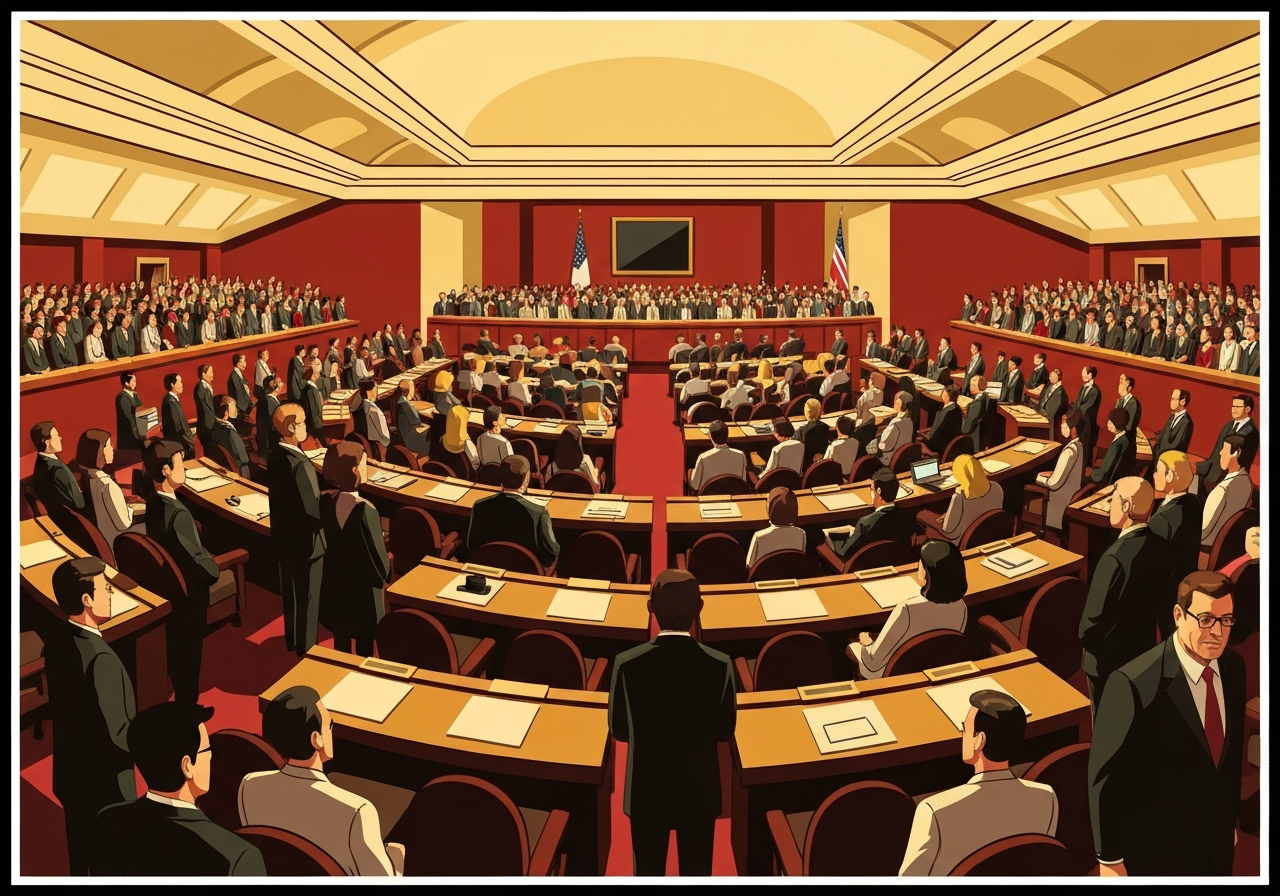
On Friday in Olympia, a hastily scheduled public hearing on Senate Bill 6346 — the so-called “millionaires tax” — filled the Senate Ways and Means Committee room for two hours, producing heated testimony from both opponents and supporters. The proposal would impose a 9.9 percent tax on income above $1 million beginning in 2028, with the first payments due in 2029. Lawmakers heard sharp warnings that the levy could expand beyond high earners and equally forceful testimony that the measure would raise roughly $3.5 billion a year to repair an “upside down” tax system. The session underscored the political and legal hurdles the bill faces as it moves through the Legislature.
Key Takeaways
- SB 6346 would tax income above $1,000,000 at 9.9 percent starting in 2028, with collections beginning in 2029.
- Legislative staff estimate the tax would raise about $3.5 billion annually from roughly 30,000 taxpayers.
- Opponents registered more than 60,000 online objections on the Legislature’s website ahead of the hearing, compared with a smaller number of supporters.
- The bill includes a $50,000 charitable contribution exemption and applies the tax only to income above the $1 million threshold.
- The proposal raises the B&O tax threshold from $125,000 to $250,000 and Gov. Bob Ferguson has suggested expanding that exemption to $1 million.
- Critics warn of a “marriage penalty” because combined spousal income over $1 million would trigger the levy.
- Democrats waived the usual five-day notice requirement to hold the hearing days after the 63-page bill was posted, prompting GOP objections.
Background
Washington is one of nine U.S. states without a broad personal income tax; voters have repeatedly rejected income-tax measures here, most recently a ballot effort in 2010. The state relies heavily on sales and business taxes, a structure critics say places a heavier burden on lower- and middle-income households. Supporters of SB 6346 argue that a targeted tax on the wealthiest residents would rebalance the system and fund essential services such as K-12 education and Medicaid.
The measure’s architects point to shifting public opinion after recent state actions, including a 2024 vote to uphold a capital gains tax on wealthy investors, as evidence that voters may now accept steep levies on top earners. Republicans and anti-tax activists counter that the state Supreme Court’s 1933 decision striking down a graduated income tax remains binding precedent and that the bill is likely to face legal challenges. Those legal questions are compounded by a clause in the draft bill declaring the levy “necessary for the support of the state government,” an attempt to limit a straightforward referendum.
Main Event
The two-hour hearing drew a standing-room crowd to Olympia, with testimony running from wealthy opponents who warned of relocation and tax-avoidance steps to families and advocacy groups calling the proposal a long-overdue correction. Opponents, including high-profile anti-tax funders, criticized the bill as unconstitutional and predicted it would expand to capture more taxpayers over time. Supporters countered with personal stories and business-owner testimony that higher contributions from the wealthiest would preserve core services and strengthen the broader economy.
Testimony included starkly contrasting personal anecdotes. A hedge-fund manager who has backed anti-tax efforts said he and others had options to restructure or leave the state, while several high-income witnesses said they were prepared to pay the new levy. Lawmakers sparred over process: Republicans pressed Democrats for more time and for guarantees the tax would not be broadened in future sessions, while the bill’s sponsor said current text limits the measure to incomes above $1 million but cannot bind future legislatures.
Procedural controversy marked the session: majority Democrats voted to waive a rule requiring five days’ notice before a public hearing, allowing the committee to hear testimony only days after the bill’s 63 pages became public. Republicans described the fast pace as unfair for the public and for small businesses that would face changes to B&O thresholds. The hearing also showcased organized online activism, with more than 60,000 oppositional registrations on the legislative site, far outpacing recorded supporters.
Analysis & Implications
If enacted, the tax would generate a material revenue stream — an estimated $3.5 billion annually — that state leaders say would stabilize funding for education, health care and other general-fund priorities. For a taxpayer earning $1.3 million, analysts note, the 9.9 percent rate would apply only to the $300,000 above the $1 million threshold, limiting the base to top-tier income. The revenue estimate assumes about 30,000 filers would be affected; volatility in high-end incomes, however, could make receipts less predictable year-to-year.
Politically, the measure tests evolving voter attitudes in a state long resistant to personal income taxes. Supporters point to recent acceptance of the capital gains tax as a signal that targeted taxes on wealthy households can gain traction. Opponents are banking on constitutional and ballot-initiative tools to block or overturn the policy, and early procedural moves — including a clause meant to preclude a referendum — suggest both sides are preparing for protracted court and campaign fights.
The legal landscape is central: a 1933 Washington Supreme Court ruling invalidated a graduated income tax, and courts will likely be asked to revisit or reinterpret that precedent if SB 6346 passes. Even beyond the state judiciary, the proposal sits amid national debates over tax fairness and inequality; proponents frame the tax as corrective, while detractors frame it as a deterrent to investment and residency. Economists caution that the net economic impact will depend on behavioral responses by high earners, changes in capital flows, and how the state deploys new revenue.
Comparison & Data
| Metric | Value |
|---|---|
| Top marginal rate | 9.9% |
| Threshold | $1,000,000 |
| Estimated annual revenue | $3.5 billion |
| Estimated affected taxpayers | ~30,000 |
| Charitable exemption | $50,000 |
| Effective (taxed) year | 2029 |
The table summarizes figures from the legislative staff analysis cited during the hearing. Those projections underpin both policy arguments and political strategy: proponents emphasize the scale of revenue and narrow taxpayer pool; opponents highlight uncertainty in behavioral responses and legal risk. The bill’s adjustments to business tax thresholds also change the calculus for small firms, with the proposal raising the B&O exemption from $125,000 to $250,000 and the governor proposing an even higher cut.
Reactions & Quotes
Speakers on both sides provided concise, pointed lines that encapsulated the debate and were used frequently by advocates and critics outside the hearing.
“Like many people in my position, I have got options.”
Brian Heywood, hedge fund manager (opponent)
Heywood, who has funded anti-tax campaigns, told the committee he fears relocation and tax avoidance by wealthy residents. His testimony included an assertion that he had heard of dozens of couples leaving the state in recent weeks because of Democratic tax actions; that claim drew skeptical follow-up questions from legislators.
“It’s better to grow the pie than to fight about slicing it.”
Jed Fowler, business owner (supporter)
Fowler, a fourth-generation construction-supply owner, argued that investing in public services helps businesses by strengthening communities. Supporters emphasized the human side of state services, with advocates noting Medicaid and other programs that assist vulnerable families.
“Families like mine are struggling to pay for life-giving care … while the rich get richer.”
Melissa Dingmon, Moms Rising (supporter)
Dingmon described the bill as a long-term funding mechanism to preserve services such as Medicaid. Her testimony connected the proposed revenue stream directly to specific services that supporters say would benefit low- and middle-income households.
Unconfirmed
- The claim that 50 couples have left the state in the past two weeks is based on testimony and has not been independently verified.
- Predictions that the tax will inevitably expand to lower-income taxpayers are speculative and reflect opponents’ projections rather than provable facts.
- Estimates of long-term behavioral responses (relocation, tax avoidance) vary; the legislative revenue projection does not incorporate worst-case migration scenarios.
Bottom Line
Friday’s hearing made clear that SB 6346 is both politically consequential and procedurally contentious: it offers a sizable revenue increase targeted at a relatively small group of filers while triggering vigorous opposition and legal questions. The bill’s immediate future will be shaped by committee votes, likely litigation over constitutionality, and a possible ballot fight if opponents gather sufficient signatures.
For policymakers, the core choice is whether to accept a targeted income tax as a tool to rebalance Washington’s revenue system and protect services, or to double down on existing tax structures and risk continued pressure on lower-income households. Regardless of outcome, the hearing signaled that the debate will be fought on legal, economic and emotional terrain for months to come.
Sources
- The Seattle Times — (news reporting)
- Washington State Legislature — (official bill information)