
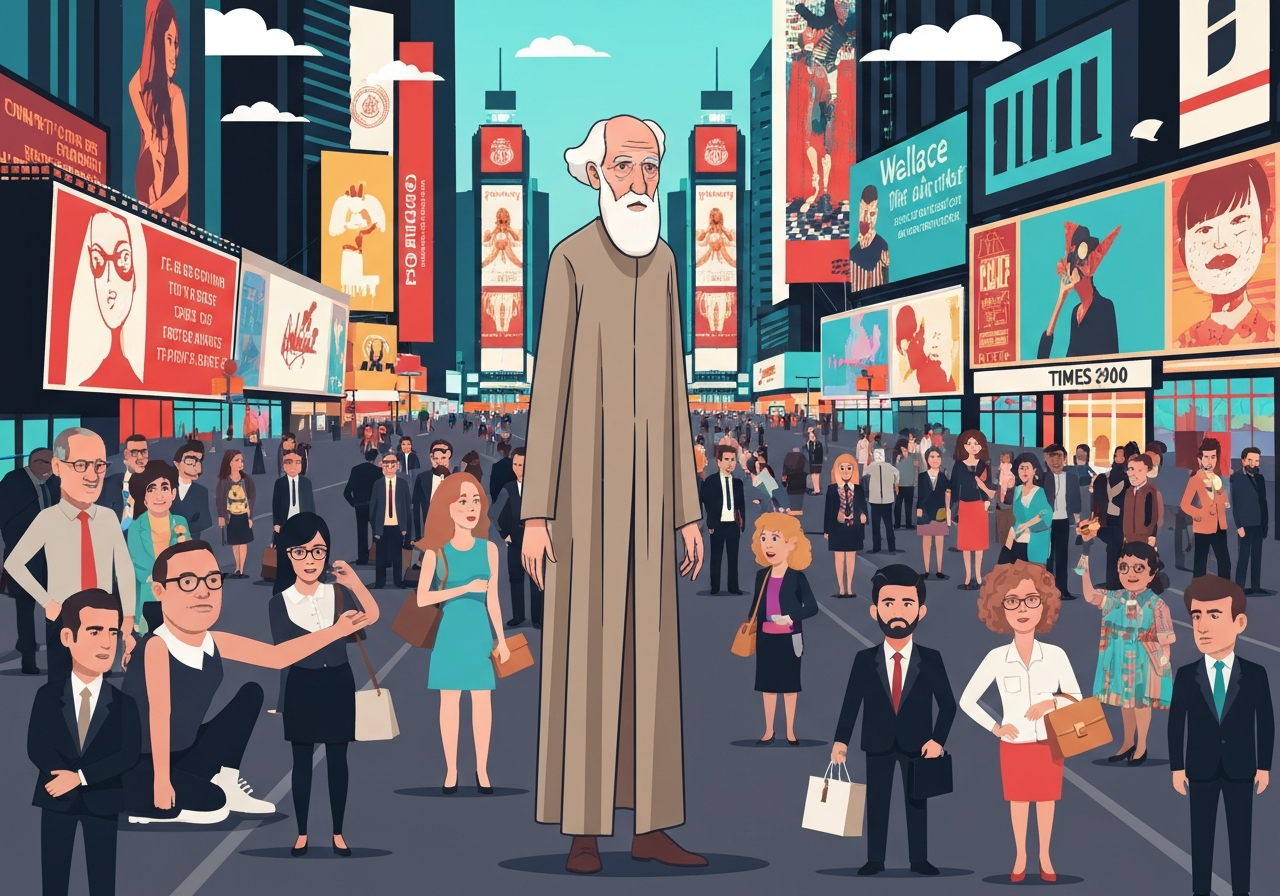
Wallace Shawn, the 82‑year‑old New Yorker known both for terse film turns and an uncompromising career as a playwright, was repeatedly recognized on the city streets during a December outing that a photographer captured on Dec. 11, 2025. Alone in a plain black parka and a moth‑holed gray cap, Shawn drew a string of enthusiastic reactions — from startled theatergoers to tourists shouting lines from his most famous film role — underscoring the peculiar overlap between pop fame and a long, often experimental artistic life. The episode raises a basic question about modern fame: how an artist whose work sits squarely in the avant‑garde becomes, paradoxically, a public attraction in the heart of Manhattan. Reported as part of a February 8, 2026 profile, the anecdote highlights both his mainstream visibility and his insistence that he is primarily a playwright.
Key Takeaways
- Wallace Shawn is 82 years old and lives in New York; a profile published Feb. 8, 2026, recounts a December 11, 2025 encounter in the city.
- On the day described he was stopped multiple times in public, including in Times Square, where fans recognized him and called out lines from The Princess Bride (1987).
- Shawn is widely known on screen for roles in The Princess Bride (1987), My Dinner With André (1981), Manhattan (1979) and Clueless (1995).
- He describes himself foremost as a playwright; notable stage works cited include Our Late Night (1975) and Grasses of a Thousand Colors (performed in 2013).
- The 30th anniversary of Clueless (1995) renewed attention to his film work and helped place his theatrical career back into broader cultural conversation.
- Photographer Sean Donnola documented Shawn on Dec. 11, 2025, a detail used in the recent profile to illustrate his public visibility.
Background
Wallace Shawn has long occupied two overlapping cultural worlds: the mainstream film and television audience that recognizes him for distinctive supporting roles, and the theatre community that knows him as an experimental playwright and essayist. His breakthrough in film included Woody Allen’s Manhattan (1979) and later a signature part as Vizzini in The Princess Bride (1987), whose repeated catchphrase became a perennial public call‑out. Parallel to that on‑screen visibility, Shawn has written plays since the 1970s that embrace provocation, interior monologue and social critique; these works circulated primarily in theatrical and academic circles rather than the mass market.
Times Square and midtown Manhattan function as amplified stages for celebrity: tourists, commuters and cultural audiences converge there, often treating public figures as attractions. That context transforms casual recognition into a social performance — interruptions, selfies and shouted lines — which can obscure the more private practice of a working artist. For someone like Shawn, whose plays interrogate intimacy and political life, this kind of public attention highlights an ongoing tension between notoriety and the quieter work of writing for the stage.
Main Event
The profile describes a lunch in December followed by a walk across town during a cold Sunday when much of the city’s slush had frozen. Shawn, described as small in stature and casually dressed in a black parka and boots, donned a gray wool cap before they left; the article notes the cap had a few moth holes. Despite his modest appearance, the party line outside a theater registered a visible stir when he approached: people in line reacted with delight and surprise, and he had already been stopped twice earlier that day by animated fans.
At one point, bystanders called out the word ‘Inconceivable!,’ a callback to his Vizzini role in The Princess Bride (1987). Those exchanges were portrayed as routine — pleasant but not emotionally weighty for Shawn — suggesting an accumulated familiarity rather than episodic stardom. The profile frames these street interruptions as a regular feature of his public life, where playgoers and passersby conflate the actor’s cinematic personae with the author who produces challenging stage work.
The anecdote underscores how particular film moments can crystallize a public identity: a single line, delivered in a memorable cadence, becomes shorthand for recognition decades later. Simultaneously, the piece stresses that Shawn’s theatrical output — from Our Late Night (1975) to later projects like the 2013 performance of Grasses of a Thousand Colors — remains central to his self‑definition even as tourists and fans fixate on his cinematic highlights.
Analysis & Implications
Shawn’s situation is a clear example of how film and television exposure can reframe an artist’s public persona irrespective of that artist’s own priorities. Roles in widely seen films supply cultural touchstones that persist in public memory; a line or a particular scene can eclipse a lifetime of stage work because it circulates more readily in popular culture. For theater practitioners who depend on reputation within a narrower field, this mismatch can be professionally flattening: it channels attention into moments rather than into ongoing projects or ideas.
At the same time, mainstream recognition can produce practical benefits for an artist engaged in less lucrative forms of work. Increased name recognition may help sell tickets for new plays, attract media coverage, and make fundraising or venue bookings easier. For Shawn, the renewed interest tied to anniversaries and streaming availability of older films could mean larger, more diverse audiences discovering his plays — a conversion of pop visibility into potential support for avant‑garde art.
There are broader cultural questions at stake about how audiences value art that resists easy digestion. When an experimental playwright becomes a street icon, the public encounter risks simplifying the artist’s oeuvre into a set of accessible identifiers. Yet it also creates openings: casual fans exposed to his name or persona might become curious about his theatrical work. The net effect depends on how cultural intermediaries — critics, programmers, institutions — frame and direct that curiosity toward substantial engagement.
Comparison & Data
| Selected Screen Work | Year | Role | Context |
|---|---|---|---|
| Manhattan | 1979 | Supporting | Woody Allen film, New York setting |
| My Dinner With André | 1981 | Co‑lead / Writer | Art‑house dialogue film; autobiographical elements |
| The Princess Bride | 1987 | Vizzini | Broad popular cult hit; memorable line |
| Clueless | 1995 | Teacher | Mainstream teen comedy; renewed interest on 30th anniversary |
The table above contrasts a few of Shawn’s best‑known screen credits and their cultural positions. While films like The Princess Bride became part of mass popular culture, projects such as My Dinner With André were more narrowly aligned with art‑house and theatrical sensibilities. This split helps explain why a single line from a 1987 movie can dominate public recognition even as his theatrical corpus remains influential among practitioners and critics.
Reactions & Quotes
Observers across the scene offered short, situational responses that clarify how different audiences register Shawn’s presence.
‘My goal as a human being, since childhood, was to be taken seriously,’ Shawn has said about his work and ambitions.
Wallace Shawn (from a past interview)
The profile uses that line to frame Shawn’s double life as both public figure and serious dramatist: repeated public interruptions test the tension between fun recognition and artistic respect.
‘Inconceivable!’
Passerby in Times Square
That exclamation, recorded as being shouted by people who recognized him, illustrates how film dialogue can become a shorthand for identification and affection among casual audiences.
Unconfirmed
- Precise counts of how many times Shawn was stopped on the day described beyond the reported twice remain unverified.
- Whether renewed streaming of his films directly increased attendance at his plays has not been demonstrated with box‑office or ticketing data.
- Details about private conversations during the reported walk were summarized from a profile; verbatim exchanges beyond brief quoted lines are not independently corroborated.
Bottom Line
Wallace Shawn’s public encounters in Times Square reveal a persistent cultural dynamic: an artist can be remembered widely for a small number of popular moments even while producing a substantial body of experimental work. That reality is neither purely flattering nor wholly diminishing — it is a mixed marketplace in which visibility can both obscure and enable deeper engagement.
For audiences and institutions alike, the productive response is to treat recognition as an entry point rather than a final judgment: use popular familiarity to invite curiosity about an artist’s fuller practice. In Shawn’s case, the street‑level encounters expose an opportunity to connect casual admirers to decades of plays that continue to challenge audiences in ways film sometimes cannot.