
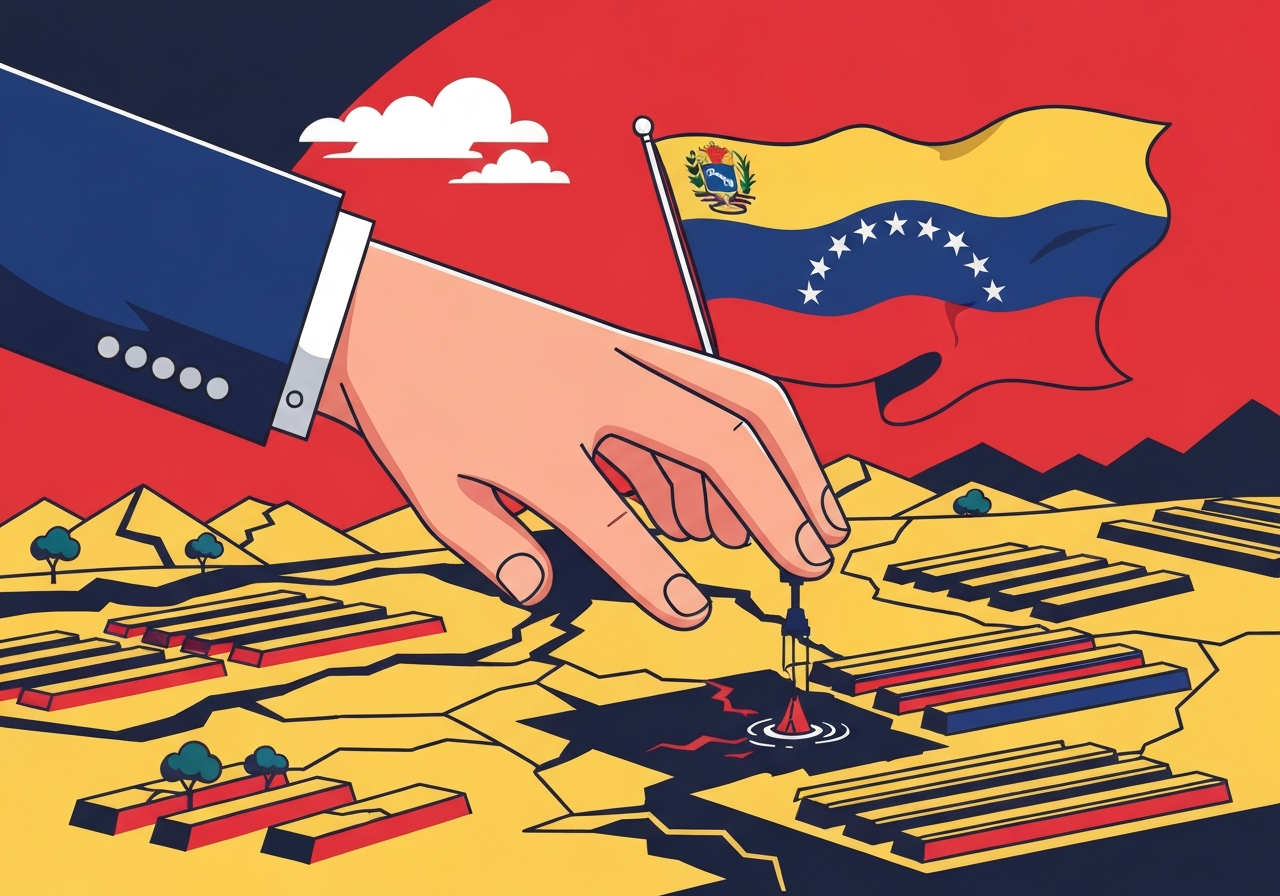
In early 2026, after U.S. forces detained Venezuela’s president, Nicolás Maduro, in January, the Biden-era narrative about U.S. restraint on foreign oil was upended when President Donald J. Trump announced plans to place Caracas’s oil industry under American control. The move, revealed in the days after the capture, targeted assets including the Cardón refinery and provoked immediate outcry from legal experts, regional governments and human-rights advocates. Supporters in Washington framed the step as securing energy assets and stabilizing markets; critics called it a revival of colonial-era seizure and a likely breach of international law. The episode marks a sharp rupture with recent U.S. practice and has set off a diplomatic and legal firestorm across the hemisphere.
Key Takeaways
- On Jan. 2026 U.S. forces captured Venezuelan leader Nicolás Maduro; shortly after, President Trump signaled an intention to take control of Venezuela’s oil sector, including the Cardón refinery.
- The declaration represents a departure from post-2003 U.S. policy, which historically avoided direct seizure of another nation’s oil reserves.
- Legal scholars warn the plan risks violating international law and could prompt sanctions, lawsuits and broader diplomatic isolation for the United States.
- Regional governments from Latin America and the Caribbean have expressed alarm; some governments signaled immediate diplomatic protests and calls for emergency multilateral meetings.
- Energy markets reacted to the announcement with price volatility as traders priced in supply and geopolitical risk tied to Venezuelan crude streams.
- American firms are not expected to be the automatic beneficiaries; previous post-conflict energy contracts in Iraq favored non-U.S. investors, particularly Chinese companies.
- Human-rights organizations and Venezuelan opposition figures are split, with some welcoming pressure on the Maduro circle while others decry the prospect of foreign appropriation of national resources.
Background
Accusations that U.S. administrations seek foreign oil have long shadowed American foreign policy, reaching a peak after the 2003 Iraq invasion. Protesters rallied worldwide under slogans such as “No blood for oil,” and regional leaders accused Washington of hidden motives tied to hydrocarbons. In response, the Bush administration publicly insisted it would not seize Iraqi oil, and occupation authorities left formal oil administration to Iraqi institutions even as reconstruction contracts flowed to foreign companies.
That pattern—military intervention without formal appropriation of national oil resources—became a de facto restraint on U.S. practice. Over the following decades, while the United States intervened in many theaters for strategic reasons, direct claims on a rival state’s hydrocarbons remained politically taboo. China, not the United States, emerged as the dominant beneficiary of new contracts in many post-conflict energy markets, underscoring a pragmatic division between combat operations and resource ownership.
Main Event
In January 2026, U.S. forces detained Nicolás Maduro during an operation that U.S. officials described as aimed at disrupting a criminal network tied to senior Venezuelan officials. Within days of the detention, President Trump publicly announced plans to place key elements of Venezuela’s oil sector under U.S. control, citing national-security and market-stability rationales. He identified strategic facilities by name, including the Cardón refinery on Venezuela’s northwest coast, and framed the action as a lawful safeguard for global energy supplies.
Administration spokespeople argued the move was necessary to prevent assets from being diverted to illicit networks or hostile powers. They also said the arrangement would temporarily place operations under an international trusteeship model overseen by Washington and partner institutions until a transitional Venezuelan authority could be installed. Officials have so far declined to publish full legal memoranda justifying the seizure, saying details would be released after coordination with allies.
Domestic political reaction split along familiar partisan lines. Some Republican lawmakers praised the measure as decisive and protective of U.S. interests, while Democrats and civil-liberties groups criticized it as a dangerous precedent. In Caracas and across Latin America, the announcement triggered protests and diplomatic condemnations; several regional leaders demanded an immediate halt to any transfers of control and called for emergency sessions of hemispheric organizations.
Analysis & Implications
The Trump administration’s move represents a tectonic shift in how Washington treats resource governance in contested states. If sustained, it could normalize a practice whereby U.S. military or political power is followed by direct control of strategic commodities—transforming a longstanding taboo into a policy tool. Legal scholars warn that such normalization would undermine established norms of state sovereignty and could weaken international support for U.S. positions in other disputes.
Economically, seizure of Venezuelan assets could provide short-term relief to global crude supplies if U.S.-managed operations restore production, but long-term prospects are uncertain. Venezuela’s oil infrastructure has suffered years of underinvestment and mismanagement; a rapid turnaround would require capital, skilled crews and stable governance—conditions that are not guaranteed amid diplomatic backlash and potential sabotage or mismanagement risks.
Regionally, the decision is likely to strain U.S. ties across Latin America. Even governments that oppose Maduro’s rule are wary of a precedent that permits foreign takeover of sovereign resources. That wariness could drive some countries toward nonaligned or alternative security and economic partners, including states critical of U.S. policy.
Comparison & Data
| Year | Country | U.S. Action | Resource Control |
|---|---|---|---|
| 2003 | Iraq | Military invasion and occupation | No formal U.S. seizure of oil; contracts awarded to foreign firms |
| 2026 | Venezuela | Detention of leader; announced U.S. control of oil sector | Planned temporary U.S.-led control of facilities including Cardón refinery |
The table contrasts the U.S. approach to Iraqi oil in 2003—where occupation authorities avoided formal appropriation—with the 2026 Venezuela case, where Washington has announced direct control. While 2003 saw international contractors and particularly Chinese firms reap commercial opportunities, the 2026 move centers on a unilateral claim of operational control. The immediate economic impact has been heightened price volatility; analysts caution that true production recovery depends on technical fixes and legal stability.
Reactions & Quotes
The announcement drew swift commentary from think tanks, foreign governments and rights groups, reflecting the contentious nature of the policy.
“I can’t think of a military operation that the U.S. engaged in to actually take oil from anybody,”
Richard Fontaine, Center for a New American Security (think tank)
This remark by a leading national-security analyst summarized how exceptional the move appears compared with recent U.S. precedent and helped crystallize critiques that the action crosses a long-standing line.
“This revives painful memories of colonial-era appropriation and risks violating international norms,”
Regional human-rights coalition (civil society)
Human-rights organizations framed the policy in historical terms, warning that forced transfers of resource control tend to deepen grievances and can undermine long-term stability in affected countries.
“We will manage Venezuelan energy assets to prevent illicit diversion and stabilize markets,”
U.S. administration spokesperson (official statement)
Administration officials emphasized market stability and anti-corruption aims as the rationale, but provided limited public detail on legal underpinnings and oversight mechanisms.
Unconfirmed
- Precise legal memos and international agreements justifying U.S. control have not been publicly released; the full legal basis is not yet confirmed.
- The administration’s long-term plan for ownership, revenue distribution, and oversight of seized assets remains unclear and unverified.
- Reports about the operational condition and controllability of the Cardón refinery under immediate U.S. management are incomplete and lack independent verification.
Bottom Line
The Trump administration’s announced seizure of Venezuelan oil assets after the January capture of Nicolás Maduro constitutes a major shift in U.S. behavior and risks eroding a long-standing international taboo. If implemented, the move could recalibrate how states balance military power, resource control and legal norms—potentially encouraging similar actions by other powers or prompting multilateral pushback against U.S. steps.
For markets and policymakers, the immediate priority will be stabilizing production and clarifying legal frameworks to reduce uncertainty. Over the longer term, expect protracted legal challenges, diplomatic frictions, and a contested debate about whether security imperatives ever justify direct control over another nation’s natural resources.
Sources
- The New York Times (news) — original reporting and timeline of announcements and quotes.
- Center for a New American Security (think tank) — commentary from national-security analysts on precedent and practice.