
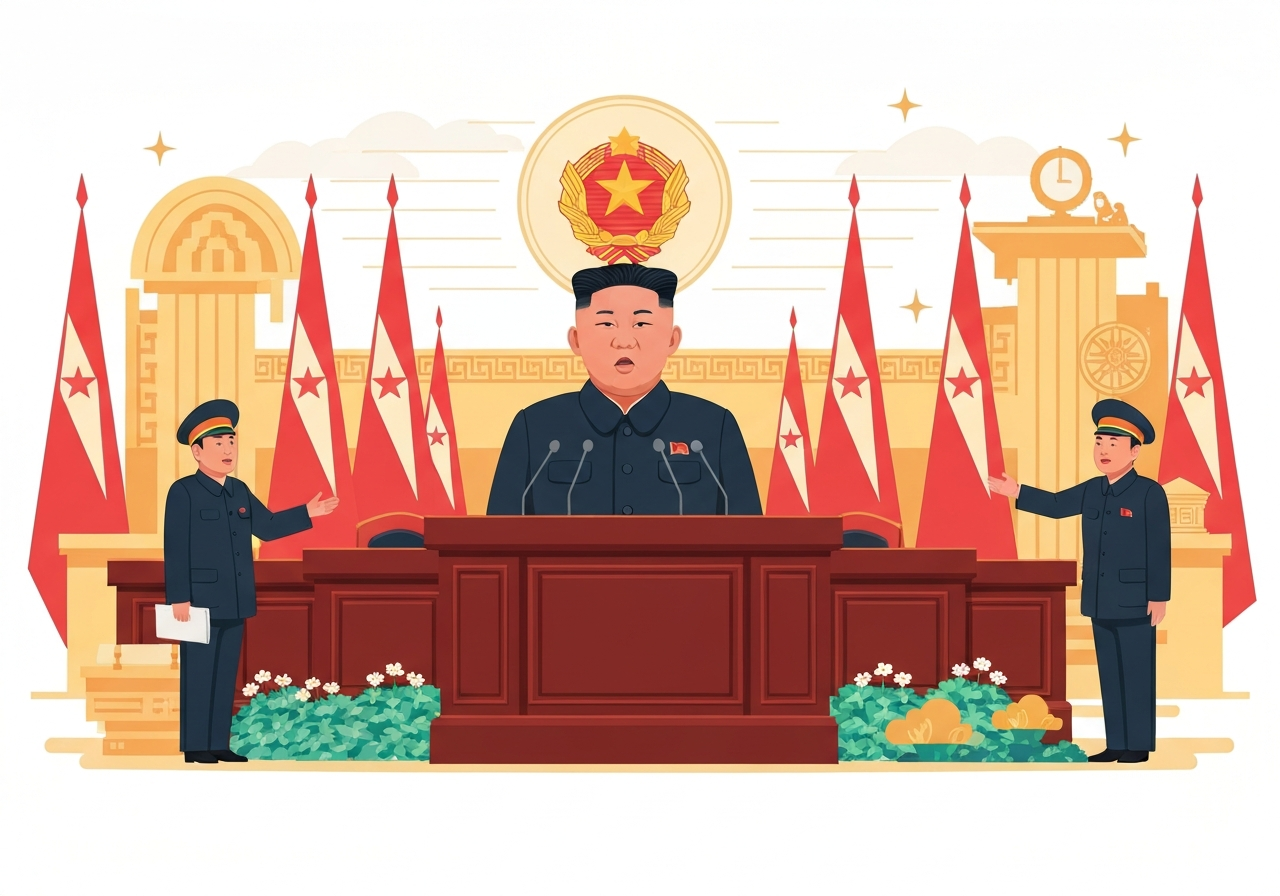
North Korea’s state media says the ruling Workers’ Party will hold a congress in late February where leader Kim Jong Un is expected to announce his domestic and foreign policy priorities for the next five years. The political bureau set the timing under Kim’s supervision, though the exact date and agenda have not been published. Observers expect the gathering to showcase military advances and economic directives after years of accelerated weapons development and closer ties with Moscow and Beijing. The meeting is likely to shape Pyongyang’s posture toward the United States and South Korea for the coming half-decade.
Key Takeaways
- The Workers’ Party congress is scheduled for late February; the political bureau confirmed the timing under Kim’s supervision but gave no specific date or agenda.
- Kim previously led party congresses in 2016 and 2021; analysts see the event as a periodic platform to set long-term plans.
- State media framed recent inspections and tests as evidence of strengthened military capabilities, using the phrase “immortal leadership” to describe Kim’s role.
- Pyongyang is expected to emphasize economic self-reliance, mass mobilization and a five-year development horizon following a 2021 plan through 2025.
- Officials and analysts anticipate announcements about expanding nuclear and conventional forces, including requests for advanced assets such as solid-fuel ICBMs and multi-warhead systems.
- Kim’s foreign policy has trended closer to Russia and China; the North’s alignment with Moscow amid the Ukraine war has contributed to heightened tensions with the United States and South Korea.
Background
The Workers’ Party congress is the highest formal gathering in North Korea’s political calendar; Kim Jong Un convened it in 2016 and again in 2021. The 2021 congress came amid the COVID-19 shock, when Pyongyang acknowledged economic setbacks and unveiled a new five-year development plan through 2025. Party congresses serve both a policymaking function and a public display of centralized control, giving Kim a stage to reset goals and reward loyalists.
Over the past several years Pyongyang accelerated missile and nuclear weapons testing and publicly strengthened ties with Russia, a relationship that deepened after Moscow’s 2022 invasion of Ukraine. Analysts say arms transfers and political coordination with Moscow, plus resumed high-level contacts with Beijing, have helped North Korea sustain its military programs despite international sanctions. At home, a strict information blockade and limited economic data make external assessment difficult, though South Korean experts report signs of gradual economic stabilization tied to trade with China and possible arms-related exports.
Main Event
State-run Korean Central News Agency reported the political bureau met under Kim’s supervision and decided to hold the congress in late February, without providing an agenda or fixed dates. The congress is expected to run for multiple days with tightly choreographed sessions that highlight Kim’s leadership and the regime’s policy direction. In recent weeks, state media emphasized Kim’s visits to weapons tests, military sites and economic projects, presenting those trips as validation of his policy track record.
Officials anticipate Kim will reiterate a dual focus on economic development through “self-sustenance” and mass mobilization while formally endorsing further military modernization. Specific items likely to be highlighted include upgrades to conventional forces, deeper integration of conventional and nuclear capabilities, and investments in strategic systems. State coverage already credits Kim’s leadership with strengthening military capacity and advancing national development, language that foreshadows firm commitments at the congress.
The summit’s foreign policy themes are expected to stress closer alignment with Russia and China while signaling a harder line toward South Korea and the United States. Kim’s willingness to resume diplomacy with Washington remains unclear; relations have been stalled since the collapse of talks after his 2019 summit with then-U.S. President Donald Trump. Pyongyang has made clear it will not accept demands that it abandon nuclear weapons as a precondition for talks, complicating prospects for renewed negotiations.
Analysis & Implications
Domestically, the congress offers Kim an opportunity to cement control and to present a roadmap for economic recovery after admitting past policy failures in 2021. A renewed emphasis on “self-sustenance” suggests intensified state direction of resources and labor mobilization, which could prioritize strategic industries over consumer welfare. That approach may produce short-term gains in targeted sectors but risks broader economic strain if external trade and investment remain constrained.
On defense, the expected push to expand nuclear and conventional capacities signals a long-term commitment to deterrence and coercive diplomacy. Publicized ambitions for solid-fuel intercontinental ballistic missiles, multi-warhead systems, tactical nuclear weapons, spy satellites and nuclear-powered submarines — all cited in prior statements — reflect an advanced, multi-domain modernization agenda. Integrating conventional forces with nuclear capabilities would complicate regional defense planning and raise the strategic stakes for Seoul and Washington.
Regionally, stronger alignment with Moscow and continued engagement with Beijing change the diplomatic calculus in Northeast Asia. North Korea’s reported military and material cooperation with Russia during the Ukraine war has deepened strategic ties and offered Pyongyang external partners for arms development. For South Korea and the United States, the congress likely means firmer deterrence postures, reinforced trilateral coordination, and renewed pressure to calibrate sanctions, military readiness and diplomatic outreach.
Internationally, persistent advances in North Korea’s weapons programs will keep arms control and nonproliferation challenges at the forefront of policy debates. If Pyongyang continues to export military goods, as analysts have suggested, other states may face secondary security and enforcement risks. The congress outcome will thus influence not only bilateral relations but also multilateral efforts to manage proliferation and regional instability.
Comparison & Data
| Congress | Year | Stated Focus |
|---|---|---|
| First under Kim in this series | 2016 | Consolidation of power and strategic modernization |
| Previous congress | 2021 | Five-year development plan through 2025; post-COVID recovery |
| Upcoming congress | Late February (2026) | Expected focus on self-sustaining economy, mass mobilization, and expanded military capabilities |
The table summarizes the role party congresses have played as policy milestones: 2016 and 2021 were used to reset priorities and claim progress, while the late-February 2026 gathering is expected to outline the next five-year trajectory. Data on economic performance is limited by Pyongyang’s opacity, so comparisons rely on state announcements and outside estimates of trade flows with China and reported arms-related activity. Analysts therefore caution that publicized goals may reflect political signaling as much as operational plans.
Reactions & Quotes
North Korea’s state media framed Kim’s recent inspections and the upcoming congress as evidence of strong, uninterrupted leadership, language intended for domestic and international audiences. The announcement serves both to rally internal support ahead of a new policy cycle and to telegraph Pyongyang’s strategic priorities externally.
“His immortal leadership has strengthened the country’s military capabilities and advanced national development,”
Korean Central News Agency (state media)
State media’s phrasing is traditional within North Korean propaganda and aims to legitimize announced policy directions. International observers interpret such language as preparatory rhetoric for concrete policy commitments and displays of military capability during the congress.
Seoul-based analysts caution that the congress will be a barometer for how Pyongyang balances economic and military priorities in the coming years. Their commentary often emphasizes that limited transparency complicates assessments but that public signaling offers useful indicators of intent.
“The congress will likely formalize a strategic mix of economic mobilization and weapons development that we’ve already seen in state coverage,”
Seoul-based analyst (academic/analysis)
Analysts point out that while the rhetoric may promise ambitious programs, implementation will depend on resources, external trade relationships and the regime’s capacity to manage societal strain. They will watch post-congress directives and budgetary shifts for evidence of real policy change.
Unconfirmed
- The exact date, duration and official agenda items for the late-February congress have not been released by state media and remain unconfirmed.
- It is unclear whether Kim will offer any concrete timetable for resuming talks with the United States; public statements suggest Pyongyang rejects denuclearization preconditions.
- Specific details and scale of reported transfers of North Korean personnel and equipment to Russia remain unverified in open-source reporting.
Bottom Line
The late-February Workers’ Party congress is positioned to set North Korea’s policy course for the next five years, combining economic priorities with an assertive military modernization agenda. For Pyongyang, the gathering will be both a domestic rallying event and a strategic signal to neighbors and global powers about its intentions and red lines. Observers should monitor the official communiqués and post-congress implementation steps—budget allocations, personnel appointments and detailed defense procurement—to distinguish rhetoric from actionable policy.
Regionally, expect intensified coordination among South Korea, the United States and Japan to counter expanded North Korean capabilities and diplomatic outreach to Moscow and Beijing. The congress outcome will thereby influence alliance postures, sanctions policy and the prospects for any future negotiations over Pyongyang’s nuclear program.
Sources
- Associated Press (news agency)
- Korean Central News Agency (official state media)