
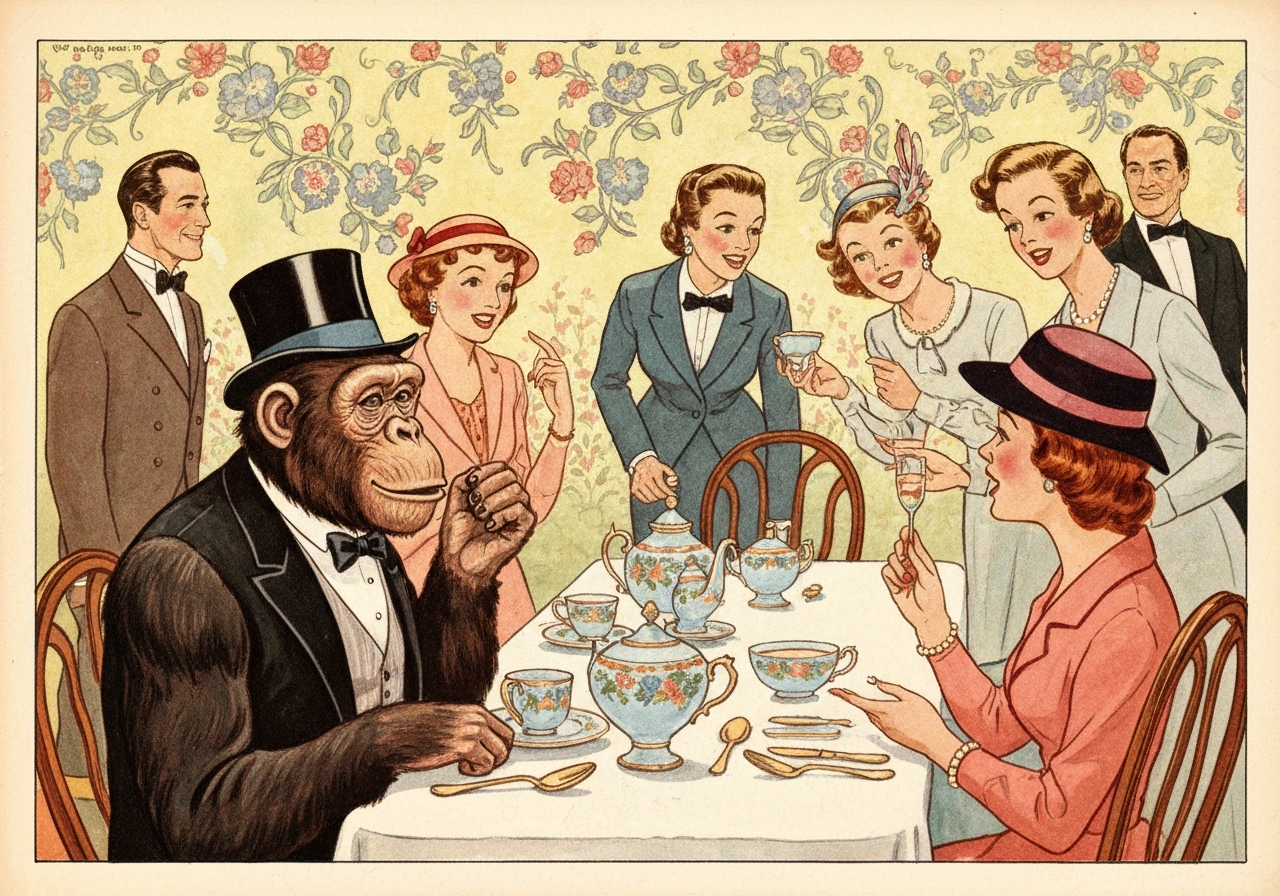
Lead: Researchers reported Thursday in the journal Science that a male bonobo named Kanzi—long studied at the Ape Initiative—responded to staged “tea party” scenarios in ways researchers interpret as pretend play. The experiments, led by Christopher Krupenye (Johns Hopkins) and Amalia Bastos (University of St. Andrews), asked Kanzi to track imaginary liquids and foods across three tasks. Kanzi pointed to locations consistent with treating some items as imaginary and others as real, performing above chance in key trials. The team says the results indicate that imagination, once viewed as uniquely human, may exist in at least some great apes.
Key Takeaways
- Study published Thursday in Science reports experiments with Kanzi, a male bonobo, testing responses to pretend ‘‘pouring’’ and transfers.
- Kanzi—an enculturated bonobo who died last year at age 44—selected the cup with imaginary liquid more often than chance in the first task.
- In a second task, Kanzi reliably distinguished a cup containing real juice from one into which imaginary juice was poured.
- A third task using imaginary grapes and bowls yielded successful identification in over 50% of trials.
- Authors: Christopher Krupenye (Johns Hopkins) and Amalia Bastos (University of St. Andrews); research conducted with the Ape Initiative.
- Bonobos are an endangered species found in the Democratic Republic of Congo; the three species (bonobos, chimpanzees, humans) share a common ancestor about 7 million years ago.
- Researchers argue the findings suggest apes can hold and compare multiple representations of the world—distinguishing reality from imagination.
Background
For decades scientists treated behaviors like having imaginary companions, role play and projecting future scenarios as hallmarks of human cognition. Laboratory tests had already shown that many primates can maintain a single internal representation—such as knowing food is hidden under a cup even when they do not see it. Those demonstrations rely on object permanence and a single sustained belief about where an item is.
The new study aimed to move beyond single-representation tasks to test whether an ape could entertain multiple, conflicting representations (real versus imaginary) and use that distinction to guide behavior. The team worked with Kanzi, an enculturated bonobo who had previously shown receptive understanding of some spoken English. Because wild bonobos are difficult to study and the species is restricted to the Congo basin, captive and habituated individuals like Kanzi provide rare opportunities for controlled experiments.
Main Event
The researchers set up three experimental scenarios analogous to a child’s pretend tea party. In the first, a scientist sat at a small table with two empty cups and a jug and mimed pouring an imaginary liquid into both cups, then ‘‘poured’’ one cup back into the jug. Observers recorded whether Kanzi could track which cup should still contain the imagined liquid. Kanzi pointed to the cup consistent with holding imaginary liquid more often than chance would predict.
In the second scenario, one cup contained real juice while the other received an imaginary pour. When asked to indicate where the juice was, Kanzi pointed toward the cup with the actual liquid at rates above chance, suggesting he distinguished the real object from the pretend one. The third experiment repeated the first design but used imaginary grapes moved between bowls; Kanzi identified the bowl with the imagined grapes in a majority of trials.
The protocols were modeled on classic pretend-play studies used with young children but adapted for nonverbal communication with an enculturated ape. Researchers controlled for obvious cues and repeated trials to assess whether selections exceeded random expectation. The team reports consistent patterns across the three tasks that they interpret as evidence of managed imagination.
Analysis & Implications
If replicated, these results change how scientists frame the evolutionary roots of imagination. The ability to entertain multiple alternative scenarios—holding a real and an imaginary representation simultaneously—supports cognitive flexibility that could aid planning, social learning and problem solving. That broader cognitive palette helps explain why humans rehearse possible outcomes before acting and suggests related capacities may have deep evolutionary roots.
However, the study rests on an enculturated individual with an atypical life history: Kanzi spent decades in a human-rich research and caretaking environment and was trained to communicate about objects. Enculturation can amplify cognitive skills or change how animals attend to human actions, so generalizing from one subject to all bonobos or to wild populations requires caution.
Methodologically, the experiments show how controlled behavioral tasks can probe internal representations without language, but they do not yet reveal the neural mechanisms or natural selection pressures responsible for the behavior. Questions remain about how frequently wild bonobos engage in pretend play, whether chimpanzees or other apes do the same in comparable tests, and what ecological or social conditions favor such capacities.
Comparison & Data
| Experiment | Task | Result |
|---|---|---|
| 1 | Imaginary pour into two cups, then empty one | Selection of cup with imagined liquid above chance |
| 2 | One cup real juice, one imaginary pour | Pointed to real juice cup above chance |
| 3 | Imaginary grapes moved between bowls | Identified bowl with imaginary grapes in >50% of trials |
These outcome summaries reflect qualitative success categories reported by the team; published paper includes statistical tests supporting that selections exceeded chance expectations. The authors emphasize pattern consistency across tasks rather than dramatic effect sizes from any single trial series.
Reactions & Quotes
This kind of finding really shows us that there’s much more richness to these animals’ minds than people give them credit for.
Christopher Krupenye, Johns Hopkins University (co‑author)
There are many benefits to not being stuck in the here and now because you can start thinking about alternative futures.
Amalia Bastos, University of St. Andrews (co‑author)
These experiments are able to peel back the layers and understand a lot more about what’s actually going on inside their minds.
Joseph Feldblum, evolutionary anthropologist, Duke University (independent comment)
Unconfirmed
- Whether the results generalize beyond Kanzi to other enculturated or wild bonobos remains untested.
- It is not yet established how often wild bonobos engage in comparable pretend play under natural conditions.
- The evolutionary pathway and selective pressures that might have produced this capacity in apes are currently speculative.
Bottom Line
The experiments with Kanzi provide the first controlled laboratory evidence that at least one bonobo could treat imaginary and real scenarios differently and use that distinction to guide action. That finding weakens the claim that imagination is strictly human and suggests cognitive ingredients for imagination existed in the common ancestor of humans and great apes.
At the same time, the result is preliminary: it centers on a single, highly socialized individual with a unique life history. Robust conclusions about species-wide cognitive abilities will require replication with additional subjects, including comparisons with wild populations and other ape species. Still, the work opens a clear path for future studies of how imagination evolved and functions across primates.
Sources
- The Seattle Times — (news)
- Science (journal) — (peer‑reviewed journal; paper published Thursday)
- Johns Hopkins University — (academic institution; co‑author affiliation)
- University of St. Andrews — (academic institution; co‑author affiliation)
- Ape Initiative — (research/animal care organization)
- Duke University — (academic; expert commenter)