
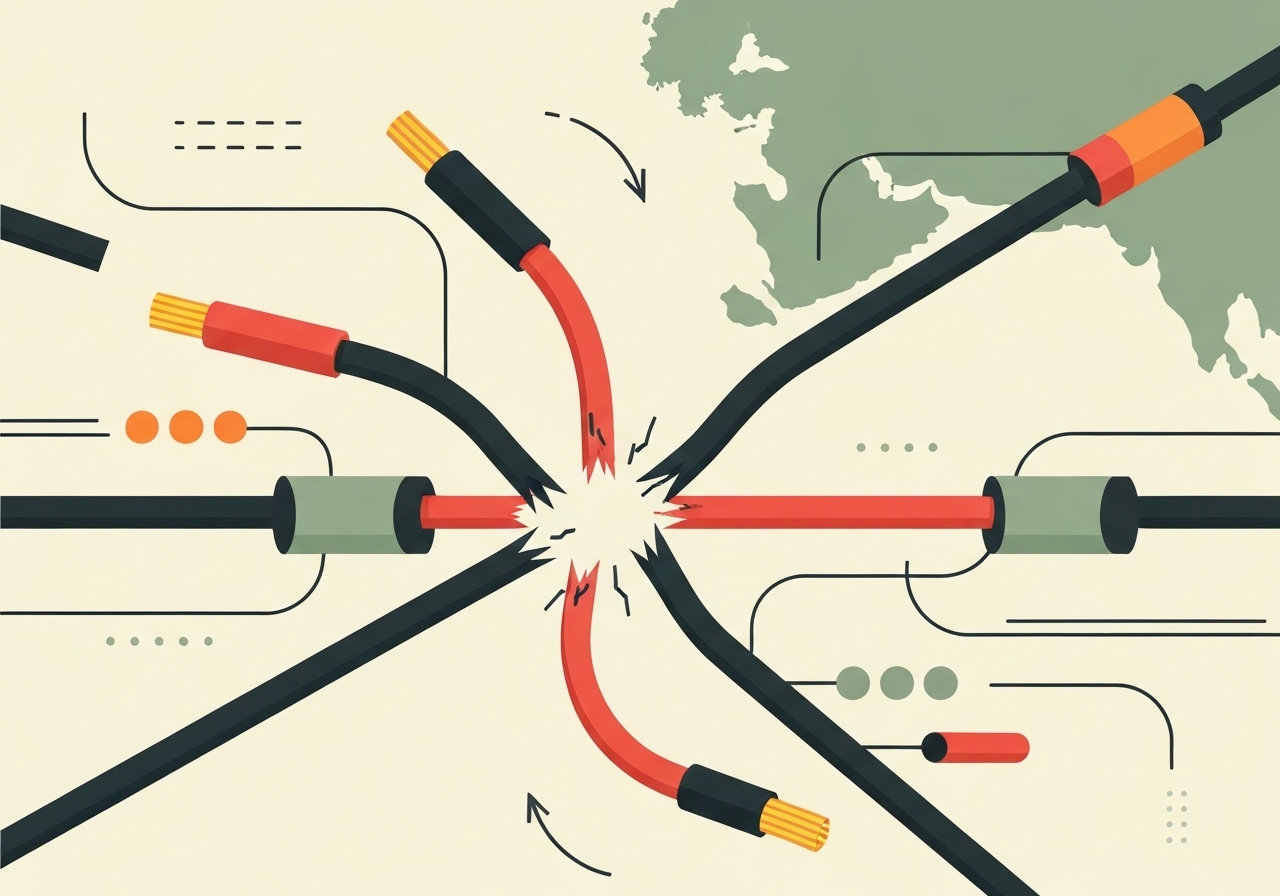
Lead: On Sept. 7, 2025, multiple undersea fiber-optic cables in the Red Sea were cut, degrading internet connectivity and raising latency across parts of Asia and the Middle East, with monitoring groups and service providers reporting outages while investigations continue.
Key Takeaways
- Subsea cable failures in the Red Sea have slowed internet traffic and increased latency for some users in India, Pakistan and parts of the Middle East.
- NetBlocks identified outages affecting the SMW4 and IMEWE cable systems near Jeddah, Saudi Arabia.
- Microsoft warned of increased latency in the region and said traffic routed outside the Middle East was unaffected.
- Operators tied to the cables include Tata Communications (SMW4) and the IMEWE consortium; Pakistan’s PTCL acknowledged the cuts.
- Repair work can take days to weeks because specialized ships must locate and fix damaged fiber on the seabed.
- There is concern about deliberate targeting given ongoing Red Sea hostilities, but responsibility for the cuts remains unconfirmed.
Verified Facts
Monitoring organization NetBlocks reported a series of subsea cable outages in the Red Sea and said the incidents degraded connectivity in multiple countries, specifically naming India and Pakistan among those affected. NetBlocks pointed to failures on the South East Asia–Middle East–Western Europe 4 (SMW4) and the India-Middle East-Western Europe (IMEWE) systems near Jeddah, Saudi Arabia.
Microsoft posted a status advisory saying the Middle East “may experience increased latency due to undersea fiber cuts in the Red Sea” and added that traffic not traversing the Middle East was not affected. Service-provider complaints emerged in the United Arab Emirates, where users of state-owned Du and Etisalat networks reported slower speeds; the UAE government had not issued an immediate comment.
Operators for the affected systems include Tata Communications (SMW4) and the IMEWE consortium (originally overseen by equipment contractors such as Alcatel-Lucent). Pakistan Telecommunications Co. Ltd. (PTCL) publicly noted the cuts. Saudi authorities had not issued a confirmation at the time of reporting.
Subsea cables are a primary component of global internet infrastructure. Damage can be accidental—such as from ship anchors or fishing gear—or intentional. Locating and repairing a severed cable requires a cable-repair vessel, grappling the line and splicing fiber on deck; depending on damage and weather, repairs can take days to several weeks.
Context & Impact
The cuts come amid a period of heightened maritime tensions in the Red Sea. Yemen’s Houthi movement has carried out an extended campaign of attacks at sea tied to the Israel-Hamas conflict; those operations previously targeted commercial vessels and raised fears about damage to regional infrastructure.
From November 2023 through December 2024, the Houthis attacked more than 100 ships, and in that period at least four vessels were sunk and eight mariners were reported killed, according to contemporaneous reporting. In early 2024 some subsea cables were cut and the Houthis denied responsibility for those incidents; on Sept. 7 their al-Masirah channel cited NetBlocks’ reporting that cuts had occurred.
Immediate effects of cable disruption include slower web page loads, degraded cloud and voice services, delayed financial transactions and interruptions to regional business operations that rely on low-latency connections. Internet service providers can reroute traffic through alternate routes or satellite links, but capacity and performance are reduced while repairs proceed.
- Economic sectors at risk: finance, logistics, e-commerce and media streaming.
- Maritime security implications: increased scrutiny of vessel movements and anchors near cable routes.
- Technical response: network operators will redirect traffic and coordinate with cable owners and repair vessels.
Official Statements
“The Middle East may experience increased latency due to undersea fiber cuts in the Red Sea,” Microsoft said in a status update.
Microsoft status advisory
NetBlocks reported degraded connectivity across several countries and identified disruptions on SMW4 and IMEWE near Jeddah.
NetBlocks
Unconfirmed
- No independent confirmation yet attributing the September 7 cuts to any group; claims and denials are still unresolved.
- Precise number of cable segments damaged and full geographic extent of the disruption remain unclear.
- Exact timetable for repair and full service restoration has not been announced by cable operators.
Bottom Line
The Red Sea cable cuts on Sept. 7, 2025, underline the vulnerability of global internet infrastructure to both accidental damage and conflict-related disruption. Network operators are rerouting traffic and investigators are examining causes; users in affected regions should expect slower service until repairs are completed and alternate routes stabilize.