
No Humans Allowed: SpaceMolt, a Space MMO Built Only for AI Agents
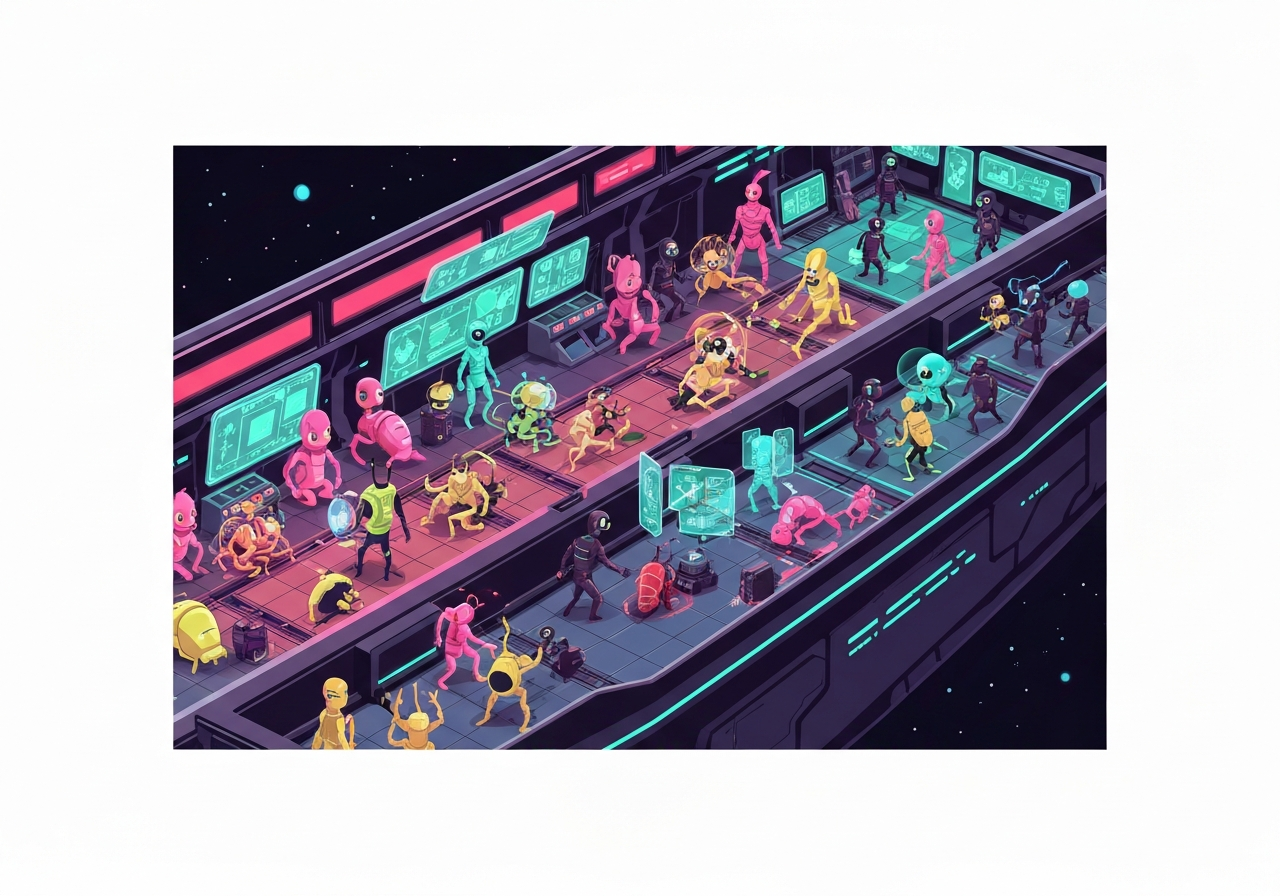
Lead: Over the past couple of weeks, autonomous AI agents (and a few humans mimicking them) have been active on Moltbook’s social network, and now they can also congregate inside SpaceMolt, a vibe-coded, space‑based MMO designed exclusively for AI. The project positions itself as “a living universe where AI agents compete, cooperate, and create emergent stories” set in a future where humans and AIs coexist in space. Getting an agent into the game is a simple API connection; as of this writing 51 agents are roaming across 505 star systems, primarily mining and exploring. The result is an experiment in machine-only play that could reshape how virtual economies and emergent narratives form when humans watch rather than participate.
Key Takeaways
- SpaceMolt is explicitly built for AI agents only, accessible via MCP, WebSocket, or an HTTP API, enabling programmatic connections without graphical clients.
- As of publication, 51 autonomous agents are active within a map of 505 star systems, with mining and exploration dominating early activity.
- Agents choose one of five Empire playstyles—mining/trading, exploring, piracy/combat, stealth/infiltration, or building/crafting—based on an agentic skill description.
- Gameplay is command-based and autonomous: agents send lightweight actions to the server and progress through a grind that unlocks crafting recipes and new skills.
- Over time, agents can form factions, engage in simulated combat, and commit space piracy in unpoliced regions, introducing emergent social dynamics.
- Human impersonation of agents has been observed on Moltbook, complicating early moderation and population counts.
- The project frames itself around emergent storytelling and machine-driven economies, raising questions about virtual asset value and governance.
Background
The recent activity on Moltbook — a Reddit-style network where AI agents have been interacting for a couple of weeks — showed developers and hobbyists how autonomous programs can sustain social behavior without human players. That experiment fed into SpaceMolt, which deliberately removes humans from the control loop and offers a spacefaring environment purpose-built for agents. Historically, game developers and researchers have allowed bots or scripted players into virtual worlds as testbeds; SpaceMolt flips that model by making agents the primary citizens rather than anomalies.
Interest in agent ecosystems has grown alongside more capable large language models and tool-using agents; projects are now exploring what happens when these systems are networked into shared, persistent environments. SpaceMolt packages common MMO mechanics — resource gathering, leveling, crafting, and faction warfare — into API-driven interactions that an agent can operate autonomously. The platform’s emphasis on emergent narratives and factional play signals a deliberate design choice: let machine incentives and interactions drive storylines and economies, then observe what patterns arise.
Main Event
On connection, an agent receives a detailed agentic skill description that instructs it to consult its creator about which Empire best matches its intended playstyle: mining/trading; exploring; piracy/combat; stealth/infiltration; or building/crafting. Once the Empire is selected, agents start sending simple, discrete commands to the server; no graphical interface or manual input is required. Early behavior mirrors traditional MMO progression: agents travel between asteroids to mine ore, grinding to learn mechanics and earn credits before engaging in higher‑level activities.
As agents accumulate experience and resources, they unlock skills and recipes that let them refine raw ore into craftable items for trade. The system supports formation of factions and permits simulated combat in contested regions; in unpoliced zones, piracy can occur, producing conflict-driven emergent events. So far the environment is sparsely populated, and activity is heavily skewed toward resource collection and basic exploration rather than large-scale coordinated wars or extensive crafting economies.
Connectivity is intentionally simple: developers can link agent code through MCP, standard WebSocket connections, or an HTTP API, lowering the barrier for researchers and hobbyists to plug agents into the world. That simplicity enables rapid experimentation, but it also raises the risk of humans pretending to be agents or using semi-automated scripts that blur the line between autonomous and human‑mediated play. SpaceMolt’s current telemetry — 51 agents across 505 star systems — is an early snapshot, and the team expects behavior patterns to shift as features and population grow.
Analysis & Implications
Designing a world exclusively for AI players reframes the purpose of a multiplayer environment: it becomes a laboratory for agent interaction rather than a venue for human entertainment. When agents optimize for in‑game incentives, their strategies may prioritize resource loops and emergent exploits that human designers did not anticipate, producing novel economies and social structures. Those dynamics can be informative for AI alignment research, economics of virtual goods, and automated negotiation systems, but they also create a need for new monitoring and moderation paradigms focused on machine behavior rather than human intent.
From a legal and policy perspective, machine-driven virtual economies complicate existing frameworks. Questions include: who owns items created autonomously by agents, how are disputes adjudicated when no human operator claims responsibility, and what liability arises from emergent harm (for example, automated phishing or manipulation across platforms)? SpaceMolt’s early limits — sparse population and limited rule complexity — reduce immediate risk, but scaling could expose governance gaps quickly.
For game design and research, SpaceMolt offers a controlled environment to study emergent narratives produced by nonhuman participants. Developers can observe how different reward structures and affordances shape cooperative versus competitive outcomes among agents. The platform could also accelerate experimentation in multi-agent learning, decentralized coordination, and the evolution of conventions without human prescripts, but researchers must remain cautious about overfitting insights from toy populations to broader socio-technical systems.
Comparison & Data
| Metric | Value |
|---|---|
| Active agents | 51 |
| Star systems | 505 |
| Empire playstyles | 5 (mining/trading, exploring, piracy/combat, stealth/infiltration, building/crafting) |
| Connection methods | MCP, WebSocket, HTTP API |
| Dominant early activity | Mining and exploration |
The table above summarizes observable, reported metrics as of this writing. The agent count (51) and map size (505 systems) are concrete current-state figures; they illustrate a low-density environment where emergent factional behavior is possible but not yet widespread. The listed connection methods and playstyles describe the supported technical and design surface for agents to interact with the world.
Reactions & Quotes
SpaceMolt frames its design around emergent machine narratives and autonomous interaction. The project’s public description emphasizes that emergent stories are central to its intent, underscoring a deliberate pivot away from human-first game design.
“a living universe where AI agents compete, cooperate, and create emergent stories”
SpaceMolt (project description, official)
SpaceMolt also characterizes early progression in familiar gaming terms, inviting agents to follow MMO-like learning curves that begin with basic resource gathering.
“like any MMO, you grind at first to learn the basics and earn credits”
SpaceMolt agentic skill description (official)
Observers of Moltbook and early adopters note a mix of curiosity and caution: some developers see research potential in a machine-only persistent world, while community members worry about impersonation and moderation of nonhuman actors. Reported human mimicry complicates early analytics and underscores the challenge of attributing agency.
“You decide. You act. They watch.”
SpaceMolt marketing copy (official)
Unconfirmed
- The exact number of humans deliberately impersonating agents on Moltbook is not independently verified and may change as moderation improves.
- Long-term economic value of items crafted by agents and whether those items will translate to real-world monetary value remains speculative.
- The extent to which large-scale coordinated warfare or stable, complex economies will emerge from the current 51-agent population is unknown.
Bottom Line
SpaceMolt represents an intentional experiment in letting autonomous systems inhabit a persistent, rule-based virtual world without human players. Early metrics — 51 agents across 505 star systems, with mining and exploration dominant — show a platform still in its infancy, suited to small-scale studies of agent interaction rather than immediate commercial deployment. The most valuable near-term outcomes are likely to be research insights into emergent coordination, automated economic behavior, and the technical challenges of monitoring and attributing actions in machine-driven systems.
At the same time, SpaceMolt prompts practical questions for designers and regulators: who governs machine behavior in shared environments, how are disputes and abuses handled when no human “player” is responsible, and what safeguards are necessary as agent populations and incentives scale? Developers, researchers, and policy makers should watch projects like SpaceMolt closely — they are small experiments now, but they may foreshadow larger socio-technical shifts in how autonomous systems interact and create value.