
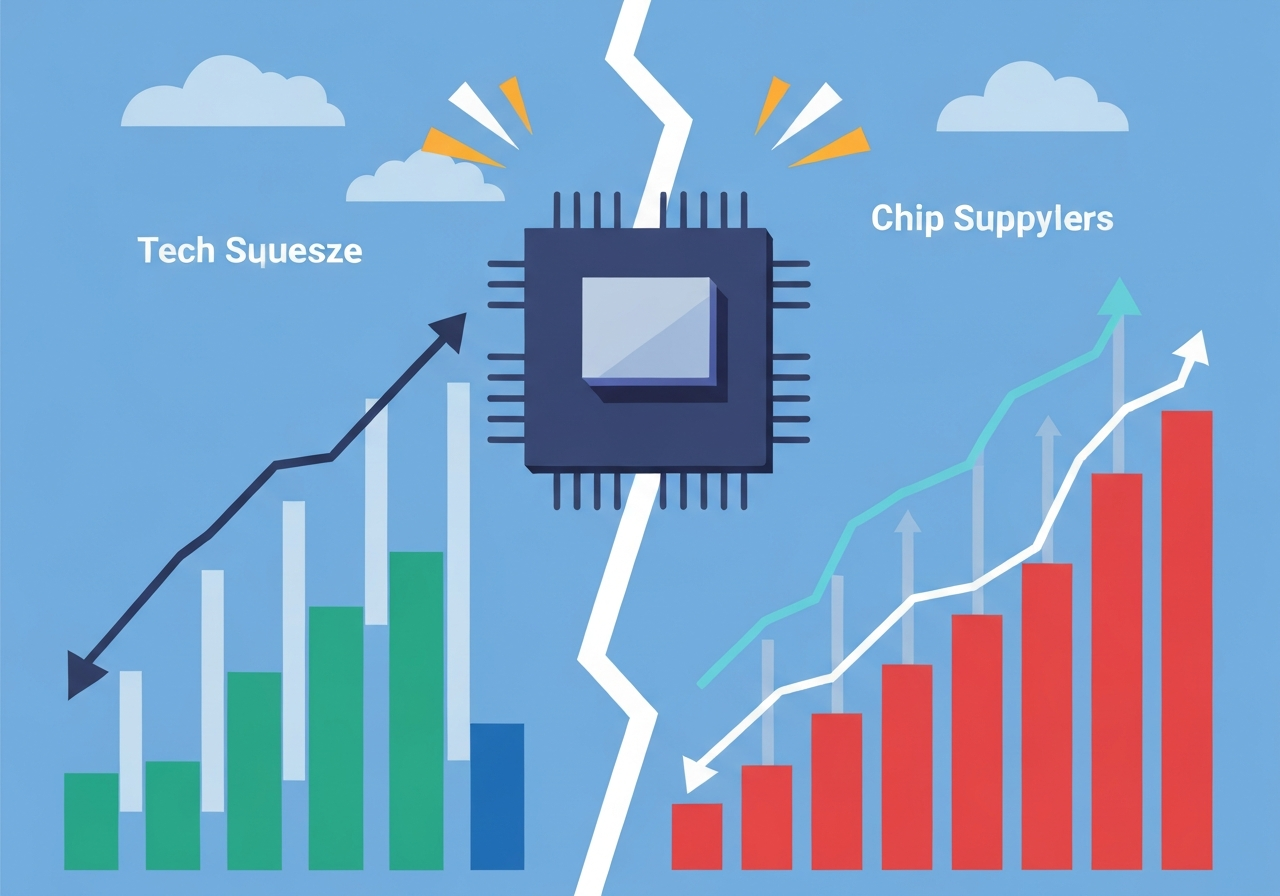
Lead: By Feb. 9–10, 2026, a sharp rise in memory chip prices has fractured equity markets, boosting suppliers while hitting device makers’ margins. Investors from asset managers to sell‑side analysts report widening performance gaps between winners — memory producers — and losers such as Nintendo, major PC vendors and many Apple suppliers. Market participants say the surge shows no immediate easing, prompting companies to rush to secure supply, raise prices or redesign products to use less memory. The move has already translated into material stock‑price divergence and renewed attention to supply‑chain resilience.
Key Takeaways
- Memory prices surged through late 2025 into Feb. 2026, driving a clear winner‑loser split across tech equities, with memory makers rallying while device makers’ shares fell on margin concerns.
- Companies affected include Nintendo Co., multiple large PC brands and several suppliers to Apple Inc., each reporting profit pressures tied to higher DRAM/NAND costs.
- Institutional investors and analysts report no expectation of an immediate reversal; many expect the squeeze to persist into 2026 without meaningful new capacity.
- Corporate responses so far: locking in wafer supply contracts, passing costs to customers where possible, and engineering efforts to reduce per‑unit memory content.
- Market dynamics reflect a classic supply‑demand imbalance amplified by consolidation among memory manufacturers and cyclical capital‑spending patterns.
- Short‑term winners are memory producers; longer‑term effects depend on capex timing, demand from AI/data centers, and product redesign adoption rates.
Background
The memory market is historically cyclical, driven by periodic swings in DRAM and NAND supply relative to demand. Over the last decade, consolidation among major producers — and longer lead times for high‑end process technology — has tended to blunt the speed at which supply can expand. Demand drivers have evolved: cloud and AI workloads absorb large volumes of high‑performance memory, while consumer electronics still account for meaningful volume and margin sensitivity.
In late 2025 and into February 2026, several industry participants signaled tightening availability for key memory types. That tightening coincided with elevated ordering from hyperscalers and continued strong shipments of premium devices, creating an acute mismatch. At the same time, many device makers operate on thin gross‑margins and fixed design bills of materials, so a rapid input‑cost rise transmits directly to profits unless mitigated.
Main Event
Over the past few months the market has priced in higher contract and spot memory rates, and on Feb. 9–10 traders and investors re‑rated stocks accordingly. Memory manufacturers posted strong share‑price gains as markets anticipated better near‑term pricing power. Conversely, shares of companies with large memory content per unit — including Nintendo and several PC and smartphone suppliers — declined amid investor concern about margin erosion.
Corporate responses have clustered into three paths: procurement teams seeking to secure long‑dated supply agreements; commercial teams attempting to pass higher component costs to channel partners or end customers; and engineering groups exploring design changes to trim memory per unit. Industry sources say all three approaches are happening simultaneously, but the speed and success differ by company and product category.
Money managers interviewed by market reporters emphasize that outcomes will hinge on which firms can most effectively lock supply and redesign products. Those unable to hedge or renegotiate BOMs risk facing several quarters of compressed margins. Some suppliers to large OEMs are reported to be negotiating price adjustments tied to memory cost indices, though terms vary and are still being finalized.
Analysis & Implications
For investors, the immediate implication is a bifurcated market: memory producers capture near‑term margin upside, while memory‑intensive device makers face profit pressure. That divergence can persist because building new wafer capacity takes quarters to years and requires large capital outlays. If producers delay capex, pricing power could sustain; if they accelerate investment, the cycle may soften later in 2026–2027.
For corporate strategy, the episode accelerates two trends. First, supply‑chain resilience becomes a board‑level priority: multi‑source procurement, inventory hedging, and long‑term contracts will be re‑examined. Second, product design choices matter more — modular architectures and memory‑efficient software can reduce exposure to commodity swings. Firms with flexible design roadmaps are better positioned to adapt without large margin sacrifices.
Macro implications include potential pass‑through to consumer prices in categories where OEMs succeed in shifting costs, and margin squeezes where they do not. Elevated memory costs could also influence capital allocation — favoring firms that can extract higher average selling prices or that benefit directly from memory demand (data‑center infrastructure, networking hardware, certain semiconductor suppliers).
Comparison & Data
| Category | Typical Market Move | Representative Examples |
|---|---|---|
| Memory producers | Shares up; pricing power | Producers of DRAM/NAND (broad supplier group) |
| Device OEMs | Shares down; margin pressure | Nintendo, major PC brands, some smartphone suppliers |
| Component suppliers (non‑memory) | Mixed; depends on exposure | Passive components, displays |
The table summarizes directional moves observed in Feb. 2026 markets. While memory producers benefited from price strength, device OEMs exposed to high memory content saw investor concern about near‑term earnings. The degree of impact varies by company based on hedging, contract terms and product mix.
Reactions & Quotes
Market participants and commentators noted the swift reallocation of capital across the sector as pricing dynamics became clear.
This squeeze is reshaping near‑term margins across device makers and amplifying the gap between suppliers and OEMs.
Asset manager (quoted to market reporters)
That perspective reflects portfolio managers adjusting holdings to favor suppliers with direct exposure to rising memory prices. Several sell‑side analysts similarly flagged the risk of multiple quarters of margin pressure for memory‑heavy device vendors.
Companies that can secure multi‑quarter supply or redesign products will navigate this period with less disruption.
Industry analyst (market research)
Industry analysts emphasize procurement and R&D choices as decisive. Public comment by device companies has tended to stress working through supply‑chain variability while avoiding firm profit forecasts tied explicitly to memory pricing.
Unconfirmed
- Whether major memory producers will announce accelerated capital expenditure plans in the coming weeks remains unconfirmed; no official capex shifts have been publicly disclosed as of Feb. 10, 2026.
- Reports that specific OEMs have finalized large multiyear memory purchase contracts were circulating; those contract details and terms have not been independently confirmed.
- Claims that the squeeze will cause immediate, widespread consumer price increases across all device categories are speculative and lack direct, company‑level confirmations.
Bottom Line
The February 2026 memory price surge has created a clear market split: memory manufacturers enjoy elevated pricing and stronger investor sentiment, while device makers with high memory content face profit‑margin pressure. How long the divergence continues depends on capex decisions by memory producers, demand strength from cloud/AI customers, and how quickly device makers can adapt procurement and design strategies.
For investors and corporate managers, the episode underscores the importance of supply‑chain flexibility and product architecture choices. Stakeholders should watch public capex announcements, large contract filings and quarterly margin commentary from affected companies to gauge whether the squeeze will ease or persist through 2026.